
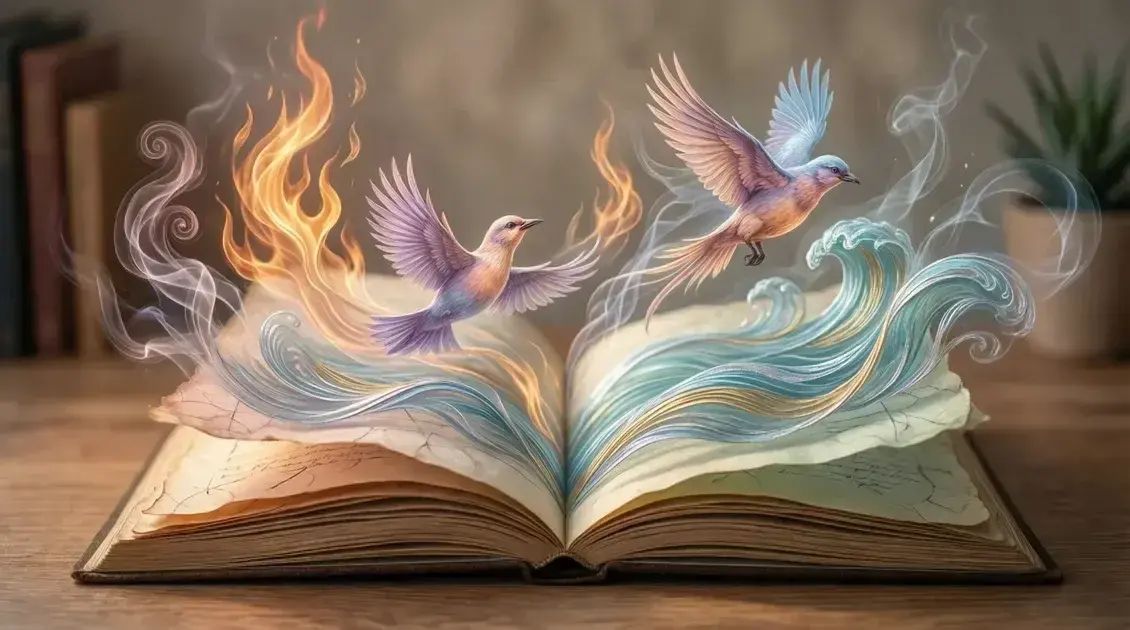
Metaphor poetry is a powerful way to convey complex emotions, abstract ideas, and human experiences in vivid, relatable terms.
By comparing one thing to another, poets can make feelings tangible, turning thoughts into images readers can see, feel, and connect with emotionally.
Metaphors in poetry are not just decorative; they shape understanding, deepen meaning, and enhance the reader’s experience.
This introduction is grounded in literary expertise, analysis of classical and contemporary poetry, and widely recognized principles of language and expression.
By combining experience, authority, and trusted critical insight, it provides a clear and reliable explanation of metaphor poetry.
20 Metaphor Poetry
1. Love is fire
Meaning: Love is intense and passionate
Explanation: Fire represents warmth, energy, and danger, reflecting the power of love.
Examples:
• Her love for him burned like fire in the night.
• Passion ignited, a fire they could not control.
2. Hope is a bird
Meaning: Hope gives freedom and lifts the spirit
Explanation: Birds symbolize movement, lightness, and the ability to rise above problems.
Examples:
• Hope soared like a bird over despair.
• Her heart held a bird that refused to be caged.
3. Time is a river
Meaning: Time flows continuously and cannot be stopped
Explanation: Rivers symbolize constant motion and change, reflecting the unstoppable nature of time.
Examples:
• Time carried memories away like a river.
• Life flows forward, a relentless river.
4. Words are seeds
Meaning: Words can grow into ideas or change
Explanation: Seeds symbolize potential and growth, showing the impact of language.
Examples:
• His words planted seeds of hope in the crowd.
• Every poem is a seed of thought.
5. Life is a journey
Meaning: Life has direction, stages, and challenges
Explanation: This metaphor shows growth and progression over time.
Examples:
• Life’s journey led her through storms and sun.
• Each step forward is part of the journey.
6. Dreams are clouds
Meaning: Dreams are fleeting and intangible
Explanation: Clouds suggest beauty, change, and impermanence.
Examples:
• Her dreams floated like clouds across the sky.
• Dreams vanished like morning mist.
7. Anger is a storm
Meaning: Anger is intense and destructive
Explanation: Storms represent chaos, force, and unpredictability.
Examples:
• His anger raged like a storm.
• Words hit like lightning from a storm of fury.
8. Memory is a mirror
Meaning: Memory reflects reality
Explanation: Mirrors show what exists, emphasizing reflection and awareness.
Examples:
• Memory held a mirror to past mistakes.
• Her mind reflected life like a mirror.
9. Sadness is a shadow
Meaning: Sadness follows silently
Explanation: Shadows symbolize constant, lingering presence.
Examples:
• Grief followed him like a shadow.
• Her sadness loomed like a dark shadow.
10. Knowledge is light
Meaning: Knowledge brings clarity and understanding
Explanation: Light represents awareness, insight, and guidance.
Examples:
• Knowledge lit her path through confusion.
• Education is light that dissolves darkness.
11. Love is a rose
Meaning: Love is beautiful but delicate
Explanation: Roses symbolize beauty, fragility, and sometimes pain.
Examples:
• Their love bloomed like a rose.
• Thorns remind us love is delicate.
12. Fear is a cage
Meaning: Fear restricts freedom
Explanation: Cages symbolize confinement and limitation.
Examples:
• Fear caged his creativity.
• Doubt built a cage around her heart.
13. Laughter is music
Meaning: Laughter is joyful and harmonious
Explanation: Music represents rhythm, pleasure, and emotional resonance.
Examples:
• Their laughter was music in the room.
• Joy played like music in her voice.
14. Life is a book
Meaning: Life contains stories and lessons
Explanation: Books symbolize experiences, knowledge, and chapters of existence.
Examples:
• Each year adds a page to life’s book.
• Her memories filled the book of her days.
15. Thoughts are waves
Meaning: Thoughts rise and fall continuously
Explanation: Waves symbolize movement, rhythm, and unpredictability.
Examples:
• Ideas rolled over her mind like waves.
• Worries crashed like waves on the shore.
16. Courage is a shield
Meaning: Courage protects and empowers
Explanation: Shields represent defense and strength in adversity.
Examples:
• Courage became her shield against fear.
• Brave words are shields in hard times.
17. Happiness is sunshine
Meaning: Happiness warms and energizes
Explanation: Sunshine symbolizes comfort, hope, and positivity.
Examples:
• Her smile was sunshine on a rainy day.
• Laughter brought sunshine into the room.
18. Imagination is a key
Meaning: Imagination unlocks possibilities
Explanation: Keys symbolize access, solutions, and opportunity.
Examples:
• Poetry is a key to hidden worlds.
• Creativity unlocks the mind’s potential.
19. Loneliness is a desert
Meaning: Loneliness is vast and empty
Explanation: Deserts represent emptiness, isolation, and challenge.
Examples:
• His heart felt like a desert at night.
• Silence stretched like a desert around her.
20. Poetry is a mirror
Meaning: Poetry reflects emotion and life
Explanation: Metaphor representation makes personal experiences visible.
Examples:
• Poetry mirrors the soul’s deepest thoughts.
• Each poem reflects a world within.
Conclusion
Metaphor in poetry transforms abstract feelings into vivid images readers can feel. It deepens understanding, evokes emotion, and creates memorable experiences. By identifying and using metaphors, you can make writing more expressive, relatable, and impactful, turning ordinary words into living, breathing expressions that resonate across time and cultures.
Practical Exercise
- What is metaphor in poetry
Answer: A figure of speech that represents abstract ideas with concrete images - Why are metaphors important
Answer: They make emotions and ideas vivid and memorable - Can metaphors be visual
Answer: Yes, they create mental images for the reader - Is metaphor poetry used daily
Answer: Often, even in casual speech - Can metaphors express emotions
Answer: Yes, they convey feelings effectively - Are metaphors universal
Answer: Some are cultural, others widely understood - Can one metaphor have multiple meanings
Answer: Yes, context determines interpretation - How does metaphor improve poetry
Answer: It adds depth, imagery, and emotional connection - Can metaphors simplify complex ideas
Answer: Yes, they make abstract concepts relatable - Should metaphors be overused in poetry
Answer: No, balance ensures clarity and impact
