
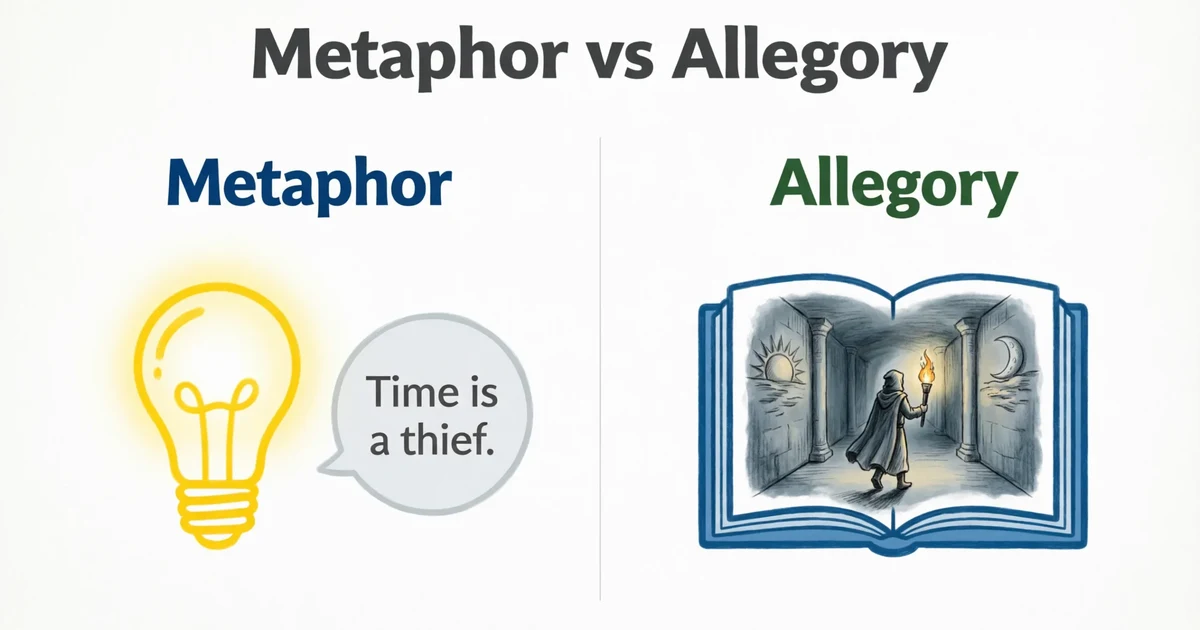
Metaphor and allegory both use figurative meaning, but they work on different scales. A metaphor is usually a single comparison that helps you understand an idea through an image. An allegory is a complete story, scene, or narrative where characters and events represent a deeper meaning throughout the whole piece.
If you focus on scope, you can quickly tell whether the writer is using a quick metaphor or shaping an entire allegory to deliver a message.
What Is a Metaphor
A metaphor says one thing is another to create a vivid picture. It does not mean the two things are literally the same. The goal is to help the reader feel or understand something more clearly.
Metaphor examples with meaning
- “Time is a thief.”
Meaning: time steals moments from us, so it feels like loss. - “Her voice is velvet.”
Meaning: her voice is smooth and soft. - “His words were daggers.”
Meaning: his words hurt deeply.
Metaphors can be short, direct, and used inside any kind of writing, including essays, poems, speeches, and everyday language.
What Is an Allegory
An allegory is a longer piece of writing where the whole story carries a second layer of meaning. Characters, settings, and events represent real ideas such as power, freedom, corruption, faith, or injustice.
In an allegory, the message is not just in one line. The message continues from beginning to end.
Simple allegory example
Imagine a story about a village where people slowly give their voices to a loudspeaker that promises safety. At first the loudspeaker helps them, but later it controls them.
Deeper meaning: people trading freedom for comfort can lead to control and loss of rights.
That whole plot is doing symbolic work. That is allegory.
Metaphor vs Allegory in One Line
- Metaphor is one comparison that creates meaning in a moment.
- Allegory is an entire story where the meaning runs through everything.
Metaphor vs Allegory Comparison Table
| Feature | Metaphor | Allegory |
|---|---|---|
| Length | Usually a phrase or sentence | Usually a full story or long passage |
| Meaning | One main figurative comparison | Many symbols working together across the whole narrative |
| Purpose | Add clarity, emotion, imagery | Teach a lesson, criticize society, or deliver a deeper message |
| Structure | One image or idea | Characters, plot, setting, and events all represent something |
| Example | Hope is a candle. | A story where a candle guides people through darkness as a symbol of hope and truth |
How to Spot a Metaphor Quickly
Use these checks:
- It compares two unlike things directly.
- It creates a strong image in one line.
- You can explain it by naming the shared quality.
Example: “His mind is a maze.”
Shared quality: complicated, hard to navigate.
How to Spot an Allegory Quickly
Use these checks:
- The text feels like a story with a hidden message.
- Many details seem symbolic, not random.
- The meaning is consistent across the whole narrative.
In allegory, the writer is not just using one metaphor. The writer is building a second meaning layer for the entire work.
Metaphor and Allegory with Clear Examples
Example 1: Metaphor in a sentence
“Jealousy is a green fire.”
- Surface meaning: jealousy is being described as fire.
- Deeper meaning: jealousy spreads, burns, and destroys peace.
This is metaphor because it is one image used to describe a feeling.
Example 2: Allegory as a short story
A king builds a mirror city where every citizen must wear a mask that shows only happiness. Anyone who removes the mask disappears. A child draws a real face on the wall and people begin to remember what honesty looks like.
- Mask = forced appearance, fake perfection
- Disappearing = punishment for truth
- Child drawing a face = courage, honesty, rebellion
This is allegory because the whole story is designed to represent a social truth.
Allegory Often Contains Metaphors
Many allegories include metaphors inside them. That does not make them the same thing.
Think of it like this:
- Metaphor is a tool.
- Allegory is an entire building that uses many tools, including metaphor, symbolism, and character roles.
Allegory vs Symbolism (Quick Clarification)
Many people confuse allegory with symbolism.
- Symbolism is when an object or event represents something else, like a dove representing peace.
- Allegory uses many symbols together to tell a story with a full hidden meaning.
A single symbol is not automatically an allegory. Allegory needs narrative structure and consistent representation.
Where You Commonly See Metaphors
- Poetry and songs
- Speeches and slogans
- Personal essays
- Descriptions of emotions
- Everyday phrases
Metaphors are widespread because they translate complex emotions into clear, relatable images.
Where You Commonly See Allegories
- Novels and plays
- Political or social commentary stories
- Religious and moral tales
- Children’s stories with lessons
- Fables and parables
Allegories are often used to teach, warn, or criticize in a way that feels like a story instead of a lecture.
Common Mistakes to Avoid
- Calling every symbolic story an allegory. Some stories are symbolic but not fully allegorical.
- Thinking allegory is just a “long metaphor.” Allegory is more structured and consistent.
- Treating metaphors as literal truths. They are meant to create understanding, not facts.
- Over-explaining metaphors in writing. Let the image do the work.
- Mixing metaphors in one paragraph. It can confuse the reader.
- Making an allegory too obvious. If every detail is forced, it feels unnatural.
- Forgetting that allegory still needs a good story. Message alone is not enough.
- Using symbolism without consistency in allegory. Allegory needs a pattern that holds.
Quick Practice (With Answers)
Part A: Metaphor or Allegory
- “Fear is a shadow that follows me.”
- A story where a classroom votes to give one student all the pencils, then slowly loses the ability to write.
- “The city is a hungry beast at night.”
- A tale where a garden grows only when people share water, but dies when they hoard it.
- “His apology was a bandage on a broken bone.”
Part B: Explain the Meaning
- “Hope is a bridge.”
- In the garden story, what might the water represent?
Part C: Rewrite Exercises
- Rewrite this weak line into a metaphor: “I felt trapped.”
- Turn this simile into a metaphor: “Her anger was like a storm.”
- Write a 2 sentence allegory idea about social media addiction.
Answers
- Metaphor
- Allegory
- Metaphor
- Allegory
- Metaphor
- Hope helps you cross from difficulty to a better future.
- Water can represent resources, kindness, trust, or cooperation.
- Example: “Walls grew inside my chest.” or “My life became a locked room.”
- “Her anger was a storm.”
- Example: A town begins to carry glowing mirrors that show only praise. Slowly they stop looking at real faces and forget how to speak without the mirrors.
Conclusion
Metaphor and allegory both go beyond literal meaning, but they work differently. A metaphor is a quick, vivid comparison that creates meaning in a line. An allegory is a full narrative where the deeper meaning stays active from start to finish. Once you focus on scale and consistency, you can spot the difference and use both tools more confidently in your writing.
FAQ
What is the easiest way to tell metaphor and allegory apart
Check the length and structure. Metaphor is usually a single image in a sentence, while allegory is a whole story with a consistent hidden meaning.
Can an allegory be short
Yes. An allegory can be a short fable or even a brief scene, as long as the whole piece carries the second meaning consistently.
Is allegory the same as symbolism
No. Symbolism can be one object representing an idea. Allegory uses many symbols across a full narrative to communicate a deeper message.
Do metaphors appear inside allegories
Yes. Allegories may use metaphors, but the allegory lies in the overall narrative structure, not in one sentence.
Why do writers use allegory instead of direct statements
Allegory can communicate sensitive ideas safely, make lessons memorable, and allow readers to interpret meaning through story.
Is every fable an allegory
Many fables are allegorical because their characters and events stand for moral ideas. A story counts as an allegory only when that deeper meaning stays consistent throughout.