
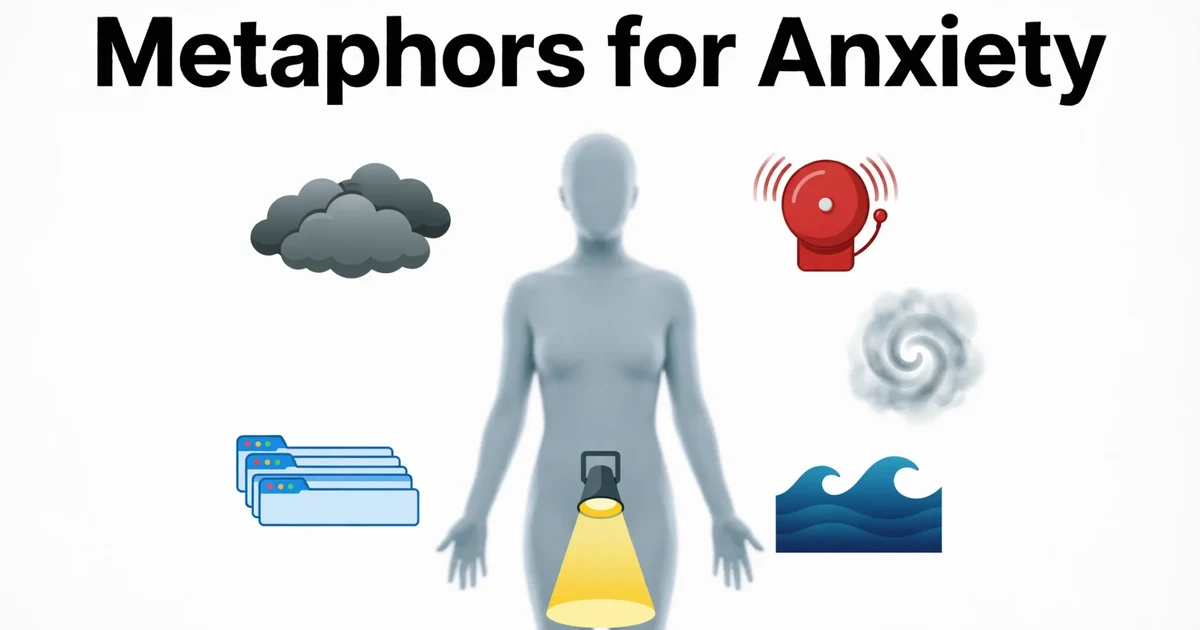
Anxiety can be loud without making a sound. It can sit in the mind like bad weather, or press on the body like weight. Metaphors help because they give a private feeling a clear shape that other people can understand.
What anxiety can feel like
Anxiety is not only worry. It can be a rush of restless energy, a tight chest, a shaky stomach, and thoughts that keep looping. Your brain scans for danger, even when you are safe.
Why metaphors help explain anxiety
Metaphors turn abstract experiences into images you can name. That can make it easier to describe what is happening, and easier to step back from the feeling instead of fighting it. In psychotherapy research, metaphors are widely used and have been linked with stronger in-session cognitive engagement when therapists and clients build them together.
Nature and weather metaphors
A storm cloud inside me
Meaning: anxiety gathers and darkens your focus.
Example: A storm cloud brewed inside me all day.
A rising tide
Meaning: anxiety builds slowly until it feels too big.
Example: Worry came in like a tide, inch by inch.
Thunder with no rain
Meaning: loud threat feelings without a real danger.
Example: My thoughts were thunder with no rain.
Fog on the road
Meaning: confusion and low clarity.
Example: I moved through the day like driving in fog.
A wildfire in the chest
Meaning: panic spreads fast and feels uncontrollable.
Example: Panic lit up my body like wildfire.
An earthquake under the skin
Meaning: trembling, jolts, sudden spikes of fear.
Example: My hands shook like an earthquake starting.
A frozen field
Meaning: feeling stuck or unable to act.
Example: My mind turned into a frozen field where nothing moved.
Waves that keep returning
Meaning: anxiety comes in cycles, even after it fades.
Example: It left, then came back like waves at night.
Body and health metaphors
A smoke alarm with a faulty sensor
Meaning: your threat system is sensitive and misfires.
Example: My body rings the alarm when nothing is burning.
A knot in the stomach
Meaning: tight dread and nervous tension.
Example: I carried a knot in my stomach all morning.
Air that feels too thin
Meaning: you feel trapped and cannot settle your breathing.
Example: In that moment the air felt too thin.
Muscles wired too tight
Meaning: the body stays on edge, ready to react.
Example: My shoulders stayed wired too tight all day.
Heavy armor I cannot remove
Meaning: constant weight and self-protection.
Example: Anxiety feels like armor that never comes off.
A boiling pot
Meaning: pressure builds until it spills.
Example: My nerves felt like a pot about to boil over.
Mind and overthinking metaphors
A hamster wheel
Meaning: thoughts run in circles with no finish line.
Example: My mind ran on a hamster wheel all night.
A browser with too many tabs
Meaning: mental overload and constant background processing.
Example: My brain had too many tabs open, all buzzing.
A news ticker of worst cases
Meaning: nonstop doom headlines in the mind.
Example: My thoughts scrolled like breaking news all day.
Radio static
Meaning: fuzzy focus and overstimulation.
Example: Anxiety filled my head with static.
A traffic jam in the brain
Meaning: too many thoughts block decisions.
Example: I could not choose through the traffic jam in my head.
A maze with mirrors
Meaning: spirals and distorted self-judgment.
Example: I got lost in a maze of thoughts and reflections.
Social anxiety metaphors
A spotlight on me
Meaning: feeling watched and exposed.
Example: Walking in felt like stepping under a spotlight.
An invisible wall
Meaning: feeling cut off from others.
Example: An invisible wall sat between me and the room.
A mask that does not fit
Meaning: forcing a persona that feels wrong.
Example: I wore a mask that never fit right.
A tiny voice in a loud room
Meaning: feeling unheard and small.
Example: My words sounded tiny in a loud room.
A puppet with tangled strings
Meaning: losing control while trying to look normal.
Example: I moved like a puppet with tangled strings.
15 ready-to-use sentences
- Anxiety is a storm cloud that follows my day.
- My thoughts run on a hamster wheel at night.
- I move through fog with no clear road.
- My stomach ties itself in knots before meetings.
- My mind turns into radio static.
- Panic lights up like wildfire in my chest.
- My body rings an alarm that will not stop.
- I carry heavy armor I cannot remove.
- My brain is a browser with too many tabs.
- Fear trembles under my skin like an earthquake.
- Worry rises like a tide I cannot hold back.
- I feel stuck in a frozen field of hesitation.
- Social moments put a spotlight on me.
- I hide behind a mask that does not fit.
- My thoughts jam up like traffic at a dead end.
Avoid these weak metaphors and use better ones
- Weak: I feel nervous.
Better: My mind is stuck on a hamster wheel. - Weak: I’m tense.
Better: My body is wired too tight. - Weak: I’m overwhelmed.
Better: Worry rises like a tide. - Weak: I can’t focus.
Better: My head is full of static. - Weak: My heart is fast.
Better: My body keeps ringing a smoke alarm. - Weak: I’m scared.
Better: Fear trembles under my skin. - Weak: I feel weird.
Better: Everything feels foggy and unclear. - Weak: I’m shy.
Better: My voice turns tiny in a loud room. - Weak: I can’t breathe.
Better: The air feels too thin. - Weak: I’m stressed.
Better: I am wearing armor I cannot remove.
How to use these metaphors in writing
- Name the kind of anxiety: panic, dread, rumination, social fear.
- Pick one main image for the paragraph.
- Add one sensory detail: breath, chest, sound, movement.
- Keep it simple: one strong metaphor beats five mixed ones.
- Show change: storm passing, alarm quieting, fog lifting.
If you use metaphors in journaling or therapy writing, they can also help you communicate patterns and create distance from the feeling. This is one reason metaphors are common in CBT-related discussions.
Quick practice (10 questions) with answers
- Thunder with no rain suggests what kind of anxiety?
- Which metaphor fits rumination?
- Replace I’m nervous with a vivid line.
- What does mask that does not fit communicate?
- Which metaphor fits social anxiety best?
- Which metaphor fits physical panic best?
- If your mind is a traffic jam, what is happening?
- Which image shows anxiety building slowly?
- Which metaphor suggests trembling?
- Which metaphor shows emotional weight?
Answers
- Threat feelings without real danger.
- Hamster wheel, news ticker, or too many tabs.
- My mind is stuck on a hamster wheel.
- Hiding feelings, forced performance.
- A spotlight on me.
- A wildfire in the chest or a smoke alarm with a faulty sensor.
- Too many thoughts block decisions.
- A rising tide.
- An earthquake under the skin.
- Heavy armor I cannot remove.
Conclusion
Metaphors give anxiety a shape you can describe. Pick an image that matches your experience, keep it consistent, and let it do the emotional work. Sometimes one clear picture explains more than a full page of explanation.
FAQs
What is a simple metaphor for anxiety
A smoke alarm with a faulty sensor works well because it explains false danger signals.
What metaphor fits overthinking
Hamster wheel and too many tabs fit repetitive thoughts and overload.
What metaphor fits panic attacks
Wildfire in the chest or earthquake under the skin captures sudden intensity.
Can metaphors help in therapy conversations
They can help people explain inner experiences and build shared language with a therapist.
How many metaphors should I use in one article
Use 6 to 12. Keep one main metaphor per paragraph to avoid mixing images.
Should I use violent metaphors for anxiety
Only if it matches your experience. Softer metaphors like fog, tide, or armor often feel safer and still accurate.