
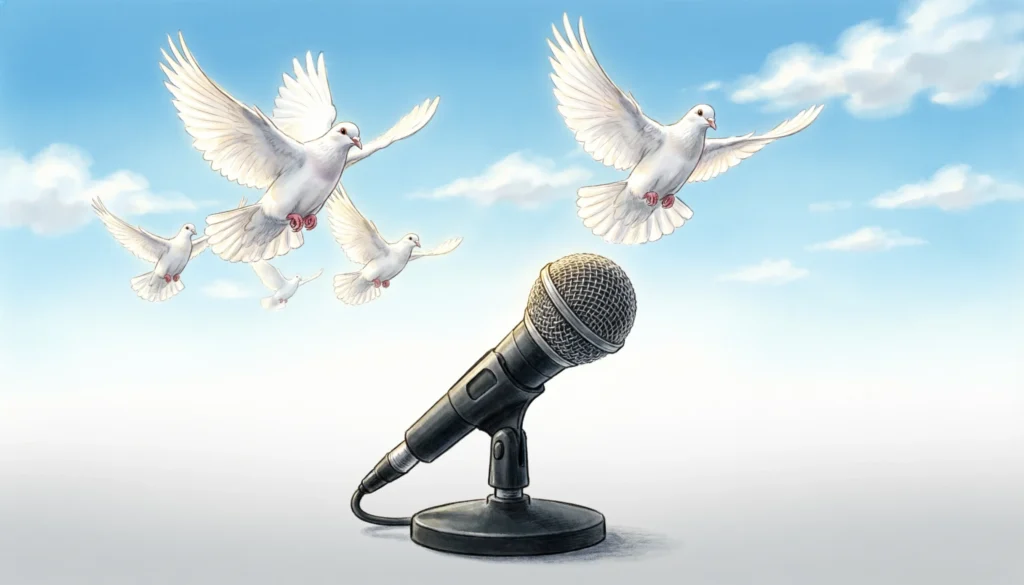
Freedom of speech is a powerful idea, but sometimes it feels abstract. Metaphors make it easier to understand, remember, and use in writing or conversation. This guide gives you clear, practical, and creative metaphors for freedom of speech—perfect for students, writers, and ESL learners.
What “metaphors for freedom of speech” means
A metaphor compares one idea to another to create a vivid image. When we use metaphors for freedom of speech, we describe it in a more visual or emotional way.
Instead of saying “people can express opinions freely,” you might say:
- “Voices can soar like birds in an open sky.”
This helps readers feel the meaning, not just understand it.
Common, popular, funny, useful, and everyday metaphors for freedom of speech
Here are different types of metaphors you’ll hear or use:
Common & Popular
- Open sky
- Free wind
- Unchained voice
Useful & Everyday
- A door without locks
- A microphone for all
- A flowing river of ideas
Creative & Funny
- A megaphone with no mute button
- A bird that refuses a cage
- A chatroom with no “delete” key
Metaphors for freedom of speech with meanings and examples
Each metaphor includes a simple meaning and a natural sentence.
1. Open sky
- Meaning: No limits on expression
- Example: In a true democracy, speech feels like an open sky.
2. Unchained voice
- Meaning: Freedom from control or restriction
- Example: Artists need an unchained voice to create honestly.
3. Flowing river
- Meaning: Continuous and natural expression of ideas
- Example: Debate should be a flowing river, not a blocked stream.
4. A door without locks
- Meaning: No barriers to speaking
- Example: Social media can act as a door without locks for opinions.
5. A burning flame
- Meaning: Passionate and powerful expression
- Example: Her speech was a burning flame of truth.
6. A bird out of a cage
- Meaning: Newly gained freedom to speak
- Example: After censorship ended, journalists felt like birds out of a cage.
7. A shared microphone
- Meaning: Everyone gets a chance to speak
- Example: A fair society offers a shared microphone to its people.
8. A clear window
- Meaning: Transparency and openness
- Example: Free speech works like a clear window into society’s thoughts.
9. A loud drum
- Meaning: Strong and attention-grabbing expression
- Example: Protesters used their voices as a loud drum.
10. A seed in the wind
- Meaning: Ideas spreading freely
- Example: Words become seeds in the wind when speech is free.
How to use metaphors for freedom of speech in sentences
You can use these metaphors in many ways:
- In essays:
“Freedom of speech acts as an open sky where ideas can grow.” - In speeches:
“Let every voice be an unchained voice.” - In daily conversation:
“That platform feels like a shared microphone.”
Keep sentences simple and natural. Avoid forcing metaphors where they don’t fit.
Metaphors for freedom of speech in writing and speaking
Metaphors improve both clarity and impact.
In writing:
- Make your ideas more engaging
- Help readers visualize abstract concepts
- Add emotional depth
In speaking:
- Make your message memorable
- Keep listeners interested
- Strengthen persuasion
Tip: Use one or two strong metaphors instead of many weak ones.
Metaphors for freedom of speech for students and ESL learners
If you’re learning English, start with easy metaphors:
- Open sky
- Free voice
- Open door
Practice by:
- Writing 3 sentences daily
- Replacing plain phrases with metaphors
- Listening to speeches and noting expressions
Example practice:
- Basic: “People can speak freely.”
- Improved: “People speak under an open sky.”
Metaphors for freedom of speech in conversations
You can use metaphors casually too:
- “This forum is like a shared microphone.”
- “He speaks like a bird out of a cage.”
- “That discussion turned into a flowing river of ideas.”
These sound natural and expressive without being too formal.
Similar phrases and expressions
These are not strict metaphors but relate closely:
- Speak your mind
- Voice your opinion
- Let your voice be heard
- Freedom to express
- Open discussion
Example:
- “Everyone should feel free to speak their mind.”
Common mistakes
Avoid these when using metaphors:
1. Mixing metaphors
❌ “His voice was a river flying in the sky.”
✔ Use one clear image at a time
2. Overusing metaphors
Too many can confuse the reader. Keep it simple.
3. Using unclear comparisons
Make sure the metaphor connects logically.
4. Forcing metaphors
If it sounds unnatural, skip it.
Conclusion
Metaphors for freedom of speech turn an abstract idea into something vivid and memorable. Whether you’re writing an essay, giving a speech, or learning English, these expressions help you communicate more clearly and creatively. Focus on simple, strong metaphors, and use them naturally.
FAQs
1. What is a metaphor for freedom of speech?
A metaphor compares freedom of speech to something visual, like an open sky or flowing river.
2. Why should I use metaphors?
They make your writing more engaging and easier to understand.
3. Are metaphors important for ESL learners?
Yes, they improve fluency and help you sound more natural.
4. Can I use these metaphors in formal writing?
Yes, but choose simple and clear ones.
5. How many metaphors should I use in one paragraph?
One or two is usually enough.
6. What is the easiest metaphor to start with?
“Open sky” is simple and widely understood.
7. Can metaphors be used in daily conversation?
Yes, they make your speech more expressive and interesting.
