
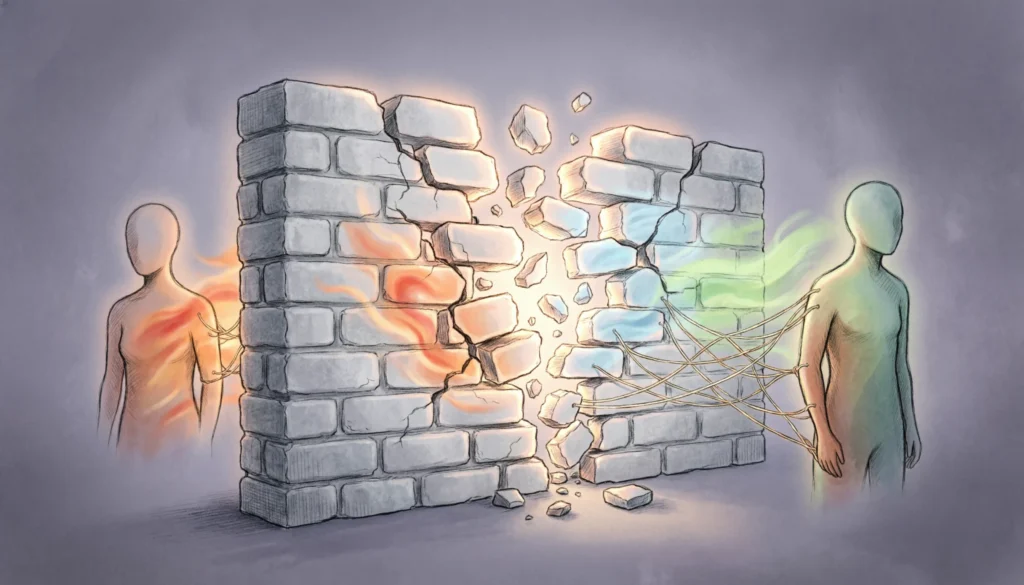
Walls appear everywhere in life—physical spaces, emotions, and even relationships. Writers often use walls as powerful symbols to show limits, protection, or separation.
In everyday language, people also use “walls” to describe feelings like fear, distance, or stubbornness. This article explains metaphors for walls in a simple, practical way for students, writers, and ESL learners.
What “metaphors for walls” means
- They describe barriers, limits, or protection using the idea of a wall
- They show emotional distance or resistance
- They represent obstacles in life or communication
- They help explain abstract ideas in a visual way
- They make writing more vivid and relatable
Common, popular, funny, useful, and everyday metaphors for walls
People use wall metaphors in both serious and casual situations. Some sound emotional, while others feel light or humorous.
Here are types you’ll often hear:
- Emotional walls (protecting feelings)
- Communication walls (lack of understanding)
- Mental blocks (difficulty thinking)
- Social barriers (differences between people)
- Funny exaggerations (dramatic reactions)
Metaphors for walls with meanings and examples
1. Hit a wall
- Meaning: To suddenly face a problem or stop making progress
- Example: I hit a wall while studying and couldn’t understand the chapter
2. Build a wall around yourself
- Meaning: To avoid others emotionally
- Example: After the argument, she built a wall around herself
3. Break down the wall
- Meaning: To remove barriers or solve problems
- Example: Open communication can break down the wall between friends
4. Talk to a wall
- Meaning: To speak without being heard or understood
- Example: Explaining rules to him feels like talking to a wall
5. Walls closing in
- Meaning: Feeling trapped or stressed
- Example: Deadlines made him feel like the walls were closing in
6. A wall between us
- Meaning: Emotional or social distance
- Example: There’s a wall between us since that misunderstanding
7. Brick wall situation
- Meaning: A problem with no easy solution
- Example: We reached a brick wall in negotiations
8. Climb the wall
- Meaning: To feel restless or frustrated
- Example: I stayed home all day and started to climb the walls
9. Paper-thin walls
- Meaning: No privacy or weak separation
- Example: The apartment has paper-thin walls
10. Knock down walls
- Meaning: To remove limits or restrictions
- Example: Education helps people knock down social walls
How to use metaphors for walls in sentences
Use these metaphors when you want to explain feelings, problems, or relationships clearly.
- Use “hit a wall” when progress stops
- Use “build a wall” for emotional distance
- Use “break down walls” when solving conflicts
- Use “talk to a wall” in frustrating conversations
Keep sentences simple and natural. Avoid overusing too many metaphors in one paragraph.
Metaphors for walls for writing and speaking
Writers use wall metaphors to add depth and emotion. They help readers imagine situations more clearly.
In speaking, these expressions make your ideas more engaging:
- They show feelings without long explanations
- They make conversations more vivid
- They help describe complex situations simply
For example, instead of saying “I felt stressed,” you can say “I felt like the walls were closing in.”
Metaphors for walls for students and ESL learners
These metaphors work well for learners because they are easy to visualize.
Tips:
- Learn one phrase at a time
- Practice using them in daily sentences
- Focus on meaning, not word-for-word translation
- Listen to how native speakers use them
Start with simple ones like “hit a wall” or “talk to a wall.”
Metaphors for walls in conversations
You can use these expressions in everyday conversations:
- “I hit a wall with this project.”
- “He built a wall after the fight.”
- “It’s like talking to a wall with her.”
- “We need to break down these walls.”
They sound natural and help express emotions quickly.
Similar phrases and expressions
These expressions carry similar meanings:
Barrier
- Meaning: Something that blocks progress
- Example: Fear can act as a barrier to success
Obstacle
- Meaning: A difficulty or challenge
- Example: Money became an obstacle
Block
- Meaning: Something stopping movement or thinking
- Example: I have a mental block
Fence between us
- Meaning: Emotional separation
- Example: There’s a fence between us now
Glass wall
- Meaning: Invisible but real barrier
- Example: She faced a glass wall in her career
Common mistakes
- Using metaphors too literally
Example mistake: “I touched the emotional wall” - Mixing different metaphors
Example mistake: “I hit a wall and climbed a river” - Overusing them in one paragraph
This makes writing confusing - Using them in formal writing without care
Some metaphors suit informal contexts better - Translating directly from another language
Not all metaphors work the same way in English
Conclusion
Metaphors for walls help you describe barriers, emotions, and challenges in a clear and engaging way. They make both writing and speaking more expressive. By learning common phrases and practicing them in real situations, you can improve your communication skills and sound more natural in English.
FAQs
1. What are metaphors for walls?
They are expressions that use walls to describe barriers, emotions, or limits.
2. Are these metaphors common in English?
Yes, many people use them in daily conversations.
3. Can ESL learners easily use them?
Yes, they are simple and visual, which makes them easy to learn.
4. Are wall metaphors formal or informal?
Most are informal, but some can fit semi-formal writing.
5. How can I practice them?
Use them in sentences, conversations, and short paragraphs.
6. Should I use many metaphors in one sentence?
No, use one at a time for clarity.
7. Do these metaphors have exact meanings?
They have general meanings that depend on context.
