
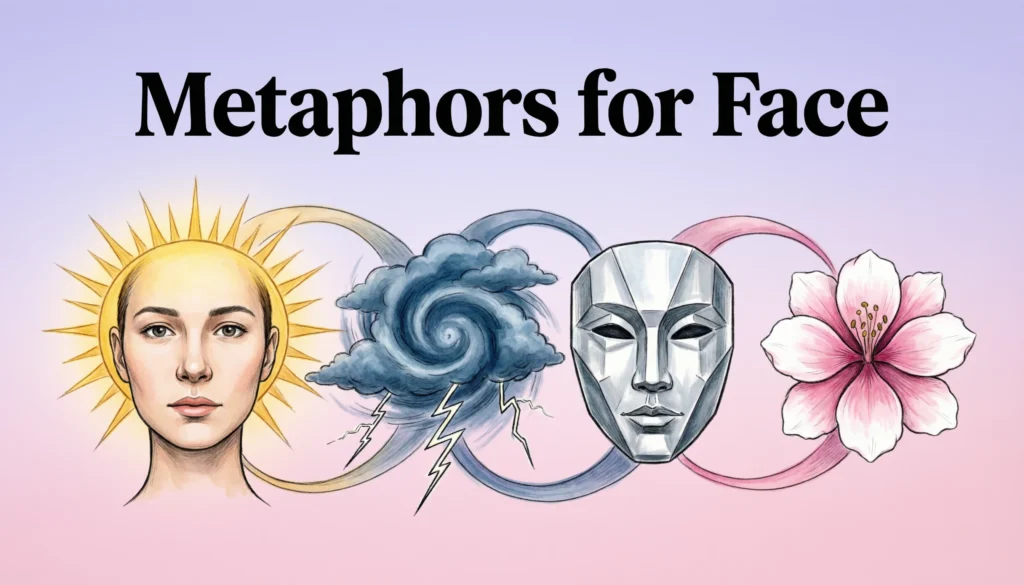
The human face carries emotion, identity, and meaning. Writers often use metaphors to describe faces in vivid and creative ways. These expressions help readers imagine feelings, beauty, or even personality without long explanations.
In everyday speech and writing, metaphors for face make language more colorful and engaging. Students, writers, and ESL learners can use them to improve storytelling, conversation, and descriptive skills. This guide explains useful, common, and creative metaphors for face with clear meanings and examples.
What “metaphors for face” means
- A metaphor compares the face to something else without using “like” or “as”
- It helps describe expressions, emotions, or appearance in a vivid way
- It adds creativity and imagery to writing and speech
- It often reflects mood, personality, or character
- It makes descriptions more memorable and engaging
Common, popular, funny, useful, and everyday metaphors for face
People use many simple metaphors in daily life. Some sound poetic, while others feel casual or humorous. You might hear phrases like “a face like thunder” or “an open book face” in conversations. These expressions quickly show emotions such as anger, honesty, or confusion. Writers also use them to build strong character descriptions without long explanations.
Metaphors for face with meanings and examples
A face like an open book
Meaning: Easy to read emotions
Example: Her face was an open book, showing every bit of her excitement.
A stone face
Meaning: No visible emotion
Example: He kept a stone face during the entire argument.
A glowing face
Meaning: Full of happiness or health
Example: She walked in with a glowing face after hearing the good news.
A stormy face
Meaning: Angry or upset
Example: His stormy face warned everyone to stay quiet.
A blank canvas face
Meaning: Showing no expression
Example: She stared at him with a blank canvas face.
A shining face
Meaning: Bright with joy or pride
Example: The child had a shining face after winning the prize.
A tired mask
Meaning: Exhaustion hidden behind a face
Example: He wore a tired mask after a long day at work.
A frozen face
Meaning: Stuck in one emotion, often shock
Example: Her frozen face showed she couldn’t believe the news.
A mirror of the soul
Meaning: Reflects inner feelings
Example: His face was a mirror of the soul, revealing his sadness.
A painted face
Meaning: Artificial or hiding real feelings
Example: She smiled with a painted face during the meeting.
How to use metaphors for face in sentences
Use these metaphors to replace plain descriptions. Instead of saying “he looked angry,” say “his face turned stormy.” Choose metaphors that match the emotion or situation. Keep sentences simple and natural. Avoid overusing metaphors in one paragraph, or your writing may feel heavy. Place them where they add impact, such as in storytelling or emotional moments.
Metaphors for face for writing and speaking
Metaphors improve both writing and speaking. In writing, they create strong imagery and help readers visualize characters. In speaking, they make conversations more expressive and engaging. For example, saying “her face lit up” sounds more lively than “she looked happy.” Use them in stories, essays, speeches, and even casual talks.
Metaphors for face for students and ESL learners
Students and ESL learners can use these metaphors to expand vocabulary and improve fluency. Start with simple ones like “stone face” or “open book.” Practice by writing short sentences or describing people. Listen to native speakers and notice how they use such expressions. Over time, you will feel more confident using them naturally.
Metaphors for face in conversations
People often use these metaphors in daily conversations. For example:
- “Why the long face?” means someone looks sad
- “His face lit up” shows sudden happiness
- “She had a blank face” means no clear emotion
These expressions make conversations more lively and expressive. They also help you sound more natural in English.
Similar phrases and expressions
- Face lit up (sudden happiness)
- Long face (sadness)
- Poker face (no emotion)
- Straight face (serious expression)
- Two-faced (dishonest personality)
Common mistakes
Many learners confuse metaphors with similes. Remember, metaphors do not use “like” or “as.” Avoid mixing too many metaphors in one sentence. Also, choose expressions that fit the context. Saying “glowing face” for anger would sound incorrect. Keep your language simple and clear instead of overly dramatic.
Conclusion
Metaphors for face help you describe emotions, expressions, and personality in a vivid way. They make writing more engaging and conversations more natural. By learning a few common expressions and practicing regularly, students and ESL learners can improve both fluency and creativity. Focus on using simple metaphors correctly rather than memorizing too many at once. With time, these expressions will become a natural part of your language. Keep observing how people speak and write, and you will find many new ways to describe the human face effectively.
FAQs
1. What is a metaphor for face?
It is a creative way to describe a face by comparing it to something else without using “like” or “as.”
2. Why should I use metaphors for face?
They make your writing and speaking more vivid and expressive.
3. Are metaphors and similes the same?
No. Metaphors compare directly, while similes use “like” or “as.”
4. Can beginners use these metaphors?
Yes. Start with simple and common expressions.
5. How can I practice them?
Write sentences, describe people, and listen to how others use them.
6. Are these expressions formal or informal?
Most work in both, but some are more casual.
7. How many metaphors should I use in writing?
Use them sparingly to keep your writing clear and effective.

Adam Brooks is an American author and storyteller known for expressing human emotions and inner struggles through powerful metaphors.
His writing style is simple, emotionally rich, and deeply relatable.
He focuses on emotional truth rather than just storytelling.
At MetaphorForge, his work encourages readers to reflect, feel, and grow.