
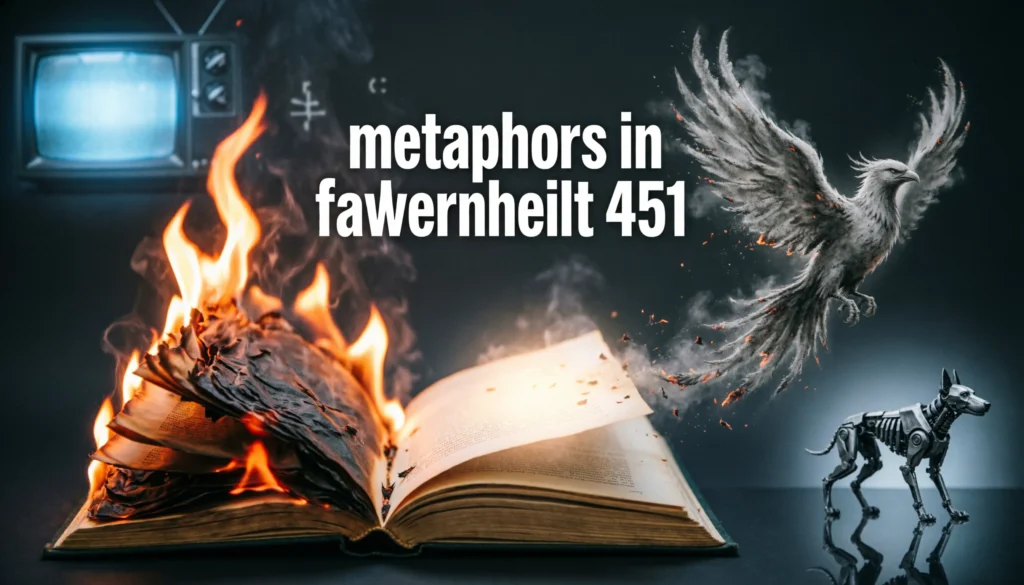
Ray Bradbury’s Fahrenheit 451 uses powerful metaphors to show a world where books, thought, memory, and human connection are under attack. These metaphors help readers understand censorship, technology, fear, loneliness, and the danger of living without independent thinking.
For students, writers, and ESL learners, studying metaphors in Fahrenheit 451 makes the novel easier to understand. Bradbury does not only tell us that society is broken. He shows it through fire, mirrors, seashells, animals, darkness, light, and burning pages. Each image carries a deeper meaning.
What “Metaphors in Fahrenheit 451” Means
Metaphors in Fahrenheit 451 means the symbolic comparisons Bradbury uses to explain deeper ideas in the novel.
Important points:
- Fire is not just fire; it becomes a symbol of destruction, control, and later renewal.
- Books are not only objects; they represent memory, truth, freedom, and human thought.
- The Mechanical Hound is not just a machine; it represents fear, surveillance, and state violence.
- The parlor walls are not only screens; they show fake connection and emotional emptiness.
- Mirrors suggest self-awareness, reflection, and the need to truly see oneself.
- Light and darkness show the difference between knowledge and ignorance.
- Nature represents peace, memory, and a more meaningful way of living.
Common, Popular, Useful, and Everyday Metaphors in Fahrenheit 451
Bradbury’s metaphors feel literary, but many connect to everyday life. A person can “burn with anger,” “feel watched,” “live inside a screen,” or “wake up from ignorance.” These ideas make the novel useful beyond the classroom.
Fire as Destruction
Phrase: Fire is destruction
Simple meaning: Fire represents the burning of books, ideas, and freedom.
Example sentence: In Fahrenheit 451, fire is destruction because it removes knowledge instead of protecting people.
Fire as Control
Phrase: Fire is control
Simple meaning: The government uses fire to scare people and erase independent thought.
Example sentence: Fire becomes control when Montag burns books for a society that fears questions.
Fire as Rebirth
Phrase: Fire is rebirth
Simple meaning: Later in the novel, fire can also mean warmth, survival, and a new beginning.
Example sentence: When Montag sees the campfire, fire becomes rebirth instead of punishment.
Books as Living Voices
Phrase: Books are living voices
Simple meaning: Books preserve human thoughts, feelings, warnings, and memories.
Example sentence: Bradbury presents books as living voices because they speak for people who are no longer alive.
The Mechanical Hound as Fear
Phrase: The Mechanical Hound is fear
Simple meaning: The Hound represents the terror of being watched and hunted.
Example sentence: The Mechanical Hound is fear because Montag feels its presence even before it attacks.
The Parlor Walls as Fake Family
Phrase: The parlor walls are fake family
Simple meaning: Mildred treats screens like real people, but they cannot give true love or care.
Example sentence: The parlor walls are fake family because they replace real conversation with empty noise.
Seashell Radios as Mental Noise
Phrase: Seashell radios are mental noise
Simple meaning: The tiny ear devices fill people’s minds and stop quiet thinking.
Example sentence: The seashell radios are mental noise because Mildred uses them to avoid silence.
Mirrors as Self-Knowledge
Phrase: Mirrors are self-knowledge
Simple meaning: Mirrors represent the need to look honestly at oneself and society.
Example sentence: Mirrors are self-knowledge because Montag must finally face what he has become.
Light as Understanding
Phrase: Light is understanding
Simple meaning: Light represents learning, awareness, and truth.
Example sentence: Clarisse brings light into Montag’s life by making him question his empty routine.
Darkness as Ignorance
Phrase: Darkness is ignorance
Simple meaning: Darkness shows a world where people avoid truth and deep thought.
Example sentence: Darkness is ignorance in the city because people live without asking meaningful questions.
Metaphors in Fahrenheit 451 With Meanings and Examples
Fire
Fire is the most important metaphor in Fahrenheit 451. At the start, Montag enjoys burning books. Fire gives him power, pleasure, and a false sense of purpose. Bradbury uses fire to show how destruction can look exciting when people stop thinking morally.
Later, fire changes meaning. When Montag joins the book people, fire becomes warmth and survival. This shift matters because Bradbury shows that symbols can change. Fire can destroy knowledge, but it can also support life.
Phrase: Fire burns truth
Simple meaning: Fire destroys books and the ideas inside them.
Example sentence: In the novel, fire burns truth when firemen destroy libraries instead of saving them.
The Salamander
The salamander appears as a symbol linked to firemen. In old myths, people believed salamanders could live in fire. Bradbury uses this image to show how firemen belong to a world of burning and destruction.
The salamander also suggests emotional coldness. Montag works inside a system that destroys books without feeling guilt. The image helps readers see how unnatural his society has become.
Phrase: The salamander is the fireman’s identity
Simple meaning: It represents a person trained to live with destruction.
Example sentence: The salamander is the fireman’s identity because Montag’s job depends on burning books.
The Phoenix
The phoenix is a mythological bird that burns and rises again from ashes. Near the end, Granger compares humanity to the phoenix. This metaphor suggests that people repeat mistakes, destroy themselves, and then try to rebuild.
Unlike the phoenix, humans can remember. Bradbury’s point feels hopeful: if people learn from the past, they may break the cycle of destruction.
Phrase: Humanity is a phoenix
Simple meaning: Society destroys itself but may rise again if it learns.
Example sentence: Humanity is a phoenix because it keeps falling into disaster and trying to begin again.
The Mechanical Hound
The Mechanical Hound works as a metaphor for fear, surveillance, and blind obedience. It has no human emotion. It follows orders, tracks victims, and punishes anyone who threatens the system.
For modern readers, the Hound also feels like a warning about technology without ethics. A machine becomes dangerous when powerful people use it to control others.
Phrase: The Hound is state fear
Simple meaning: It represents the government’s power to hunt and punish people.
Example sentence: The Hound is state fear because it turns Montag’s private doubts into a public crime.
The Parlor Walls
The parlor walls are huge screens that fill Mildred’s home with constant entertainment. They represent fake happiness and fake relationships. Mildred calls the people on the screens her “family,” but they do not truly know or love her.
Bradbury uses this metaphor to criticize shallow media culture. The screens keep people busy, distracted, and emotionally empty.
Phrase: The parlor walls are empty connection
Simple meaning: They create the feeling of company without real human closeness.
Example sentence: The parlor walls are empty connection because Mildred chooses screen voices over Montag.
The Seashells
The seashell radios sit in people’s ears and fill their minds with sound. They represent distraction and mental escape. Mildred uses them even while sleeping, which shows how deeply she fears silence.
This metaphor matters because silence gives people space to think. In Bradbury’s world, constant noise helps society avoid truth.
Phrase: Seashells are escape from thought
Simple meaning: They stop people from facing their own feelings and questions.
Example sentence: Seashells are escape from thought because Mildred uses them to avoid emotional pain.
Books
Books are a metaphor for human memory. They hold experiences, arguments, mistakes, beauty, and wisdom. The government burns books because books make people uncomfortable, thoughtful, and harder to control.
Bradbury does not present books as magical objects. He presents them as containers of human depth. Without books, people lose access to serious thought.
Phrase: Books are stored memory
Simple meaning: Books preserve what people have learned and felt.
Example sentence: Books are stored memory because they protect ideas that society tries to erase.
Clarisse as a Mirror
Clarisse works like a mirror for Montag. She asks simple questions, but those questions force him to see his life clearly. Her honesty reveals his unhappiness.
This metaphor matters because Montag does not change through violence first. He changes because someone helps him look at himself.
Phrase: Clarisse is a mirror
Simple meaning: She helps Montag see the truth about his life.
Example sentence: Clarisse is a mirror because her questions reveal Montag’s hidden emptiness.
How to Use Metaphors in Fahrenheit 451 in Sentences
You can use these metaphors in essays, discussions, and classroom answers. The best method is to name the metaphor, explain its meaning, and connect it to a theme.
Essay Sentence Examples
Phrase: Fire as censorship
Simple meaning: Fire shows how society destroys unwanted ideas.
Example sentence: Bradbury uses fire as censorship to show how fear can turn knowledge into a crime.
Phrase: The Hound as surveillance
Simple meaning: The Hound represents a society that watches and punishes people.
Example sentence: The Mechanical Hound acts as surveillance because it turns technology into a weapon against free thought.
Phrase: Books as freedom
Simple meaning: Books give people access to independent ideas.
Example sentence: Books become freedom in Fahrenheit 451 because they allow people to think beyond the rules of the state.
Phrase: Screens as isolation
Simple meaning: The parlor walls make people feel connected while keeping them emotionally alone.
Example sentence: Bradbury uses screens as isolation to show how entertainment can replace real relationships.
Metaphors in Fahrenheit 451 for Writing and Speaking
Writers can learn a lot from Bradbury’s metaphor style. He does not use symbols randomly. Each metaphor connects to character, setting, theme, and conflict.
For speaking, these metaphors help explain the novel in simple but smart ways. Instead of saying “the book is about censorship,” you can say, “Bradbury turns fire into a metaphor for censorship.” That sounds clearer and more analytical.
Useful Speaking Phrases
Phrase: Fire shows social control
Simple meaning: Fire represents how the government controls knowledge.
Example sentence: In my view, fire shows social control because people fear books before they even read them.
Phrase: The parlor walls show emotional emptiness
Simple meaning: The screens reveal how lonely people are.
Example sentence: The parlor walls show emotional emptiness because Mildred feels closer to screens than to her husband.
Phrase: The phoenix shows hope
Simple meaning: The phoenix suggests society can rebuild after destruction.
Example sentence: The phoenix shows hope because Bradbury ends the novel with the possibility of learning from the past.
Metaphors in Fahrenheit 451 for Students and ESL Learners
For students and ESL learners, Bradbury’s metaphors may feel difficult at first because they carry more than one meaning. The key is to connect each image to a simple idea.
Fire means destruction at first. Books mean memory. The Hound means fear. Screens mean fake connection. Mirrors mean self-awareness. Once you understand this pattern, the novel becomes much easier.
Simple Learning Table
| Metaphor | Simple Meaning | Main Theme |
|---|---|---|
| Fire | Destruction and later renewal | Censorship, rebirth |
| Books | Memory and truth | Knowledge, freedom |
| Mechanical Hound | Fear and control | Surveillance, violence |
| Parlor walls | Fake connection | Technology, loneliness |
| Seashells | Distraction | Escapism, silence |
| Phoenix | Rebirth after destruction | Hope, history |
| Mirror | Self-awareness | Identity, change |
Easy ESL Examples
Phrase: Fire is danger
Simple meaning: Fire shows the danger of destroying ideas.
Example sentence: Fire is danger because it burns books and hides truth.
Phrase: Books are voices
Simple meaning: Books let people from the past speak to us.
Example sentence: Books are voices because they share human thoughts across time.
Phrase: Screens are fake friends
Simple meaning: Screens seem friendly but cannot replace real people.
Example sentence: Screens are fake friends because Mildred talks to them more than Montag.
Metaphors in Fahrenheit 451 in Conversations
You can also use ideas from Fahrenheit 451 in daily conversations about technology, reading, media, and society. The novel still feels modern because many people worry about distraction, censorship, and shallow entertainment.
For example, someone might say, “My phone feels like Mildred’s seashells,” meaning constant sound keeps them from thinking. A teacher might say, “The parlor walls remind us of screen addiction.” These uses show how Bradbury’s metaphors still fit real life.
Conversation Examples
Phrase: My phone is a seashell
Simple meaning: My phone keeps filling my mind with noise.
Example sentence: After scrolling for three hours, I joked that my phone is a seashell from Fahrenheit 451.
Phrase: This room feels like the parlor walls
Simple meaning: People are surrounded by screens but not truly talking.
Example sentence: During dinner, everyone stared at a device, so the room felt like the parlor walls.
Phrase: We need mirrors, not screens
Simple meaning: We need self-reflection instead of distraction.
Example sentence: The novel reminds us that we need mirrors, not screens, when society avoids hard truths.
Similar Phrases and Expressions
These phrases are not all direct quotes from the novel, but they help explain the same ideas in simple language.
Burning Bridges
Phrase: Burning bridges
Simple meaning: Destroying relationships or chances.
Example sentence: Montag burns bridges with his old life when he chooses books over obedience.
Light of Knowledge
Phrase: Light of knowledge
Simple meaning: Understanding, learning, or truth.
Example sentence: Clarisse brings the light of knowledge into Montag’s dark routine.
Drowning in Noise
Phrase: Drowning in noise
Simple meaning: Feeling overwhelmed by constant distraction.
Example sentence: Mildred is drowning in noise because she never gives herself time to think.
Wake-Up Call
Phrase: Wake-up call
Simple meaning: An event that makes someone realize the truth.
Example sentence: Clarisse becomes Montag’s wake-up call when she asks if he is happy.
Empty Shell
Phrase: Empty shell
Simple meaning: A person who looks alive but feels emotionally empty.
Example sentence: Mildred seems like an empty shell because she avoids deep feeling and real conversation.
Ashes of the Past
Phrase: Ashes of the past
Simple meaning: What remains after destruction or failure.
Example sentence: The survivors must build a better future from the ashes of the past.
Common Mistakes
Many students make the mistake of calling every symbol a metaphor. A symbol represents an idea, while a metaphor directly compares one thing to another. In Fahrenheit 451, fire works as both a symbol and a metaphor because it represents destruction and also acts like a force that consumes truth.
Another mistake is explaining the metaphor too generally. Do not only write, “Fire means bad.” Say what kind of bad it shows: censorship, violence, fear, control, or destruction of memory.
Students also forget that fire changes meaning. At first, fire destroys. Later, fire warms. This change helps show Montag’s growth.
Mistake Examples
Phrase: Fire only means destruction
Simple meaning: This is incomplete because fire also means warmth and rebirth later.
Example sentence: A stronger answer says fire first means destruction, but later becomes a sign of survival.
Phrase: Books only mean education
Simple meaning: This is too narrow because books also mean memory, freedom, and human depth.
Example sentence: Books mean more than education because they protect human experience from being erased.
Phrase: The Hound is only a robot
Simple meaning: This misses its deeper meaning as fear and surveillance.
Example sentence: The Hound is not only a robot; it is a metaphor for a society that hunts independent thinkers.
Conclusion
Metaphors in Fahrenheit 451 help readers understand the novel’s deepest warnings. Bradbury uses fire, books, screens, machines, mirrors, and the phoenix to explore censorship, fear, distraction, memory, and hope. These metaphors make the story more than a warning about burning books. They show what happens when people stop thinking, stop reading, and stop speaking honestly. For students, writers, and ESL learners, these images offer a clear path into the novel’s meaning. Once you understand Bradbury’s metaphors, Fahrenheit 451 becomes easier, richer, and much more powerful.
FAQs
What is the main metaphor in Fahrenheit 451?
The main metaphor is fire. At first, fire represents censorship, destruction, and control. Later, it also represents warmth, survival, and rebirth.
What do books metaphorically represent in Fahrenheit 451?
Books represent memory, truth, independent thought, and human experience. The government burns books because they make people question society.
Is the Mechanical Hound a metaphor?
Yes. The Mechanical Hound is a metaphor for fear, surveillance, and technology used without morality.
What do the parlor walls represent?
The parlor walls represent fake connection, shallow entertainment, and emotional isolation. Mildred treats them like family, but they cannot give real love.
What does the phoenix metaphor mean?
The phoenix represents humanity’s cycle of destruction and rebirth. It suggests that people may rebuild society if they learn from their mistakes.
Why are metaphors important in Fahrenheit 451?
Metaphors help Bradbury explain complex themes in a visual and emotional way. They make ideas like censorship, ignorance, and hope easier to understand.
How can students write about metaphors in Fahrenheit 451?
Students should name the metaphor, explain its simple meaning, connect it to a theme, and give an example from the novel’s events or characters.

Luna Grace is a contemporary author whose writing blends emotional depth with powerful metaphors.
Her work explores healing, self-discovery, and the quiet courage found in personal growth.
With a reflective and poetic style, she turns lived experiences into meaningful insights.
At MetaphorForge, Luna Grace represents writing that resonates, comforts, and inspires transformation.