
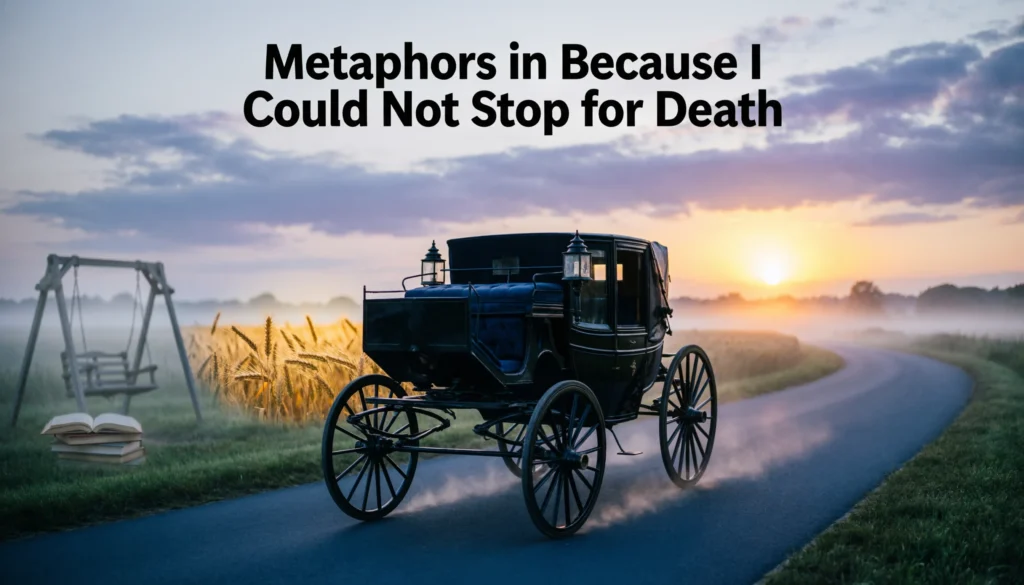
Metaphors in Because I Could Not Stop for Death help readers understand death, time, life, and eternity in a deeper way. Emily Dickinson does not present death as something violent or frightening. Instead, she turns death into a polite carriage driver who gently takes the speaker on a journey.
This makes the poem powerful for students, writers, and ESL learners because its meaning becomes easier to see through images. The carriage, the school, the fields, the sunset, and the house all work as metaphors. Each one shows a different stage of human life and the speaker’s movement toward eternity.
What “Metaphors in Because I Could Not Stop for Death” Means
Metaphors in Because I Could Not Stop for Death means the symbolic images Emily Dickinson uses to explain death and life after death.
- Death is shown as a polite gentleman, not a monster.
- The carriage ride represents the journey from life to death.
- The school, fields, and sunset represent stages of life.
- The house in the ground represents the grave.
- Eternity represents life beyond ordinary human time.
- The poem uses calm images to make death feel quiet and unavoidable.
- The metaphors help readers understand serious ideas without direct explanation.
Common, Popular, Useful, and Everyday Metaphors in Because I Could Not Stop for Death
Emily Dickinson uses metaphors that feel simple on the surface but carry deep meaning. The poem does not use random decoration. Every image helps the reader move through the speaker’s final journey.
Death as a Gentleman Caller
Phrase: Death is a gentleman caller
Simple meaning: Death comes politely and patiently, like a respectful visitor.
Example sentence: In the poem, Death is a gentleman caller who kindly stops for the speaker.
Life as a Journey
Phrase: Life is a journey
Simple meaning: Human life moves through different stages from childhood to death.
Example sentence: Dickinson shows life as a journey through schoolyards, fields, and sunset.
The Carriage as Death’s Vehicle
Phrase: The carriage is the vehicle of death
Simple meaning: The carriage carries the speaker away from life toward eternity.
Example sentence: The carriage becomes the vehicle of death as the speaker leaves the living world.
The School as Childhood
Phrase: The school represents childhood
Simple meaning: The school scene shows the early stage of life.
Example sentence: The school metaphor reminds readers of childhood and the beginning of life.
The Fields as Adulthood
Phrase: The fields represent adult life
Simple meaning: The fields suggest work, growth, maturity, and human activity.
Example sentence: The fields of grain represent adulthood and the productive years of life.
The Sunset as Old Age
Phrase: The sunset represents old age
Simple meaning: The setting sun shows the end of life.
Example sentence: The sunset metaphor suggests that the speaker’s life is reaching its close.
The House as a Grave
Phrase: The house is a grave
Simple meaning: The speaker’s final resting place looks like a house in the ground.
Example sentence: Dickinson turns the grave into a house to make death feel permanent and quiet.
Eternity as Timelessness
Phrase: Eternity is timelessness
Simple meaning: After death, normal time no longer matters.
Example sentence: The speaker realizes that centuries feel shorter than a single day in eternity.
Metaphors in Because I Could Not Stop for Death With Meanings and Examples
The main metaphors in the poem work together like a slow story. Dickinson does not simply say, “The speaker dies.” She creates a symbolic ride that shows how death takes a person from daily life into eternity.
Because I Could Not Stop for Death
Phrase: Death stops for the speaker
Simple meaning: Death arrives when the speaker cannot choose the time herself.
Example sentence: The opening line presents death as someone who stops for the speaker because she cannot stop for him.
This metaphor makes death seem active and personal. The speaker does not chase death. Death comes to her. The tone feels calm, which makes the poem unusual because many poems show death as terrifying.
The Carriage Ride
Phrase: The carriage ride is the journey toward death
Simple meaning: The ride represents the speaker’s movement from life into the afterlife.
Example sentence: The carriage ride shows the slow and unavoidable journey from life to death.
The carriage creates a peaceful image. It also gives the poem movement. Readers travel with the speaker as she passes scenes from life and reaches her final destination.
Death and Immortality as Passengers
Phrase: Death and Immortality travel with the speaker
Simple meaning: Death leads the speaker away from life, while immortality points to life beyond death.
Example sentence: Death and Immortality become symbolic passengers in the speaker’s final ride.
This metaphor gives the poem a spiritual dimension. Death is not the end of meaning. Immortality suggests that the speaker is moving into something larger than ordinary life.
We Passed the School
Phrase: The school is childhood
Simple meaning: The school scene represents the first stage of human life.
Example sentence: The school metaphor shows childhood through children playing at recess.
The image of children at school makes the poem feel familiar and human. It reminds readers that life begins with energy, play, and learning.
We Passed the Fields of Gazing Grain
Phrase: The fields are maturity
Simple meaning: The fields represent growth, work, harvest, and adulthood.
Example sentence: The fields of grain suggest the speaker’s adult years and the fullness of life.
Grain often connects with growth and harvest. In this poem, the field may suggest the productive middle stage of life before decline begins.
We Passed the Setting Sun
Phrase: The setting sun is death or old age
Simple meaning: The sunset marks the end of life.
Example sentence: The setting sun metaphor shows that the speaker is moving toward life’s final stage.
Sunset is one of the poem’s clearest metaphors. Daylight fades just as life fades. The image feels natural, gentle, and serious.
A House That Seemed a Swelling of the Ground
Phrase: The house is the grave
Simple meaning: The speaker’s burial place looks like a small house under the earth.
Example sentence: The house metaphor turns the grave into a quiet final home.
This image feels calm but also unsettling. A house usually means comfort and shelter, but here it means burial and permanence.
Centuries Feel Shorter Than the Day
Phrase: Time becomes meaningless in eternity
Simple meaning: After death, human time loses its normal shape.
Example sentence: Dickinson uses the final time metaphor to show how eternity changes the speaker’s sense of time.
This metaphor gives the poem its haunting ending. The speaker looks back and realizes that centuries have passed, yet they feel brief.
How to Use Metaphors in Because I Could Not Stop for Death in Sentences
Students and writers can use these metaphors when discussing the poem’s meaning, tone, and themes. The key is to explain what each image represents instead of only naming it.
Academic Sentence Examples
Phrase: Death as a polite caller
Simple meaning: Death appears gentle and civilized.
Example sentence: Dickinson presents death as a polite caller to reduce fear and create a calm tone.
Phrase: The carriage as a journey
Simple meaning: The carriage represents the path from life to eternity.
Example sentence: The carriage metaphor helps readers understand death as a gradual journey rather than a sudden event.
Phrase: The sunset as life’s ending
Simple meaning: The sunset symbolizes the close of human life.
Example sentence: The setting sun works as a metaphor for old age, decline, and death.
Phrase: The house as a grave
Simple meaning: The grave appears as the speaker’s final home.
Example sentence: The house metaphor makes the grave feel both familiar and disturbing.
Phrase: The school, fields, and sun as life stages
Simple meaning: These images represent childhood, adulthood, and old age.
Example sentence: The school, fields, and sun create a symbolic timeline of the speaker’s life.
Metaphors in Because I Could Not Stop for Death for Writing and Speaking
These metaphors can improve both literary essays and classroom discussions. They allow you to explain abstract ideas in clear language.
For Essay Writing
Use the metaphors to support your argument about death, immortality, time, and memory. A strong essay should connect each metaphor to the poem’s larger message.
Phrase: Death is not an enemy
Simple meaning: Dickinson makes death seem calm and courteous.
Example sentence: The poem’s central metaphor suggests that death is not an enemy but a quiet guide.
Phrase: The journey moves through life
Simple meaning: The speaker passes symbolic scenes from human life.
Example sentence: The journey metaphor helps organize the poem around childhood, adulthood, old age, and eternity.
Phrase: The grave becomes a home
Simple meaning: Death creates a final dwelling place.
Example sentence: By calling the grave a house, Dickinson makes death feel strangely domestic.
For Speaking
When speaking about the poem, keep your explanation simple. Say what the image is, what it represents, and why it matters.
For example, you can say: “The carriage is important because it represents the speaker’s journey from life to death. Dickinson uses this calm image to make death feel slow, polite, and unavoidable.”
Metaphors in Because I Could Not Stop for Death for Students and ESL Learners
For ESL learners, this poem can feel difficult because Dickinson uses symbolic language. However, the main metaphors become easier when you connect them with everyday ideas.
Simple Breakdown
Phrase: Death is a person
Simple meaning: Death acts like a human being.
Example sentence: Death is a person in the poem because he stops, waits, and drives the carriage.
Phrase: The carriage is a journey
Simple meaning: The speaker is moving from life to death.
Example sentence: The carriage is a journey because it carries the speaker away from the living world.
Phrase: The school is childhood
Simple meaning: The speaker remembers the beginning of life.
Example sentence: The school is childhood because children are playing there.
Phrase: The fields are adulthood
Simple meaning: The grain shows growth and maturity.
Example sentence: The fields are adulthood because grain suggests work, harvest, and life’s middle stage.
Phrase: The sunset is the end
Simple meaning: The speaker’s life is ending.
Example sentence: The sunset is the end because the day finishes just as life finishes.
Phrase: The house is the grave
Simple meaning: The speaker has reached burial.
Example sentence: The house is the grave because it appears as a swelling in the ground.
Metaphors in Because I Could Not Stop for Death in Conversations
You can use these ideas in class discussions, study groups, or literature conversations. The goal is to sound clear, not overly complicated.
Conversation Examples
Phrase: Death as a driver
Simple meaning: Death guides the speaker toward the afterlife.
Example sentence: I think Death as a driver makes the poem feel calm instead of scary.
Phrase: Life as passing scenes
Simple meaning: The speaker sees different stages of life during the ride.
Example sentence: The passing scenes show that life moves quickly from childhood to death.
Phrase: The grave as a house
Simple meaning: The speaker’s final place becomes a home-like image.
Example sentence: The grave as a house feels peaceful, but it also feels eerie.
Phrase: Eternity as changed time
Simple meaning: Time feels different after death.
Example sentence: The ending shows eternity as changed time because centuries feel shorter than a day.
Similar Phrases and Expressions
These expressions are not all from the poem, but they connect with its ideas. They can help students compare Dickinson’s metaphors with everyday language.
Death Came Calling
Phrase: Death came calling
Simple meaning: Death arrived for someone.
Example sentence: In Dickinson’s poem, death came calling in the form of a polite carriage driver.
The Final Journey
Phrase: The final journey
Simple meaning: A person’s movement from life to death.
Example sentence: The carriage ride represents the speaker’s final journey.
The End of the Road
Phrase: The end of the road
Simple meaning: The final stage of life or an experience.
Example sentence: The grave marks the end of the road for the speaker’s earthly life.
The Sunset Years
Phrase: The sunset years
Simple meaning: The later years of life.
Example sentence: The setting sun can suggest the speaker’s sunset years.
A Final Resting Place
Phrase: A final resting place
Simple meaning: A grave or burial place.
Example sentence: The house in the ground becomes the speaker’s final resting place.
Time Stood Still
Phrase: Time stood still
Simple meaning: Time seemed to stop or lose meaning.
Example sentence: In the final stanza, time stood still because eternity changed the speaker’s sense of centuries.
Common Mistakes
Many students misunderstand the metaphors in Because I Could Not Stop for Death because the poem sounds calm. The calm tone does not mean the poem is simple. It hides deep ideas about mortality, memory, and eternity.
Mistake 1: Thinking Death Is Literally a Man
Death is not a real human character in the normal sense. Dickinson personifies death and turns it into a metaphor. This helps readers imagine death as a polite guide.
Mistake 2: Ignoring Immortality
Immortality matters because it changes the poem’s meaning. The speaker does not travel with Death alone. Immortality suggests that the journey continues beyond the grave.
Mistake 3: Treating the Carriage as Only Transportation
The carriage is not just a vehicle. It represents the transition from life to death. It carries the speaker through symbolic scenes that summarize human life.
Mistake 4: Missing the Life Stages
The school, fields, and sunset are not random details. They represent childhood, adulthood, and the end of life. Together, they create a compressed version of human existence.
Mistake 5: Seeing the House as a Normal Home
The house is actually the grave. Dickinson makes the grave look like a home to create a calm but haunting image.
Mistake 6: Forgetting the Poem’s Tone
The poem’s tone is controlled, quiet, and reflective. It does not scream about death. That quietness makes the metaphors more powerful.
Conclusion
Metaphors in Because I Could Not Stop for Death make Emily Dickinson’s poem memorable, meaningful, and emotionally complex. Death becomes a polite companion, the carriage becomes a journey, and the scenes along the road become stages of life. The school, fields, sunset, grave, and eternity all help readers understand the speaker’s movement from life into the unknown. These metaphors also make the poem easier for students and ESL learners to discuss because each image carries a clear symbolic meaning. Dickinson’s genius lies in making death feel ordinary, gentle, strange, and unforgettable at the same time.
FAQs
What is the main metaphor in Because I Could Not Stop for Death?
The main metaphor is the carriage ride. It represents the speaker’s journey from life to death and then toward eternity.
How is death a metaphor in the poem?
Death is shown as a polite gentleman or carriage driver. This metaphor makes death seem calm, patient, and unavoidable.
What does the carriage symbolize?
The carriage symbolizes the speaker’s transition from the living world to the afterlife. It carries her through symbolic stages of life.
What do the school, fields, and sunset mean?
The school represents childhood, the fields represent adulthood, and the sunset represents old age or the end of life.
What does the house symbolize in the poem?
The house symbolizes the grave. Dickinson describes it as a swelling in the ground to show the speaker’s burial place.
Why does Dickinson use calm metaphors for death?
Dickinson uses calm metaphors to make death feel less violent and more mysterious. This quiet tone makes the poem more haunting.
Is Because I Could Not Stop for Death about immortality?
Yes, the poem connects death with immortality. The speaker’s journey does not simply end at the grave; it points toward eternity.

Ryan Chase is a skilled writer at MetaphorForge, recognized for his powerful and meaningful metaphors. He explores themes of personal growth, emotions, and everyday life with clarity and depth. His writing turns complex feelings into simple, relatable expressions. Through his work, readers gain fresh perspectives on their own experiences.