
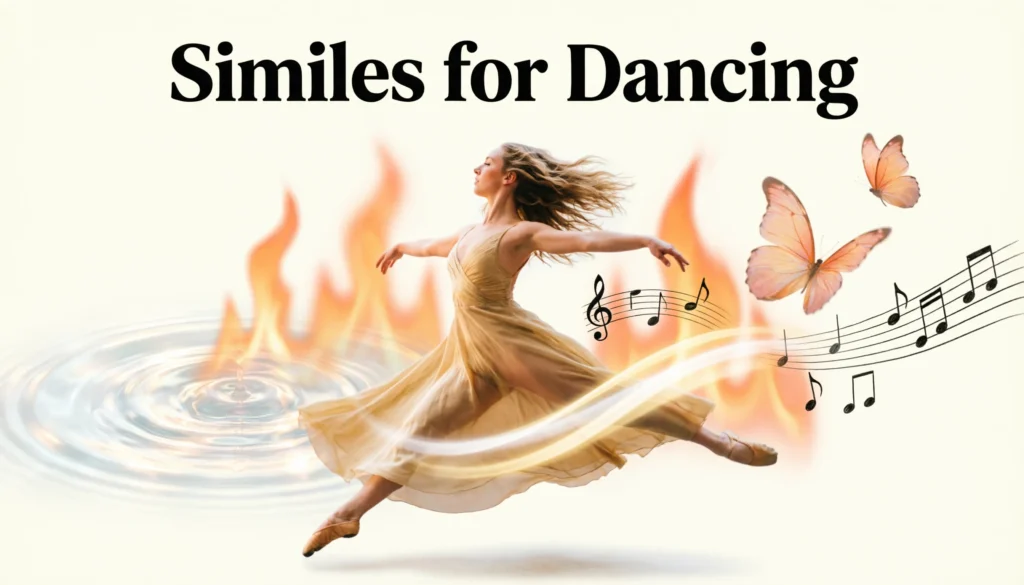
Dancing can look graceful, wild, smooth, joyful, awkward, or full of energy. Good similes help writers describe those movements in a clear and vivid way. Instead of saying someone danced well, you can say they danced like a leaf in the wind or moved like silk across the floor.
Similes for dancing are useful for students, creative writers, poets, ESL learners, and anyone who wants stronger descriptive language. They help readers imagine rhythm, emotion, body movement, and mood without long explanations.
What Similes for Dancing Mean
Similes for dancing compare a dancer or dance movement to something familiar using words like “as” or “like.”
Key points:
- A simile makes dancing easier to picture.
- It can describe grace, speed, rhythm, joy, or clumsiness.
- It often uses nature, animals, music, or everyday objects.
- It helps writing feel more visual and expressive.
- It works well in stories, poems, essays, and speaking.
Example:
“She danced like a flame in the dark.”
This means her movement looked bright, lively, and full of energy.
Common, Popular, Funny, Useful, and Everyday Similes for Dancing
Some dancing similes sound beautiful. Some sound funny. Others work well in everyday speech. The best one depends on the scene, the dancer, and the feeling you want to create.
1. Danced like a leaf in the wind
Simple meaning: Moved lightly and freely.
Example sentence: She danced like a leaf in the wind, soft and full of grace.
2. Danced like a flame
Simple meaning: Moved with energy and passion.
Example sentence: He danced like a flame, quick, bright, and impossible to ignore.
3. Danced like a bird in the sky
Simple meaning: Moved freely and beautifully.
Example sentence: The little girl danced like a bird in the sky.
4. Danced like a wave on the sea
Simple meaning: Moved smoothly and rhythmically.
Example sentence: The dancers moved like waves on the sea.
5. Danced like nobody was watching
Simple meaning: Danced freely without fear or embarrassment.
Example sentence: At the party, Mia danced like nobody was watching.
6. Danced like a spinning top
Simple meaning: Turned around very fast.
Example sentence: The child danced like a spinning top in the living room.
7. Danced like a puppet on strings
Simple meaning: Moved stiffly or awkwardly.
Example sentence: He danced like a puppet on strings during his first lesson.
8. Danced like a robot
Simple meaning: Moved in a stiff, mechanical way.
Example sentence: My brother danced like a robot and made everyone laugh.
9. Danced like a butterfly
Simple meaning: Moved lightly, softly, and gracefully.
Example sentence: She danced like a butterfly across the stage.
10. Danced like thunder in a storm
Simple meaning: Danced with power and force.
Example sentence: The group danced like thunder in a storm.
Similes for Dancing With Meanings and Examples
These similes can help you describe different types of dance movement. Use them when you want your writing to feel more specific and alive.
11. Danced like silk in the air
Simple meaning: Moved smoothly and elegantly.
Example sentence: Her dress flowed as she danced like silk in the air.
12. Danced like moonlight on water
Simple meaning: Moved softly and beautifully.
Example sentence: He danced like moonlight on water during the slow song.
13. Danced like sparks from a fire
Simple meaning: Moved quickly and excitedly.
Example sentence: The children danced like sparks from a fire.
14. Danced like rain on a rooftop
Simple meaning: Moved with steady rhythm.
Example sentence: Their feet danced like rain on a rooftop.
15. Danced like a cat
Simple meaning: Moved quietly, smoothly, and gracefully.
Example sentence: She danced like a cat, light on every step.
16. Danced like a deer in a meadow
Simple meaning: Moved gently and naturally.
Example sentence: The young dancer moved like a deer in a meadow.
17. Danced like a fish in water
Simple meaning: Moved naturally and comfortably.
Example sentence: On the dance floor, he danced like a fish in water.
18. Danced like the wind through trees
Simple meaning: Moved freely and softly.
Example sentence: Her arms moved like the wind through trees.
19. Danced like fireworks in the night
Simple meaning: Danced with excitement and bright energy.
Example sentence: The team danced like fireworks in the night.
20. Danced like a shadow
Simple meaning: Moved silently and smoothly.
Example sentence: The dancer moved like a shadow across the room.
How to Use Similes for Dancing in Sentences
A dancing simile works best when it matches the mood of the scene. A romantic dance needs a soft image. A funny dance needs a playful image. A powerful performance needs a strong image.
Use these tips:
- Use “like” before a noun phrase.
- Use “as” when comparing a quality.
- Match the simile with the dancer’s movement.
- Avoid using too many similes in one paragraph.
- Choose clear images that readers understand.
Examples:
- She danced like a butterfly at the school show.
- His feet moved like rain on a tin roof.
- They danced like waves under the moon.
- He danced like a robot to make his friends laugh.
- The performer moved like fire across the stage.
Similes for Dancing for Writing and Speaking
In writing, similes help create a strong picture. In speaking, they help people understand your meaning quickly. You can use dancing similes in stories, poems, speeches, classroom answers, and daily conversations.
For graceful dancing:
- She danced like silk floating in the breeze.
- He moved like water over smooth stones.
- The ballerina danced like a swan on a lake.
For energetic dancing:
- They danced like flames in the wind.
- The crowd moved like thunder.
- She danced like sparks flying from a fire.
For funny dancing:
- He danced like a robot with loose batteries.
- My uncle danced like a chicken at a wedding.
- The toddler danced like a bouncing ball.
Similes for Dancing for Students and ESL Learners
Students and ESL learners should start with simple similes. Clear comparisons help you understand both the image and the meaning. You do not need complicated language to write well.
Easy examples:
- She danced like a bird.
- He danced like a robot.
- They danced like waves.
- The baby danced like a bouncing ball.
- The girl danced like a butterfly.
Practice pattern:
Subject + danced + like + comparison
Examples:
- The boy danced like a spinning top.
- The dancers moved like waves.
- She danced like a flower in the breeze.
This pattern helps ESL learners build natural sentences without confusion.
Similes for Dancing in Conversations
People often use dancing similes when they describe parties, weddings, school events, concerts, or funny moments. In conversation, keep the simile short and easy to understand.
Natural examples:
- “She danced like nobody was watching.”
- “He danced like a robot.”
- “They moved like professionals.”
- “My little cousin danced like a jumping bean.”
- “The bride danced like a princess.”
These expressions sound natural because they connect dancing with familiar images.
Similar Phrases and Expressions
Some phrases about dancing are not strict similes, but they still help describe movement, mood, and rhythm. You can use them when you want more variety.
Moved with grace
Simple meaning: Moved beautifully and smoothly.
Example sentence: She moved with grace during the final performance.
Light on her feet
Simple meaning: Moved easily and softly.
Example sentence: The dancer looked light on her feet.
Full of rhythm
Simple meaning: Moved naturally with the beat.
Example sentence: He was full of rhythm from the first song.
Lost in the music
Simple meaning: Enjoyed the dance deeply.
Example sentence: She looked lost in the music.
Moved to the beat
Simple meaning: Danced in time with the music.
Example sentence: The children moved to the beat.
Took over the dance floor
Simple meaning: Danced confidently and attracted attention.
Example sentence: Omar took over the dance floor at the wedding.
Common Mistakes When Using Similes for Dancing
Good similes feel natural. Weak similes confuse the reader or sound forced. Always check whether the image matches the movement.
Common mistakes:
- Using a simile that does not fit the mood.
- Writing too many similes close together.
- Choosing images that readers cannot picture.
- Mixing two different comparisons in one sentence.
- Using a funny simile in a serious scene.
- Using a serious simile in a playful scene.
Weak example:
“She danced like a pencil in the ocean.”
This sounds confusing because the image does not clearly show rhythm, grace, or movement.
Better example:
“She danced like a wave on the ocean.”
This works because waves move smoothly and rhythmically.
Conclusion
Similes for dancing make movement easier to see, feel, and understand. They help writers describe grace, energy, rhythm, joy, humor, and emotion in a simple way. A dancer can move like a flame, a wave, a butterfly, or a shadow, depending on the scene. Students can use these similes in essays and creative writing. ESL learners can use them to build stronger sentences. Writers can use them to add color and feeling. The best dancing simile always fits the mood, the character, and the type of movement you want readers to imagine.
FAQs
What are similes for dancing?
Similes for dancing are comparisons that describe dance movement using “like” or “as.” For example, “She danced like a butterfly” shows graceful movement.
What is a beautiful simile for dancing?
A beautiful simile is “She danced like moonlight on water.” It suggests soft, smooth, and graceful movement.
What is a funny simile for dancing?
A funny simile is “He danced like a robot with loose batteries.” It suggests awkward but amusing movement.
Which simile is best for graceful dancing?
“Danced like a swan on a lake” works well for graceful dancing because it creates a smooth and elegant image.
Can students use dancing similes in essays?
Yes, students can use dancing similes in descriptive essays, stories, poems, and classroom writing. They should choose simple and clear comparisons.
Are dancing similes useful for ESL learners?
Yes, dancing similes help ESL learners understand comparison, movement words, and natural sentence patterns.
What is a strong simile for energetic dancing?
“Danced like sparks from a fire” is a strong choice because it shows fast, lively, and excited movement.

Ryan Chase is a skilled writer at MetaphorForge, recognized for his powerful and meaningful metaphors. He explores themes of personal growth, emotions, and everyday life with clarity and depth. His writing turns complex feelings into simple, relatable expressions. Through his work, readers gain fresh perspectives on their own experiences.