
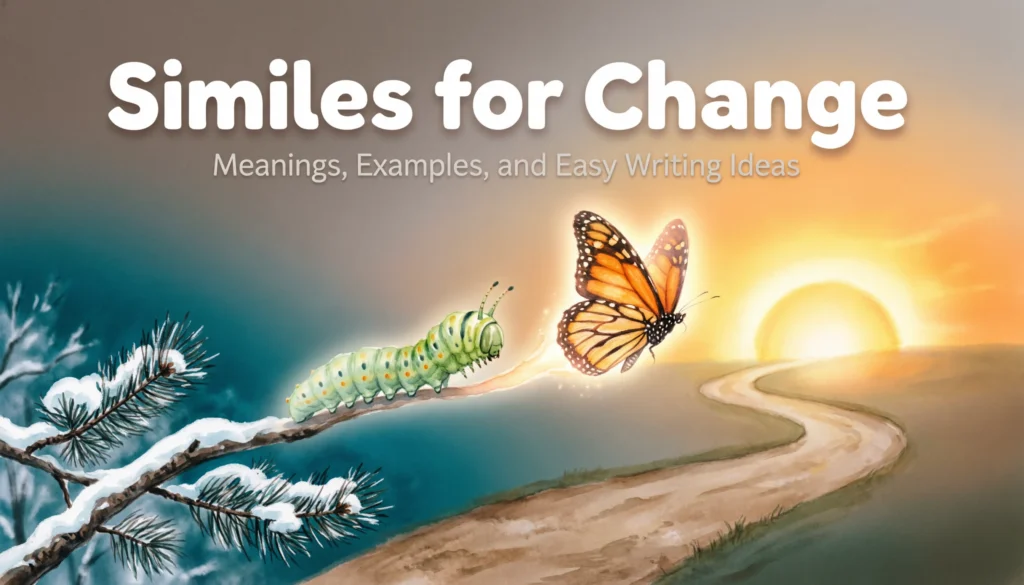
Change is part of life, writing, learning, and communication. Sometimes change feels exciting. Sometimes it feels scary, sudden, slow, confusing, or necessary. Similes help us describe these feelings in a clear and creative way.
Students, writers, and ESL learners can use similes for change to make sentences more vivid. Instead of saying “things changed,” you can say “things changed like the weather before a storm.” This gives the reader a stronger picture and feeling.
What Similes for Change Mean
Similes for change compare change to something familiar by using words like “as” or “like.”
They help explain:
- How fast something changes
- How deeply something changes
- How surprising change feels
- How natural change can be
- How emotional or difficult change feels
- How people, places, moods, seasons, and situations transform
A simple example is:
Her mood changed like the sky before rain.
This means her mood shifted quickly and noticeably.
Common Similes for Change
Here are some common similes for change with simple meanings and natural example sentences.
Changed Like the Weather
Meaning: Changed quickly or unpredictably.
Example: His opinion changed like the weather after he heard the full story.
Changed Like Day Turns Into Night
Meaning: Changed completely.
Example: After the argument, their friendship changed like day turns into night.
Changed Like Seasons
Meaning: Changed naturally over time.
Example: Her confidence changed like seasons as she grew older.
Changed Like a Caterpillar Into a Butterfly
Meaning: Changed beautifully or completely.
Example: The shy student changed like a caterpillar into a butterfly after joining the drama club.
Changed Like a River After Rain
Meaning: Became stronger, faster, or more intense.
Example: The quiet discussion changed like a river after rain when everyone joined in.
Changed Like Ice Melting in the Sun
Meaning: Changed slowly and gently.
Example: His anger changed like ice melting in the sun after she apologized.
Changed Like a Spark Into a Fire
Meaning: Grew from something small into something powerful.
Example: Her small idea changed like a spark into a fire.
Changed Like a Seed Into a Tree
Meaning: Grew slowly into something strong.
Example: His dream changed like a seed into a tree through years of hard work.
Popular Similes for Change With Meanings and Examples
As Different as Night and Day
Meaning: Very different from before.
Example: The town looked as different as night and day after the new roads opened.
As Fresh as a New Morning
Meaning: New, hopeful, and clean.
Example: Her attitude felt as fresh as a new morning after the break.
As Sudden as Lightning
Meaning: Very quick and unexpected.
Example: The decision came as sudden as lightning.
As Clear as a New Window
Meaning: Easier to understand after change.
Example: After the teacher explained it again, the lesson felt as clear as a new window.
As Unsteady as a Boat in a Storm
Meaning: Uncertain or unstable during change.
Example: During the move, their daily routine felt as unsteady as a boat in a storm.
As Natural as Leaves Falling in Autumn
Meaning: Normal and expected.
Example: Growing apart can feel as natural as leaves falling in autumn.
As Bright as a Room After Opening the Curtains
Meaning: Positive and refreshing.
Example: Her new plan felt as bright as a room after opening the curtains.
Funny Similes for Change
Funny similes make writing more playful. They work well in casual writing, speeches, classroom examples, and conversations.
Changed Like a Cat Hearing a Vacuum
Meaning: Changed suddenly because of surprise or fear.
Example: His face changed like a cat hearing a vacuum when the principal entered.
Changed Like WiFi During a Storm
Meaning: Became unstable or unpredictable.
Example: Her mood changed like WiFi during a storm.
Changed Like a Phone Battery at One Percent
Meaning: Dropped or shifted quickly.
Example: His energy changed like a phone battery at one percent after lunch.
Changed Like a Kid Seeing Cake
Meaning: Became excited very quickly.
Example: His attitude changed like a kid seeing cake when he heard about the prize.
Changed Like Plans on a Rainy Picnic Day
Meaning: Changed because of unexpected problems.
Example: Our weekend plan changed like plans on a rainy picnic day.
Everyday Similes for Change
Everyday similes use simple images that most people understand.
Changed Like Traffic at Rush Hour
Meaning: Became busy, slow, or stressful.
Example: The classroom changed like traffic at rush hour when the bell rang.
Changed Like Milk Turning Sour
Meaning: Became unpleasant over time.
Example: Their friendly talk changed like milk turning sour.
Changed Like Clothes After a Long Day
Meaning: Became different because of need or comfort.
Example: His tone changed like clothes after a long day.
Changed Like a Quiet Street During a Festival
Meaning: Became lively and active.
Example: The school changed like a quiet street during a festival.
Changed Like a Blank Page Into a Story
Meaning: Developed into something meaningful.
Example: Her idea changed like a blank page into a story.
Similes for Change in People
People change through growth, experience, pain, learning, and confidence.
Changed Like a Student Becoming a Teacher
Meaning: Became wiser or more mature.
Example: He changed like a student becoming a teacher after years of practice.
Changed Like a Flower Opening
Meaning: Became more confident or expressive.
Example: She changed like a flower opening when she found supportive friends.
Changed Like a Shadow Moving With the Sun
Meaning: Changed gradually throughout time.
Example: His personality changed like a shadow moving with the sun.
Changed Like Clay in Careful Hands
Meaning: Improved through guidance or effort.
Example: Her writing changed like clay in careful hands after regular practice.
Changed Like a Locked Door Opening
Meaning: Became more open or welcoming.
Example: He changed like a locked door opening after he learned to trust people.
Similes for Change in Life
Life change can feel hopeful, painful, exciting, or confusing. These similes can help express those moments.
Life Changed Like a Road Taking a New Turn
Meaning: Life moved in a new direction.
Example: After graduation, her life changed like a road taking a new turn.
Life Changed Like a Book Starting a New Chapter
Meaning: A new stage began.
Example: Moving to a new city changed his life like a book starting a new chapter.
Life Changed Like a Garden After Rain
Meaning: Life became fresh, hopeful, or full of growth.
Example: After months of struggle, her life changed like a garden after rain.
Life Changed Like a Song Switching Its Tune
Meaning: The feeling or direction of life shifted.
Example: Their life changed like a song switching its tune after the baby arrived.
Life Changed Like a Map Being Redrawn
Meaning: Plans and direction changed completely.
Example: The new job changed his life like a map being redrawn.
Similes for Change in Writing and Speaking
You can use similes for change in essays, stories, speeches, poems, and daily conversations.
For Stories
Phrase: The village changed like a sleepy child waking up.
Meaning: The village became active or lively.
Example: At sunrise, the village changed like a sleepy child waking up.
For Essays
Phrase: Society changes like a river shaping the land.
Meaning: Society changes slowly but powerfully.
Example: Technology changes society like a river shaping the land.
For Speeches
Phrase: Change can arrive like a sunrise after a long night.
Meaning: Change can bring hope after difficulty.
Example: Change can arrive like a sunrise after a long night, giving people a reason to begin again.
For Poems
Phrase: My heart changed like winter becoming spring.
Meaning: Feelings became warmer or happier.
Example: My heart changed like winter becoming spring when I saw her smile.
For Conversations
Phrase: Things changed like someone flipped a switch.
Meaning: Things changed very suddenly.
Example: After the announcement, things changed like someone flipped a switch.
Similes for Change for Students and ESL Learners
Students and ESL learners should start with simple similes. Clear images work better than complicated ones.
Easy Similes for Change
| Simile | Meaning | Example Sentence |
|---|---|---|
| Changed like the weather | Changed quickly | His mood changed like the weather. |
| Changed like seasons | Changed naturally | Her style changed like seasons. |
| Changed like ice melting | Changed slowly | His fear changed like ice melting. |
| Changed like a seed growing | Developed over time | The small plan changed like a seed growing. |
| Changed like night into day | Changed completely | The room changed like night into day after cleaning. |
These examples are easy to use in school writing because they are clear and natural.
Similes for Change in Conversations
In daily speech, people often use simple and direct similes. You do not need complex language.
Changed Like Someone Flipped a Switch
Meaning: Changed suddenly.
Example: He was quiet all morning, then changed like someone flipped a switch.
Changed Like a New Person
Meaning: Became very different.
Example: After joining the team, she changed like a new person.
Changed Like a Room After Cleaning
Meaning: Improved clearly.
Example: His desk changed like a room after cleaning.
Changed Like a Storm Passing
Meaning: Became calm after trouble.
Example: Her anger changed like a storm passing.
Changed Like Coffee Going Cold
Meaning: Lost energy, warmth, or interest.
Example: Their excitement changed like coffee going cold.
Similar Phrases and Expressions for Change
Some phrases are not exact similes, but they express change in a useful way.
Turned Over a New Leaf
Meaning: Started behaving better.
Example: He turned over a new leaf and began studying every day.
A New Chapter
Meaning: A fresh stage in life.
Example: College felt like a new chapter in her life.
A Fresh Start
Meaning: A chance to begin again.
Example: The new school gave him a fresh start.
A Turning Point
Meaning: A moment that changes everything.
Example: Winning the contest became a turning point in her confidence.
A Breath of Fresh Air
Meaning: A welcome and positive change.
Example: The new teacher was a breath of fresh air.
Out With the Old, In With the New
Meaning: Replace old things with new ones.
Example: They cleaned the office and said, out with the old, in with the new.
Like Starting From Scratch
Meaning: Starting again from the beginning.
Example: After losing the files, the project felt like starting from scratch.
Common Mistakes When Using Similes for Change
Many learners use similes incorrectly because they mix ideas or use unclear comparisons.
Using a Simile That Does Not Match the Feeling
Do not use a happy simile for a painful change unless you want contrast.
Weak example:
The breakup changed her life like a sunny picnic.
Better example:
The breakup changed her life like a storm crossing a quiet field.
Making the Simile Too Long
A simile should create a quick picture. Do not explain too much inside the sentence.
Weak example:
His mood changed like a person who first feels sad and then slowly becomes happy after hearing good news.
Better example:
His mood changed like clouds clearing after rain.
Using Too Many Similes Together
One strong simile works better than three weak ones.
Weak example:
Her life changed like a river, like a storm, and like a butterfly.
Better example:
Her life changed like a caterpillar becoming a butterfly.
Forgetting Like or As
A simile usually uses “like” or “as.”
Correct example:
The city changed like a stage before a play.
Correct example:
The change felt as sudden as thunder.
Choosing a Confusing Image
Use images that readers understand.
Weak example:
The plan changed like invisible glass.
Better example:
The plan changed like a map after a detour.
Best Similes for Change
Here are some strong similes you can use in writing.
| Simile | Best Use |
|---|---|
| Changed like seasons | Natural change |
| Changed like lightning | Sudden change |
| Changed like a seed into a tree | Growth |
| Changed like winter into spring | Hopeful change |
| Changed like day into night | Complete change |
| Changed like ice melting | Slow emotional change |
| Changed like a river after rain | Powerful change |
| Changed like a blank page into a story | Creative growth |
Conclusion
Similes for change help writers explain transformation in a clear and memorable way. They can show whether change is fast, slow, painful, hopeful, funny, or complete. A good simile uses a familiar image, such as weather, seasons, rivers, seeds, storms, or sunlight. Students can use simple similes in essays. Writers can use deeper similes in stories and poems. ESL learners can use everyday comparisons to sound more natural. The best simile always matches the feeling behind the change. When the image fits the meaning, your sentence becomes stronger, clearer, and more expressive.
FAQs
What are similes for change?
Similes for change are comparisons that describe transformation using “like” or “as.” For example, “Her mood changed like the weather.”
What is a good simile for sudden change?
A good simile for sudden change is “changed like lightning.” It means something changed very quickly and unexpectedly.
What is a simile for positive change?
A strong simile for positive change is “changed like winter into spring.” It suggests hope, warmth, and renewal.
What is a simile for personal growth?
“Changed like a seed into a tree” is a good simile for personal growth. It shows slow progress and strength over time.
Can I use similes for change in essays?
Yes. Similes can make essays more expressive, but use them carefully. Choose clear comparisons that support your main idea.
What is a funny simile for change?
A funny simile for change is “changed like a cat hearing a vacuum.” It means someone changed suddenly because of surprise or fear.
Are similes and metaphors the same?
No. A simile uses “like” or “as.” A metaphor says something is something else directly. For example, “Change is a storm” is a metaphor.

Ryan Chase is a skilled writer at MetaphorForge, recognized for his powerful and meaningful metaphors. He explores themes of personal growth, emotions, and everyday life with clarity and depth. His writing turns complex feelings into simple, relatable expressions. Through his work, readers gain fresh perspectives on their own experiences.