
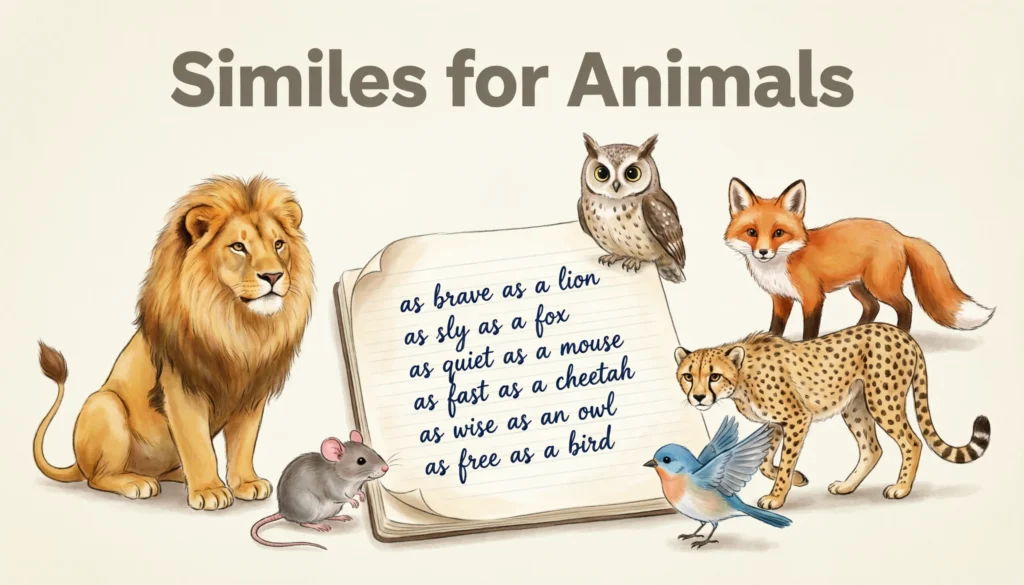
Animals give writers a simple way to describe people, actions, feelings, and scenes. Similes for animals compare someone or something to an animal by using words like “as” or “like.” These comparisons help readers understand speed, strength, beauty, fear, laziness, cleverness, and many other qualities.
Students, writers, and ESL learners can use animal similes to make sentences clearer and more lively. A sentence like “He ran fast” sounds plain, but “He ran like a cheetah” creates a strong picture. Good animal similes make writing easier to imagine and more enjoyable to read.
What “Similes for Animals” Mean
Similes for animals mean comparisons that use animals to describe a quality, action, or feeling.
They usually use “like” or “as.”
They help readers picture an idea quickly.
They can describe people, places, behavior, emotions, and movement.
They often connect an animal’s known trait with a human or object.
They work well in school writing, stories, poems, conversations, and ESL practice.
Example: “She is as quiet as a mouse” means she is very quiet.
Common, Popular, Funny, Useful, and Everyday Similes for Animals
As brave as a lion
Simple meaning: Very brave and confident.
Example sentence: The little boy stood as brave as a lion during his first speech.
As busy as a bee
Simple meaning: Very active and hardworking.
Example sentence: My mother stayed as busy as a bee before the guests arrived.
As sly as a fox
Simple meaning: Very clever in a tricky way.
Example sentence: The thief moved as sly as a fox through the dark street.
As quiet as a mouse
Simple meaning: Very quiet or silent.
Example sentence: The children became as quiet as a mouse when the teacher entered.
As strong as an ox
Simple meaning: Extremely strong.
Example sentence: My grandfather is still as strong as an ox.
As free as a bird
Simple meaning: Completely free and happy.
Example sentence: After exams, I felt as free as a bird.
As blind as a bat
Simple meaning: Unable to see well.
Example sentence: Without my glasses, I am as blind as a bat.
As proud as a peacock
Simple meaning: Very proud, often in a showy way.
Example sentence: He walked into the room as proud as a peacock.
As gentle as a lamb
Simple meaning: Very kind and gentle.
Example sentence: Her voice sounded as gentle as a lamb.
As hungry as a wolf
Simple meaning: Very hungry.
Example sentence: After football practice, I was as hungry as a wolf.
Similes for Animals With Meanings and Examples
Like a cheetah
Simple meaning: Very fast.
Example sentence: She ran like a cheetah across the field.
Like an eagle
Simple meaning: Sharp, focused, or watchful.
Example sentence: The guard watched the gate like an eagle.
Like a turtle
Simple meaning: Very slow.
Example sentence: The old car moved like a turtle on the hill.
Like a fish in water
Simple meaning: Very comfortable in a situation.
Example sentence: He spoke on stage like a fish in water.
Like a deer in headlights
Simple meaning: Shocked, scared, or frozen.
Example sentence: She looked like a deer in headlights when the principal called her name.
Like a bear
Simple meaning: Big, strong, or rough.
Example sentence: He hugged me like a bear.
Like a puppy
Simple meaning: Playful, excited, or innocent.
Example sentence: The child followed his older brother like a puppy.
Like a cat
Simple meaning: Quiet, graceful, or careful.
Example sentence: She walked like a cat through the silent hallway.
Like a monkey
Simple meaning: Playful, silly, or active.
Example sentence: The kids climbed the trees like monkeys.
Like a shark
Simple meaning: Aggressive, sharp, or determined.
Example sentence: The lawyer questioned the witness like a shark.
Like a horse
Simple meaning: Strong, hardworking, or energetic.
Example sentence: He worked like a horse all summer.
Like a snail
Simple meaning: Extremely slow.
Example sentence: The line at the bank moved like a snail.
Like a rabbit
Simple meaning: Quick, nervous, or jumpy.
Example sentence: His heart beat like a rabbit during the test.
Like a wolf
Simple meaning: Fierce, hungry, or wild.
Example sentence: The team attacked the game like wolves.
Like a butterfly
Simple meaning: Light, delicate, or graceful.
Example sentence: The dancer moved like a butterfly.
How to Use Similes for Animals in Sentences
Use animal similes when they make the meaning clearer. Choose an animal that matches the quality you want to describe.
Plain sentence:
She moved quickly.
Better sentence:
She moved like a cheetah.
Plain sentence:
He was very quiet.
Better sentence:
He was as quiet as a mouse.
Plain sentence:
The child was playful.
Better sentence:
The child jumped around like a monkey.
A good simile should feel natural. Do not add an animal comparison only because it sounds decorative. Use it when it helps the reader see, hear, or feel something more clearly.
Similes for Animals for Writing and Speaking
Animal similes work well in both creative and everyday language. Writers use them to build strong images. Speakers use them to explain ideas quickly.
For stories, animal similes can describe characters.
Example:
The old man stared like an eagle, noticing every small movement.
For essays, animal similes can make examples more vivid.
Example:
The students worked as busy as bees during the science fair.
For speaking, animal similes can make casual sentences more colorful.
Example:
I slept like a bear after the long trip.
Use familiar animals when writing for students or ESL learners. A reader understands “as fast as a cheetah” more easily than a rare or unknown animal comparison.
Similes for Animals for Students and ESL Learners
Students and ESL learners should start with common animal similes because they appear often in books, conversations, and classroom writing.
Here are some easy patterns:
As adjective as animal
Example: as brave as a lion
Verb like animal
Example: run like a cheetah
Feel like animal image
Example: I felt like a trapped bird.
A simple learning method:
Choose a quality, such as fast, quiet, strong, or proud.
Choose an animal known for that quality.
Build a sentence with “as” or “like.”
Example:
Quality: fast
Animal: cheetah
Sentence: He ran like a cheetah.
This method helps learners create original similes instead of memorizing only fixed phrases.
Similes for Animals in Conversations
Animal similes sound natural in daily conversations when you use them in the right situation.
“You are as busy as a bee today.”
Simple meaning: You are working a lot.
Example sentence: You are as busy as a bee today, so I will help with dinner.
“He eats like a horse.”
Simple meaning: He eats a lot.
Example sentence: My brother eats like a horse after basketball practice.
“She sings like a bird.”
Simple meaning: She sings sweetly.
Example sentence: Your sister sings like a bird.
“Stop moving like a snail.”
Simple meaning: Move faster.
Example sentence: Stop moving like a snail or we will miss the bus.
“He sleeps like a bear.”
Simple meaning: He sleeps deeply.
Example sentence: My father sleeps like a bear after night duty.
Animal similes make conversation more expressive, but tone matters. Some comparisons can sound funny, warm, rude, or critical depending on context.
Similar Phrases and Expressions
Animal metaphors
A metaphor compares directly without using “like” or “as.”
Example:
He is a lion in battle.
Meaning:
He is very brave.
Animal idioms
An idiom has a fixed meaning that may not match the literal words.
Example:
Let the cat out of the bag.
Meaning:
Reveal a secret.
Animal expressions
Animal expressions include similes, metaphors, idioms, and common sayings.
Example:
The early bird catches the worm.
Meaning:
People who act early often get the best chance.
Personification with animals
Personification gives human actions or feelings to animals.
Example:
The lonely dog stared at the moon.
Meaning:
The sentence gives the dog a humanlike emotional quality.
More Animal Similes for Better Writing
As graceful as a swan
Simple meaning: Very elegant.
Example sentence: The ballerina moved as graceful as a swan.
As playful as a kitten
Simple meaning: Very playful and lively.
Example sentence: The baby laughed as playful as a kitten.
As stubborn as a mule
Simple meaning: Very unwilling to change.
Example sentence: My little cousin can be as stubborn as a mule.
As wise as an owl
Simple meaning: Very wise or thoughtful.
Example sentence: The old teacher seemed as wise as an owl.
As slippery as an eel
Simple meaning: Hard to catch or hard to trust.
Example sentence: The clever salesman was as slippery as an eel.
As slow as a sloth
Simple meaning: Very slow.
Example sentence: He cleaned his room as slow as a sloth.
As jumpy as a rabbit
Simple meaning: Nervous or easily frightened.
Example sentence: She felt as jumpy as a rabbit before the interview.
As fierce as a tiger
Simple meaning: Very strong, bold, or intense.
Example sentence: The boxer fought as fierce as a tiger.
As loyal as a dog
Simple meaning: Very faithful and dependable.
Example sentence: His best friend stayed as loyal as a dog.
As noisy as a parrot
Simple meaning: Very talkative or loud.
Example sentence: The classroom became as noisy as a parrot cage.
Common Mistakes When Using Similes for Animals
Using the wrong animal quality
Do not compare someone to an animal if the trait does not match.
Weak:
He whispered like a lion.
Better:
He whispered as quiet as a mouse.
Mixing two different images
Avoid using two animals in one confusing comparison.
Weak:
She ran like a cheetah and flew like a bird through the hallway.
Better:
She ran like a cheetah through the hallway.
Overusing common similes
Common similes help beginners, but too many can make writing dull. Try to add fresh details.
Common:
He was as brave as a lion.
More vivid:
He stood like a lion guarding its pride.
Using rude comparisons carelessly
Some animal similes can sound insulting.
Example:
He eats like a pig.
This means he eats messily, but it can hurt someone’s feelings. Use it only in suitable informal or fictional contexts.
Forgetting “like” or “as”
A simile usually needs “like” or “as.”
Incorrect:
She is a mouse quiet.
Correct:
She is as quiet as a mouse.
Conclusion
Similes for animals help students, writers, and ESL learners describe ideas in a clear and memorable way. Animals carry familiar meanings, so readers quickly understand comparisons like “as brave as a lion,” “as quiet as a mouse,” or “like a cheetah.” These similes can show speed, strength, fear, pride, kindness, hunger, and many other qualities. Use them when they make your sentence stronger, not just longer. Choose the animal carefully, match it with the right trait, and keep the sentence natural. With practice, animal similes can make writing more colorful, expressive, and easy to understand.
FAQs
What are similes for animals?
Similes for animals are comparisons that use animals to describe a person, action, feeling, or thing. They often use “like” or “as,” such as “as brave as a lion” or “run like a cheetah.”
What is a good animal simile for bravery?
“As brave as a lion” is a common animal simile for bravery. It means someone shows courage and confidence in a difficult situation.
What is a funny animal simile?
“He eats like a horse” can sound funny in casual speech. It means someone eats a lot. Another funny one is “The kids climbed like monkeys.”
Are animal similes good for students?
Yes, animal similes help students make writing more descriptive. They also make ideas easier to picture, especially in stories, poems, and school essays.
What is the difference between an animal simile and an animal metaphor?
An animal simile uses “like” or “as,” such as “She sings like a bird.” An animal metaphor compares directly, such as “She is a songbird.”
Can ESL learners use animal similes in conversation?
Yes, ESL learners can use simple animal similes in everyday speech. Common examples like “as busy as a bee” and “as quiet as a mouse” sound natural and easy to understand.
How do I create my own animal simile?
Pick a quality first, such as fast, slow, quiet, or strong. Then choose an animal known for that quality. Finally, build a sentence with “like” or “as.”

Ryan Chase is a skilled writer at MetaphorForge, recognized for his powerful and meaningful metaphors. He explores themes of personal growth, emotions, and everyday life with clarity and depth. His writing turns complex feelings into simple, relatable expressions. Through his work, readers gain fresh perspectives on their own experiences.