
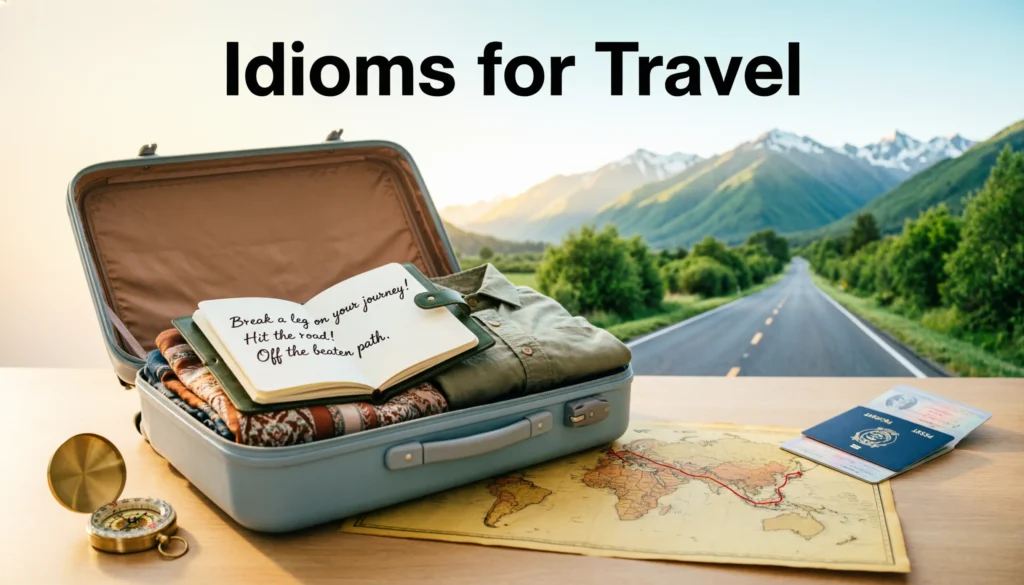
Travel becomes more vivid when we describe it with natural English expressions. Idioms for travel help students, writers, and ESL learners talk about journeys, movement, adventure, delays, plans, and life changes in a more interesting way.
These phrases do not always mean exactly what the words say. Some describe real trips, while others use travel as a symbol for progress, change, or experience. Learning them can improve speaking, writing, storytelling, essays, and everyday conversation.
What “Idioms for Travel” Means
Idioms for travel are expressions that describe journeys, movement, or travel related experiences in a figurative or natural way.
They can mean:
- Starting a journey
- Moving from one place to another
- Exploring new places
- Facing delays or problems
- Making progress in life
- Changing direction
- Taking risks or seeking adventure
- Returning home after being away
Some travel idioms refer to actual trips, while others describe life, work, school, or personal growth.
Common, Popular, Funny, Useful, and Everyday Idioms for Travel
These common idioms for travel appear in daily speech, stories, blogs, and casual conversation. They help you describe trips in a natural and memorable way.
Hit the road
Simple meaning: To start a journey or leave a place.
Example sentence: We packed our bags early and decided to hit the road before sunrise.
On the road
Simple meaning: Traveling from place to place.
Example sentence: The band spent three months on the road during its summer tour.
Take the scenic route
Simple meaning: To choose a longer but more beautiful or interesting way.
Example sentence: We took the scenic route through the hills and enjoyed every minute.
Travel light
Simple meaning: To carry only a few things while traveling.
Example sentence: I always travel light so I can move easily through airports.
Off the beaten track
Simple meaning: In a place that tourists do not visit often.
Example sentence: They found a quiet village off the beaten track near the coast.
A bumpy ride
Simple meaning: A difficult journey or experience.
Example sentence: Starting the business felt like a bumpy ride, but they kept going.
Get itchy feet
Simple meaning: To feel a strong desire to travel or move somewhere new.
Example sentence: After six months at home, she got itchy feet and booked a trip.
Catch the travel bug
Simple meaning: To become very interested in traveling.
Example sentence: He caught the travel bug after his first trip abroad.
Go places
Simple meaning: To become successful or make good progress.
Example sentence: With her talent and confidence, she will go places.
In the same boat
Simple meaning: In the same situation as someone else.
Example sentence: Our flight got canceled, so we were all in the same boat.
Idioms for Travel With Meanings and Examples
These idioms for travel can help you write better essays, stories, captions, and dialogues.
At a crossroads
Simple meaning: At a point where someone must make an important decision.
Example sentence: After graduation, he felt at a crossroads and considered traveling for a year.
Miss the boat
Simple meaning: To miss an opportunity.
Example sentence: She missed the boat when she waited too long to buy cheap tickets.
Jump on the bandwagon
Simple meaning: To join something popular.
Example sentence: Many travelers jumped on the bandwagon and started visiting hidden mountain towns.
The road less traveled
Simple meaning: An unusual or less common choice in life or travel.
Example sentence: He chose the road less traveled and moved to a small island to write.
Smooth sailing
Simple meaning: Easy progress without problems.
Example sentence: Once we passed security, the rest of the journey was smooth sailing.
Go the extra mile
Simple meaning: To make more effort than expected.
Example sentence: The tour guide went the extra mile and helped us find a local restaurant.
Put down roots
Simple meaning: To settle in one place.
Example sentence: After years of travel, they decided to put down roots in a quiet town.
Road to nowhere
Simple meaning: A plan or journey that leads to no useful result.
Example sentence: Without a clear budget, their travel plan became a road to nowhere.
Pack your bags
Simple meaning: To prepare to leave.
Example sentence: When the job offer came, he packed his bags and moved to another city.
Blaze a trail
Simple meaning: To do something new and lead the way for others.
Example sentence: The young explorer blazed a trail through remote travel writing.
Funny and Casual Idioms for Travel
These expressions sound more relaxed and work well in conversation, blogs, and informal writing.
Are we there yet
Simple meaning: A humorous way to show impatience during a trip.
Example sentence: After one hour in the car, the kids started asking, are we there yet.
My bags are packed
Simple meaning: I am ready to leave or eager to go.
Example sentence: When she heard about the beach trip, she said her bags were packed.
Fly by the seat of your pants
Simple meaning: To do something without much planning.
Example sentence: We had no hotel booking, so we had to fly by the seat of our pants.
Like ships passing in the night
Simple meaning: People who meet briefly and then separate.
Example sentence: We met at the station for five minutes, like ships passing in the night.
All over the map
Simple meaning: Confused, scattered, or moving in many directions.
Example sentence: Our travel ideas were all over the map until we chose one city.
Take a hike
Simple meaning: To go away, often used rudely or jokingly.
Example sentence: When the taxi driver asked for too much money, my brother told him to take a hike.
Drive someone up the wall
Simple meaning: To annoy someone a lot.
Example sentence: The long traffic jam started to drive everyone up the wall.
Useful Everyday Idioms for Travel
These everyday travel idioms fit school writing, emails, social media captions, and spoken English.
Make tracks
Simple meaning: To leave quickly or start moving.
Example sentence: We had to make tracks before the storm reached the road.
Step out of your comfort zone
Simple meaning: To try something unfamiliar or challenging.
Example sentence: Solo travel helped her step out of her comfort zone.
Find your way
Simple meaning: To learn how to manage or reach a goal.
Example sentence: He got lost at first, but he slowly found his way around the city.
Go with the flow
Simple meaning: To accept changes calmly.
Example sentence: Our plan changed twice, so we decided to go with the flow.
Take a detour
Simple meaning: To choose a different route or change plans.
Example sentence: We took a detour through a small town and found a lovely café.
Reach your destination
Simple meaning: To arrive at a place or achieve a goal.
Example sentence: After years of hard work, she finally reached her destination.
Back on track
Simple meaning: Returning to the right plan or direction.
Example sentence: After missing one train, we got back on track by taking the next one.
How to Use Idioms for Travel in Sentences
Idioms for travel work best when the context makes the meaning clear. Do not add too many idioms in one paragraph. One strong phrase can make a sentence more natural and expressive.
For example, use hit the road when someone starts a trip. Use off the beaten track when describing a quiet or unusual place. Use smooth sailing when the trip or plan goes well. Use at a crossroads when travel connects with a life decision.
Examples for sentence practice
Phrase: Hit the road
Simple meaning: Start traveling
Example sentence: We hit the road early to avoid traffic.
Phrase: Off the beaten track
Simple meaning: Away from popular tourist places
Example sentence: The best part of the trip was a small café off the beaten track.
Phrase: Smooth sailing
Simple meaning: Easy progress
Example sentence: After the first delay, the journey became smooth sailing.
Phrase: Travel light
Simple meaning: Carry few things
Example sentence: Students should travel light during short study trips.
Phrase: Go with the flow
Simple meaning: Stay flexible
Example sentence: When rain changed our plan, we chose to go with the flow.
Idioms for Travel for Writing and Speaking
Writers use travel idioms to create movement, emotion, and a sense of discovery. These phrases can make essays, stories, speeches, and blog posts sound more natural.
In speaking, travel idioms help you sound fluent without using complex grammar. ESL learners can use them in daily conversations about holidays, school trips, airport problems, road journeys, and future plans.
Good travel idioms for writing
Phrase: The road less traveled
Simple meaning: An unusual path or choice
Example sentence: Her memoir follows the road less traveled through remote villages and quiet cities.
Phrase: A bumpy ride
Simple meaning: A difficult experience
Example sentence: Their first month abroad was a bumpy ride full of mistakes and lessons.
Phrase: Blaze a trail
Simple meaning: Lead the way
Example sentence: The writer blazed a trail by exploring places few tourists knew.
Phrase: At a crossroads
Simple meaning: Facing an important choice
Example sentence: The main character stands at a crossroads after leaving home.
Phrase: Put down roots
Simple meaning: Settle in one place
Example sentence: After years of moving, the family finally put down roots.
Good travel idioms for speaking
Phrase: Catch the travel bug
Simple meaning: Start loving travel
Example sentence: I caught the travel bug after visiting my first foreign city.
Phrase: Pack your bags
Simple meaning: Prepare to leave
Example sentence: Pack your bags because we leave tomorrow morning.
Phrase: On the road
Simple meaning: Traveling
Example sentence: I will call you while we are on the road.
Phrase: Take the scenic route
Simple meaning: Use a longer beautiful route
Example sentence: Let us take the scenic route and enjoy the view.
Phrase: Make tracks
Simple meaning: Leave quickly
Example sentence: It is getting late, so we should make tracks.
Idioms for Travel for Students and ESL Learners
Students and ESL learners should learn travel idioms in groups. Start with phrases that describe real journeys, then move to expressions that describe life and progress.
A strong method is to write one meaning and one personal sentence for each idiom. This makes the phrase easier to remember. Avoid translating every word directly, because idioms often carry a figurative meaning.
Easy travel idioms for learners
Phrase: Travel light
Simple meaning: Take only a few things
Example sentence: I travel light when I visit my cousins.
Phrase: Hit the road
Simple meaning: Start a trip
Example sentence: We hit the road after breakfast.
Phrase: Miss the boat
Simple meaning: Miss a chance
Example sentence: I missed the boat because I applied too late.
Phrase: Back on track
Simple meaning: Return to the right plan
Example sentence: After a short delay, our class project got back on track.
Phrase: In the same boat
Simple meaning: Sharing the same problem
Example sentence: We forgot our tickets, so we were in the same boat.
Phrase: Go places
Simple meaning: Become successful
Example sentence: My teacher says I will go places if I keep practicing.
Phrase: Take a detour
Simple meaning: Change route
Example sentence: We took a detour because the main road was closed.
Idioms for Travel in Conversations
Travel idioms make conversations sound friendly and natural. They often appear when people talk about trips, delays, plans, holidays, and life choices.
Conversation examples
Phrase: Hit the road
Simple meaning: Leave or start traveling
Example sentence: We should hit the road now if we want to arrive before lunch.
Phrase: Go with the flow
Simple meaning: Stay relaxed when plans change
Example sentence: The hotel changed our room, but we decided to go with the flow.
Phrase: Itchy feet
Simple meaning: Desire to travel
Example sentence: I have itchy feet again and want to visit somewhere new.
Phrase: Off the beaten track
Simple meaning: Away from tourist crowds
Example sentence: I prefer small places off the beaten track.
Phrase: Smooth sailing
Simple meaning: Easy and trouble free
Example sentence: The airport was busy, but after check in everything was smooth sailing.
Phrase: Same boat
Simple meaning: Same situation
Example sentence: You lost your luggage too, so we are in the same boat.
Phrase: Scenic route
Simple meaning: Longer but prettier way
Example sentence: We have time, so let us take the scenic route.
Similar Phrases and Expressions
Some travel related expressions are not strict idioms, but they still help describe movement, adventure, and change. These phrases work well in writing and speaking.
Similar travel expressions
Phrase: Journey of a lifetime
Simple meaning: A very special and unforgettable trip
Example sentence: Visiting the ancient city felt like the journey of a lifetime.
Phrase: Adventure awaits
Simple meaning: An exciting experience is coming
Example sentence: She smiled at the airport because adventure awaits.
Phrase: Home away from home
Simple meaning: A place that feels comfortable like home
Example sentence: The small guesthouse became our home away from home.
Phrase: Lost in the moment
Simple meaning: Fully enjoying an experience
Example sentence: We watched the sunset and felt lost in the moment.
Phrase: New horizons
Simple meaning: New opportunities or experiences
Example sentence: Studying abroad opened new horizons for her.
Phrase: A change of scenery
Simple meaning: A different place or environment
Example sentence: I needed a change of scenery after a stressful month.
Phrase: Life is a journey
Simple meaning: Life involves growth, change, and experience
Example sentence: His speech reminded us that life is a journey.
Common Mistakes
Students often make small mistakes when using idioms for travel. These mistakes can make a sentence sound unnatural or confusing.
Mistake 1: Taking every idiom literally
Phrase: Miss the boat
Simple meaning: Miss an opportunity
Example sentence: I missed the boat when I forgot the scholarship deadline.
Do not use this only for a real boat. It often talks about missed chances.
Mistake 2: Changing the wording too much
Phrase: Hit the road
Simple meaning: Start a journey
Example sentence: We hit the road at six in the morning.
Do not say hit a road when you mean start traveling.
Mistake 3: Using too many idioms together
Phrase: Smooth sailing
Simple meaning: Easy progress
Example sentence: After we fixed the booking issue, the trip was smooth sailing.
One idiom usually works better than three idioms in the same sentence.
Mistake 4: Using rude idioms in formal writing
Phrase: Take a hike
Simple meaning: Go away
Example sentence: He jokingly told his friend to take a hike.
This phrase can sound rude, so avoid it in formal essays.
Mistake 5: Confusing travel idioms with travel vocabulary
Phrase: Off the beaten track
Simple meaning: Away from popular places
Example sentence: Their hotel was off the beaten track but peaceful.
This phrase means more than location. It also suggests something unusual or less common.
Mistake 6: Forgetting the context
Phrase: At a crossroads
Simple meaning: Facing a major decision
Example sentence: She stood at a crossroads when she had to choose between work and travel.
Use this idiom for important choices, not small decisions like choosing a snack.
Conclusion
Idioms for travel help you describe trips, movement, adventure, delays, decisions, and personal growth in a natural way. Some phrases, such as hit the road and travel light, talk about real journeys. Others, such as at a crossroads and the road less traveled, describe life choices and progress. Students, writers, and ESL learners can use these expressions to make sentences more vivid and fluent. The best way to learn them is to understand the meaning, read examples, and practice with your own travel or life experiences. Use them carefully, and your English will sound clearer and more expressive.
FAQs
What are idioms for travel?
Idioms for travel are expressions that describe journeys, movement, adventure, or travel related situations. Some refer to real trips, while others use travel as a symbol for life, progress, or change.
What is a common travel idiom?
Hit the road is a common travel idiom. It means to leave or start a journey. For example, We hit the road early to avoid traffic.
Are travel idioms useful for ESL learners?
Yes, travel idioms help ESL learners sound more natural in speaking and writing. They also improve understanding of books, films, conversations, and travel related content.
Is off the beaten track a travel idiom?
Yes, off the beaten track is a travel idiom. It means a place that many tourists do not visit. It often describes quiet, unusual, or less crowded locations.
What does catch the travel bug mean?
Catch the travel bug means to develop a strong interest in traveling. People often use it after someone enjoys a trip and wants to travel more.
Can travel idioms describe life?
Yes, many travel idioms describe life. At a crossroads means facing an important decision, while the road less traveled means choosing an unusual path.
How can I practice idioms for travel?
Choose five idioms, learn their meanings, and write one personal sentence for each. Then use them in short conversations, captions, essays, or travel diary entries.

Mia Belle is a skilled content writer at MetaphorForge, celebrated for her elegant use of language and vivid metaphors. She crafts emotionally rich pieces that make complex ideas easy to grasp. With a refined storytelling style, she connects deeply with readers. Her work reflects creativity, insight, and clarity.