
Introduction
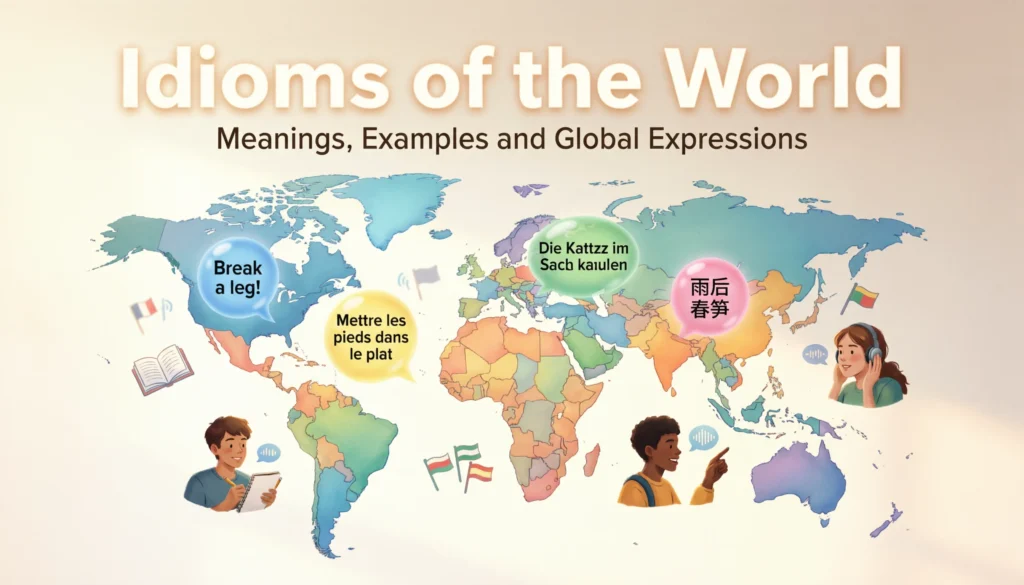
Idioms of the world are expressions from different cultures that often do not mean exactly what their words say. They show how people use humor, history, food, animals, weather, and daily life to explain ideas in a colorful way.
For students, writers, and ESL learners, these idioms help build stronger vocabulary and cultural understanding. Learning them also makes speaking and writing sound more natural, expressive, and confident.
What “Idioms of the World” Means
Idioms of the world means:
- Common expressions used in different countries and languages
- Phrases with meanings that are not always literal
- Cultural sayings that reflect local habits, humor, and values
- Useful expressions for writing, speaking, and conversation
- A way to understand how people think across cultures
Common, Popular, Funny, Useful, and Everyday Idioms of the World
Spill the beans
Simple meaning: To reveal a secret.
Example sentence: Maya spilled the beans about the surprise party.
Break the ice
Simple meaning: To make people feel comfortable.
Example sentence: The teacher told a joke to break the ice.
When pigs fly
Simple meaning: Something will never happen.
Example sentence: He will clean his room without being asked when pigs fly.
Cost an arm and a leg
Simple meaning: Very expensive.
Example sentence: That designer bag costs an arm and a leg.
Hit the nail on the head
Simple meaning: To say exactly the right thing.
Example sentence: You hit the nail on the head with that answer.
Once in a blue moon
Simple meaning: Very rarely.
Example sentence: We eat at that restaurant once in a blue moon.
Let the cat out of the bag
Simple meaning: To reveal hidden information.
Example sentence: Ali let the cat out of the bag about the gift.
The ball is in your court
Simple meaning: It is your turn to act.
Example sentence: I sent the proposal, so now the ball is in your court.
Bite off more than you can chew
Simple meaning: To take on too much work.
Example sentence: She bit off more than she could chew with five projects.
Under the weather
Simple meaning: Feeling sick.
Example sentence: I stayed home because I felt under the weather.
Idioms of the World With Meanings and Examples
A storm in a teacup
Simple meaning: A big reaction to a small problem.
Example sentence: The argument became a storm in a teacup.
Not my circus, not my monkeys
Simple meaning: This problem is not my responsibility.
Example sentence: I refused to join the office drama because it was not my circus, not my monkeys.
To have other cats to whip
Simple meaning: To have more important things to do.
Example sentence: I cannot worry about gossip because I have other cats to whip.
Feed the donkey sponge cake
Simple meaning: To waste something valuable on someone who does not appreciate it.
Example sentence: Giving him rare books is like feeding the donkey sponge cake.
To have a wide face
Simple meaning: To have strong influence or social respect.
Example sentence: He got the meeting because he has a wide face in the company.
To give someone pumpkins
Simple meaning: To reject someone romantically.
Example sentence: She gave him pumpkins after the first date.
The shrimp that falls asleep gets carried by the current
Simple meaning: Lazy or careless people miss chances.
Example sentence: Study now because the shrimp that falls asleep gets carried by the current.
To walk around hot porridge
Simple meaning: To avoid speaking directly.
Example sentence: Stop walking around hot porridge and tell me the truth.
To wear a cat on your head
Simple meaning: To have messy hair.
Example sentence: You look like you are wearing a cat on your head this morning.
To slide in on a shrimp sandwich
Simple meaning: To get success without much effort.
Example sentence: He slid in on a shrimp sandwich and got the easiest job.
How to Use Idioms of the World in Sentences
Use idioms when they match the situation clearly. Do not force them into every sentence. A good idiom should make the meaning stronger, not confusing.
For example, use under the weather when someone feels ill. Use break the ice when people feel shy. Use the ball is in your court when someone must make the next move.
Idioms of the World for Writing and Speaking
Writers can use idioms of the world to make dialogue sound natural and culturally rich. A character from one country may use a local expression that reveals background, humor, or personality.
Speakers can use these idioms in casual talks, class discussions, speeches, and storytelling. However, formal writing needs care. In academic essays, explain unusual idioms so readers do not misunderstand them.
Idioms of the World for Students and ESL Learners
Students should learn idioms by meaning, not by direct translation. Many idioms sound strange when translated word for word, but they make sense inside their culture.
ESL learners should start with common English idioms first, then explore global expressions. Keep a notebook with the phrase, meaning, and example sentence. This method builds memory and confidence.
Idioms of the World in Conversations
Idioms make conversations warmer and more expressive. They help people explain feelings, problems, success, failure, and humor in a short way.
Example conversation:
A: I feel nervous before the presentation.
B: Tell a small joke first. It will break the ice.
A: Good idea. I do not want to make a storm in a teacup over this.
Similar Phrases and Expressions
Similar expressions include proverbs, sayings, slang phrases, metaphors, and cultural expressions. Idioms often work like metaphors because they compare one idea with another.
For example, cost an arm and a leg is idiomatic and metaphorical. It does not mean real body parts. It means something is extremely expensive.
Common Mistakes
One common mistake is translating idioms word for word. This can sound confusing or funny in another language.
Another mistake is using idioms in the wrong tone. Some idioms sound casual, playful, or old-fashioned. Choose expressions that match your audience.
Learners also overuse idioms. One or two strong idioms can improve writing, but too many can make a paragraph feel unnatural.
Conclusion
Idioms of the world show how language carries culture, humor, wisdom, and everyday experience. They help students and ESL learners move beyond basic vocabulary and understand how people really speak. Writers can use them to create lively characters, stronger dialogue, and richer descriptions. The best way to learn idioms is to study the meaning, notice the situation, and practice each phrase in a natural sentence. When used carefully, idioms make English more colorful, memorable, and human.
FAQs
What are idioms of the world?
Idioms of the world are expressions from different cultures that have meanings beyond their literal words.
Are idioms the same in every language?
No. Some idioms share similar meanings, but many use different images based on local culture.
Why are idioms hard for ESL learners?
They are hard because the literal words often do not explain the real meaning.
Can I use global idioms in essays?
Yes, but explain unusual idioms if your reader may not know them.
What is the best way to learn idioms?
Learn the phrase, simple meaning, and one natural example sentence together.
Are idioms useful for speaking?
Yes. Idioms make everyday speech sound more fluent, natural, and expressive.

Noah Cole is a contemporary writer known for crafting metaphors that bridge emotion and everyday experience. His work focuses on human resilience, inner conflict, and quiet transformation through vivid imagery. With a minimalist yet powerful style, he turns simple moments into lasting insights. At MetaphorForge, Noah Cole’s voice reflects clarity, depth, and meaning-driven storytelling.