
Introduction
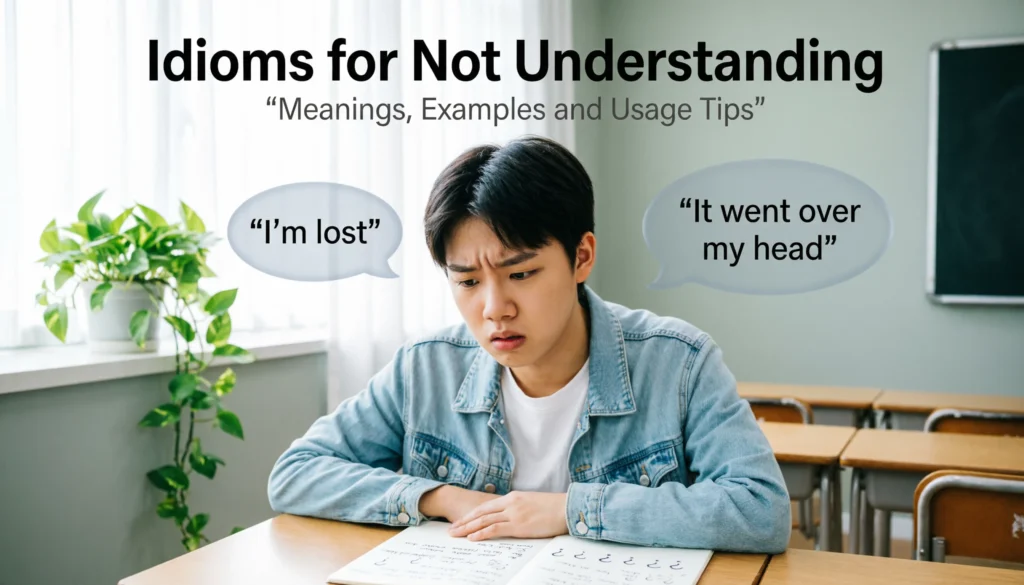
Idioms for not understanding help you describe confusion in a natural and expressive way. Instead of only saying “I don’t understand,” you can use phrases like “I’m lost,” “it went over my head,” or “I can’t make heads or tails of it.”
These expressions are useful for students, writers, and ESL learners because they sound more fluent in real conversations. They also help writers show confusion, uncertainty, surprise, or difficulty without repeating the same plain sentence again and again.
What “Idioms for Not Understanding” Mean
Idioms for not understanding are phrases people use when:
- They cannot follow an idea clearly
- Something feels confusing or difficult
- A joke, lesson, rule, or explanation makes no sense
- They feel mentally lost during a conversation
- They need someone to explain something again
- They want to describe confusion in a more natural way
Common, Popular, Funny, Useful, and Everyday Idioms for Not Understanding
1. I’m lost
Simple meaning: I do not understand what is happening or being explained.
Example sentence: I was following the lesson at first, but now I’m lost.
2. It went over my head
Simple meaning: It was too difficult or advanced for me to understand.
Example sentence: The professor explained the theory, but most of it went over my head.
3. I can’t make heads or tails of it
Simple meaning: I cannot understand it at all.
Example sentence: I read the instructions twice, but I can’t make heads or tails of it.
4. I’m in the dark
Simple meaning: I do not have enough information to understand the situation.
Example sentence: Everyone seems to know the plan, but I’m still in the dark.
5. It doesn’t click
Simple meaning: I understand the words, but the idea is not clear yet.
Example sentence: I practiced the grammar rule, but it still doesn’t click.
6. I don’t get it
Simple meaning: I do not understand it.
Example sentence: Everyone laughed at the joke, but I don’t get it.
7. I’m drawing a blank
Simple meaning: I cannot think of the answer or understand what to say.
Example sentence: The teacher asked me the meaning, and I started drawing a blank.
8. It makes no sense to me
Simple meaning: I cannot understand the logic of something.
Example sentence: His explanation makes no sense to me.
9. I’m confused
Simple meaning: I do not understand clearly.
Example sentence: I’m confused about the difference between these two words.
10. I’m all at sea
Simple meaning: I feel completely confused.
Example sentence: After ten minutes of legal language, I was all at sea.
Idioms for Not Understanding With Meanings and Examples
11. I’m not following you
Simple meaning: I do not understand what you are saying.
Example sentence: Sorry, I’m not following you. Can you explain that again?
12. You lost me
Simple meaning: I understood before, but now I do not.
Example sentence: You lost me when you started talking about the formula.
13. That’s beyond me
Simple meaning: I cannot understand it because it is too difficult.
Example sentence: Advanced physics is beyond me.
14. I can’t wrap my head around it
Simple meaning: I find it hard to understand or accept.
Example sentence: I can’t wrap my head around how this machine works.
15. It’s Greek to me
Simple meaning: It is completely unclear or impossible for me to understand.
Example sentence: This computer code is Greek to me.
16. I’m out of my depth
Simple meaning: I am dealing with something too difficult for my knowledge or skill.
Example sentence: In that finance meeting, I felt out of my depth.
17. I haven’t got a clue
Simple meaning: I have no idea.
Example sentence: I haven’t got a clue why the app stopped working.
18. I’m none the wiser
Simple meaning: I still do not understand after hearing an explanation.
Example sentence: He explained the rule twice, but I’m none the wiser.
19. My mind went blank
Simple meaning: I suddenly could not think or understand.
Example sentence: During the test, my mind went blank.
20. It’s clear as mud
Simple meaning: It is not clear at all.
Example sentence: His answer was clear as mud.
How to Use Idioms for Not Understanding in Sentences
Use these idioms when you want to sound natural, polite, or expressive. In formal writing, choose softer phrases like “I’m not following the argument” or “the meaning remains unclear.” In casual speech, you can say “I don’t get it,” “you lost me,” or “it went over my head.”
Examples:
I’m lost. Could you explain the first step again?
That joke went over my head.
I can’t make heads or tails of this form.
You lost me after the second example.
I’m still in the dark about the final decision.
Idioms for Not Understanding for Writing and Speaking
Writers can use these expressions to show a character’s confusion without saying “he was confused” every time. For example, “She stared at the contract, unable to make heads or tails of it” sounds more vivid than “She did not understand the contract.”
In speaking, these idioms help you ask for help naturally. “I’m not following you” sounds polite in class or work. “I don’t get it” sounds casual with friends. “It’s Greek to me” adds humor when something feels very difficult.
Idioms for Not Understanding for Students and ESL Learners
Students and ESL learners should learn both casual and polite forms. Some idioms fit classrooms, while others fit everyday conversation.
Useful classroom phrases:
I’m not following you
Simple meaning: I need the explanation again.
Example sentence: I’m not following you. Could you repeat the last point?
This part doesn’t click
Simple meaning: I understand some of it, but not this part.
Example sentence: The vocabulary is easy, but the grammar doesn’t click.
I’m confused about this
Simple meaning: I need clarification.
Example sentence: I’m confused about how to use this idiom in a sentence.
Idioms for Not Understanding in Conversations
Here are natural conversation examples:
A: Did you understand the joke?
B: No, it went over my head.
A: The answer comes from the second formula.
B: Sorry, you lost me there.
A: Do you know why the meeting changed?
B: No, I’m completely in the dark.
A: Can you read this legal notice?
B: I tried, but I can’t make heads or tails of it.
Similar Phrases and Expressions
These are not always idioms, but they express the same idea clearly.
I need more context
Simple meaning: I need more background information.
Example sentence: I need more context before I can understand the problem.
Could you clarify that?
Simple meaning: Please explain it more clearly.
Example sentence: Could you clarify that last sentence?
That part is unclear
Simple meaning: One part is hard to understand.
Example sentence: The beginning is fine, but that part is unclear.
I need another example
Simple meaning: One explanation is not enough.
Example sentence: I need another example to understand this rule.
Can you break it down?
Simple meaning: Please explain it in smaller steps.
Example sentence: Can you break it down for me?
Common Mistakes
Do not use very casual idioms in formal academic writing. For example, “It’s Greek to me” sounds too informal for a research essay.
Do not overuse the same phrase. If every sentence says “I don’t get it,” the writing becomes weak.
Do not confuse “I’m in the dark” with physical darkness. It usually means lacking information.
Do not use “clear as mud” when you want to sound serious or polite. It often sounds humorous or slightly critical.
Do not say “I can’t understand nothing.” Say “I can’t understand anything” or “I don’t understand anything.”
Conclusion
Idioms for not understanding make your English sound more natural, expressive, and flexible. They help you describe confusion in class, at work, in writing, and in daily conversations. Phrases like “I’m lost,” “it went over my head,” and “I can’t make heads or tails of it” give you better ways to explain when something feels unclear. Students and ESL learners should start with simple expressions, then slowly use more idiomatic ones. Writers can also use these phrases to create realistic dialogue and show a character’s confusion in a vivid way.
FAQs
What is the best idiom for not understanding?
“I’m lost” is one of the simplest and most common idioms for not understanding.
What does “it went over my head” mean?
It means something was too difficult, complex, or advanced for you to understand.
Is “I don’t get it” an idiom?
It is a common informal expression that means “I do not understand.”
What does “it’s Greek to me” mean?
It means something is completely confusing or impossible for you to understand.
Can I use these idioms in formal writing?
Use them carefully. Formal writing usually needs clearer phrases like “the meaning remains unclear.”
Which phrase is polite for class or work?
“I’m not following you” and “Could you clarify that?” sound polite and natural.
What is a funny idiom for confusion?
“Clear as mud” is a funny expression that means something is not clear at all.

Noah Cole is a contemporary writer known for crafting metaphors that bridge emotion and everyday experience. His work focuses on human resilience, inner conflict, and quiet transformation through vivid imagery. With a minimalist yet powerful style, he turns simple moments into lasting insights. At MetaphorForge, Noah Cole’s voice reflects clarity, depth, and meaning-driven storytelling.