
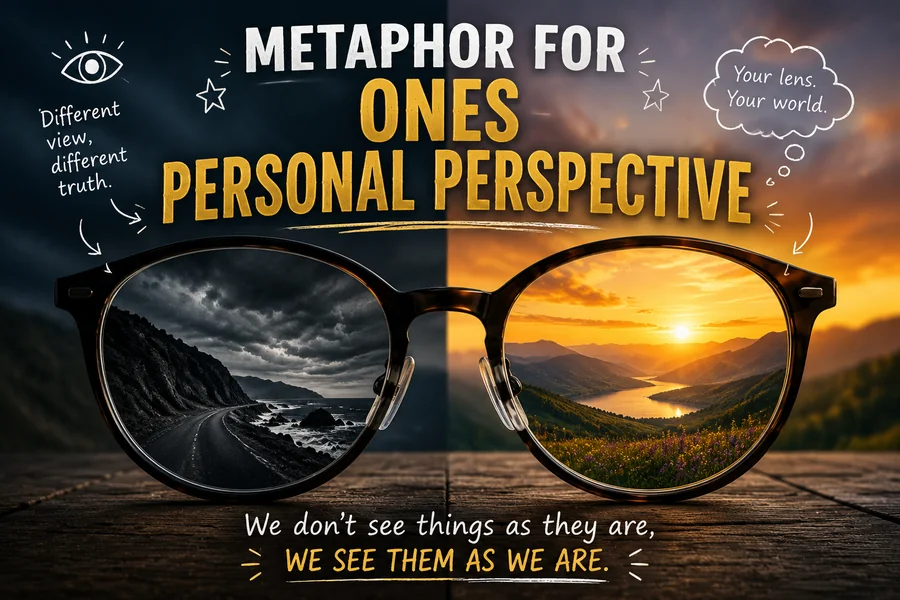
No two people see the world the same way. That is not a guess — it is how the human mind works. Your experiences, your beliefs, the things that shaped you — they all combine into something that colors everything you see. The best way to explain it? A metaphor for ones personal perspective.
Lenses. Maps. Filters. Each one captures something true. This article breaks them down so you can use them — in writing, in conversation, and in real life.
What Exactly Is A Metaphor For Ones Personal Perspective?
Here is a simple way to put it.
A metaphor for ones personal perspective takes something invisible — the way your mind interprets the world — and gives it a shape you can picture. The most common one you will hear is a lens. Your life experiences, your culture, the things you have been through — they all sit in front of your eyes like a lens on a camera. They decide what comes into focus and what gets blurred out.
But a lens is just one option. There are others that fit different situations better. And once you understand them, you start noticing how much your perspective shapes your choices without you realizing it.
See Also: Idioms for Scared Explained
The Metaphors That Actually Work
A Lens This one shows up everywhere — in therapy, in classrooms, in leadership books. And it works because it is accurate. You do not see raw reality. You see reality through everything that has happened to you. Two people can sit in the same room, watch the same argument unfold, and walk away with completely different versions of what happened. Same room. Different lenses.
A Map Your mental picture of the world is not the world. It is a map. And maps have gaps. They go out of date. They leave things off. The philosopher Alfred Korzybski said it plainly: “the map is not the territory.” Your perspective is your map — useful, necessary, but never the full picture.
A Window A window gives you a view. But it also creates a frame. Whatever falls outside that frame? You might never think to look for it. That is what personal perspective does. It opens up a view — and quietly closes off others.
A Filter Think about how a filter works on a photo. It does not change what is in the picture. It changes how everything looks. Your personal perspective does the same thing to experience. It shifts the tone before you even process what happened.
A Compass Where you stand affects which direction feels right. A compass does not give you a universal answer — it gives you a reading based on your position. That is perspective. What looks like the right path depends entirely on where you are coming from.
Fact Table: Metaphors for Personal Perspective at a Glance
| Metaphor | What It Means | When to Use It | What It Misses |
| Lens | Your experiences focus and filter what you see | Explaining bias or worldview | Suggests a fixed focus you might not question |
| Map | Your internal model guides how you move through life | Belief systems, decision-making | Maps can be wrong or out of date |
| Window | Gives you a view but frames and limits it | Bounded awareness, blind spots | You cannot see what falls outside the frame |
| Filter | Shapes the tone of what gets through to you | Selective attention, emotion | Can lock you inside an echo chamber |
| Compass | Points you based on where you currently stand | Values-driven decisions | Can be thrown off by outside pressure |
| Mirror | Shows you what you already believe about yourself | Identity and self-reflection | Only shows one angle |
| Prism | Breaks experience into layers and facets | Complex or creative thinking | Can distort as much as it reveals |
| Tinted Glasses | Colors everything with personal bias | Talking about prejudice | Implies distortion, not just difference |
Why the Metaphor You Pick Actually Matters
This is not just word choice. It changes how you think about change itself.
If you use the lens metaphor, you are saying perspective is something that can shift. Lenses can be swapped. That framing gives people room to grow.
If you use the filter metaphor, the tone is more passive. Things arrive, you sort them. There is less sense of control in that picture.
The map metaphor — popular in psychology and philosophy — carries a specific idea: your worldview guides your behavior, but it might be incomplete. That matters when you are trying to understand why someone does not see what seems obvious to you.
Pick the metaphor that fits what you are actually trying to say. Because the one you choose shapes the whole conversation.
See Also: Idioms for Sadness
Where These Metaphors Show Up in Real Life
They do not get ‘hangry’ and stay on the page. These concepts occur frequently.
The lens and filter metaphors are used during therapy sessions to give individuals insight into how their thinking patterns shape their emotions. A therapist may ask “what lens are you viewing this situation with?
Leaders who know that people have different maps on their chest make less assumptions when they are working with them in leadership. They make more inquiries. They communicate better.
In education, the window metaphor can be used to help students recognize that their experiences affect the way they read a text, and that other people come to a text with different windows.
Conflict involves two people who disagree and typically aren’t fighting over facts. They’re seeing things differently. After naming that, then the argument can transform.
One Last Thing
Choosing a metaphor for ones personal perspective is not just a writing exercise. It is a thinking exercise.
The lens you use to describe how you see the world quietly shapes how much you think that lens can change. And that matters — whether you are trying to understand yourself, communicate with someone different from you, or help someone else grow.
The most self-aware people are not the ones with the clearest view. They are the ones who know their view has limits.
FAQs:
Q: What is a metaphor for ones personal perspective?
A: It is a comparison that turns how someone sees the world into something you can picture — like a lens, a map, or a filter. These metaphors make it easier to talk about how experience and belief shape the way we interpret what happens to us.
Q: What is the best metaphor for perspective?
A: Most people land on the lens. It captures the idea that your past shapes what you see — and it leaves room for the idea that lenses can change, which makes it useful in conversations about growth or bias.
Q: What does “looking through a different lens” mean?
A: It means bringing a different set of experiences or values to the same situation. Two people can look at the same event and reach different conclusions — not because one is wrong, but because they are looking through different lenses.
Q: How is perspective like a map?
A: A map represents a place — it is not the place itself. Your perspective works the same way. It is your internal model of reality, shaped by what you have lived through. And like any map, it can have gaps or outdated information.
Q: Why do metaphors help explain perspective?
A: Because perspective is abstract. You cannot touch it or point to it. A metaphor gives it a shape — something you can hold in your mind. That makes it easier to talk about, teach, and actually examine.
Q: Is personal perspective the same as cognitive bias?
A: They are connected but not the same thing. Your perspective is the broader framework. Cognitive bias refers to specific, repeatable errors in thinking that often come out of that framework.
Q: What is the window metaphor for perspective?
A: It says your perspective gives you a view of the world — but that view has edges. What sits outside the frame, you may never notice. It is a useful metaphor when talking about blind spots or limited awareness.
