
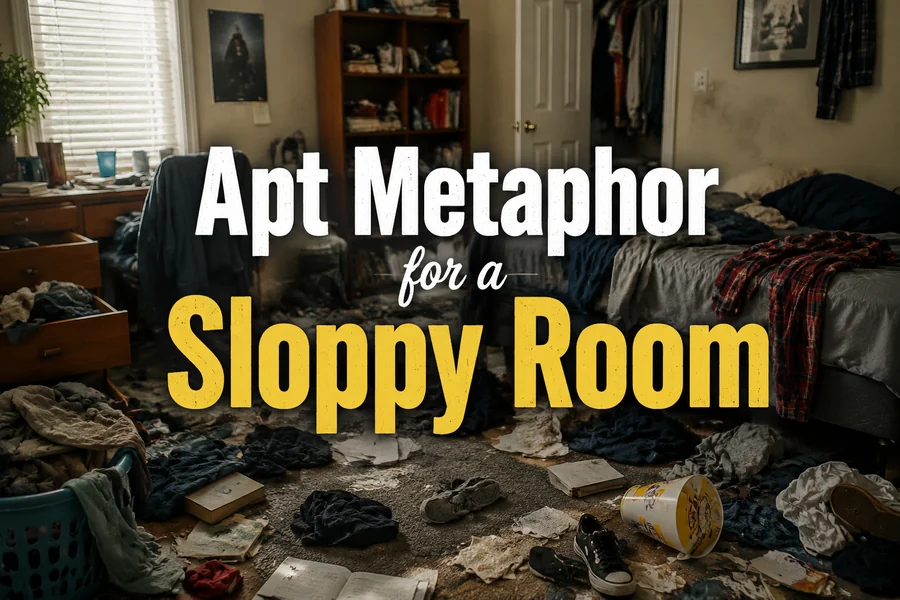
You know the feeling. You walk into a room and stop in your tracks. Clothes on the floor. Cups on the desk. Stuff everywhere with no clear reason for being there. You need an apt metaphor for a sloppy room — something that captures the chaos without sounding like you’re reading from a thesaurus.
This article gives you exactly that. No fluff. Just the comparisons that actually land.
What Is an Apt Metaphor for a Sloppy Room?
A metaphor works when it tells the truth in a way that a plain description can’t. Saying a room is “messy” is forgettable. Saying it “looks like a yard sale after a windstorm” — that sticks.
An apt metaphor for a sloppy room does one specific thing. It makes the reader feel the mess instead of just hearing about it.
Here are some that work.
The Best Apt Metaphors for a Sloppy Room
1. “It looks like a tornado passed through.” This one is everywhere because it earns its place. A tornado doesn’t organize anything. It scatters. That’s exactly what a sloppy room feels like — random displacement with no logic.
2. “The room swallowed itself.” Objects aren’t just misplaced. They’ve disappeared into the room’s own disorder. You can’t find anything. The room absorbed everything.
3. “A yard sale no one cleaned up.” Things are out in the open. They’re visible. But nothing has a home. This metaphor works because it suggests there was once order — and it’s now gone.
4. “It looks like a storage unit exploded.” This is less about elegance and more about volume. Stuff everywhere. No categories. No logic. Just density.
5. “The room forgot what it was for.” This one hits differently. It isn’t angry or dramatic. It’s just sad and accurate. A room that no longer functions the way it was meant to.
6. “Living inside a laundry pile.” Specific. Visual. Easy to picture. You’re not just surrounded by mess — the mess is the environment.
Read More: Is Your Refrigerator Running a Metaphor
Apt Metaphors for a Sloppy Room — At a Glance
| Metaphor | What It Emphasizes | Tone | Best Used In |
| “Tornado passed through” | Speed and random scatter | Casual, familiar | Everyday speech, humor writing |
| “The room swallowed itself” | Depth of disorder | Reflective, literary | Essays, narratives |
| “Yard sale no one cleaned up” | Volume and visibility | Dry, observational | Blog posts, humor |
| “Storage unit exploded” | Density of clutter | Blunt, direct | Social media, informal writing |
| “Room forgot what it was for” | Loss of function | Quiet, thoughtful | Personal essays, storytelling |
| “Living inside a laundry pile” | Total immersion in mess | Relatable, specific | Parenting content, lifestyle writing |
| “Bomb site” | Sudden destruction | Dramatic | Fiction, exaggeration |
| “Museum of poor decisions” | Judgment with humor | Witty, sharp | Comedy writing, self-reflection |
Why the Right Metaphor Matters
When you use a weak description, readers scroll past it. When you use an apt metaphor for a sloppy room, readers slow down. They see the room. They feel it. That’s the whole point.
This matters in writing because:
- It creates a picture faster than three sentences of description
- It tells the reader something about how the speaker sees the world
- It makes ordinary scenes feel worth reading about
A sloppy room isn’t interesting on its own. But “a museum of poor decisions”? That makes a reader think — and smile.
The One Metaphor That Stands Above the Rest
If there’s one apt metaphor for a sloppy room that works across every context, it’s this:
“It looks like someone started unpacking and gave up halfway through.”
Why does this work? It’s so meaningful that it tells a story. There was intention. There was effort. But then came the loss. Better than “messy,” that’s. More specific than “cluttered. It’s right, it’s not rude.
It’s used in fiction, in conversation, in a message to a friend and in a published essay.
Read More: Metaphor Moon
How Writers Use These Metaphors Well
Strong writers don’t drop metaphors randomly. They pick the one that fits the tone of the piece. A dark comedy calls for “a bomb site.” A personal essay calls for “the room forgot what it was for.” A quick social post works with “tornado passed through.”
The skill isn’t collecting metaphors. It’s knowing which one to use and when.
Here’s a quick decision guide:
| Writing Context | Best Metaphor Choice |
| Funny/casual | “Yard sale no one cleaned up” |
| Emotional/personal | “The room forgot what it was for” |
| Fiction/drama | “Bomb site” or “swallowed itself” |
| Relatable everyday | “Tornado passed through” |
| Witty/sharp | “Museum of poor decisions” |
Quick Answers
| Question | Short Answer |
| What is an apt metaphor for a sloppy room? | A “tornado passed through” or “yard sale no one cleaned up” captures the chaos well. |
| How do you describe a messy room creatively? | Use metaphors like “storage unit exploded” or “the room forgot what it was for.” |
| What does a messy room say about a person? | It often signals stress, overload, or avoidance — not laziness, according to psychology research. |
| What is a good simile for a messy room? | “The room looked like a yard sale hit by a windstorm” is direct and visual. |
| Is there a literary metaphor for clutter and disorder? | Yes — “the room swallowed itself” is a strong literary metaphor for deep, unresolved clutter. |
| Why are metaphors useful for describing messy spaces? | They create immediate mental images and help readers feel the environment rather than just picture it. |
Final Thought
Finding an apt metaphor for a sloppy room isn’t about finding the cleverest phrase. It’s about finding the truest one. The metaphor that makes someone read it and say — yes, that’s exactly it.
Start with what the room feels like to be in. Not what it looks like. Feelings make better metaphors than visuals every time.
The room didn’t just get messy. It told a story. Your job is to find the right way to retell it.
Read More: Metaphor in The Landlady
FAQs:
Q: Can I use these metaphors in professional writing?
Yes — some of them. “The room forgot what it was for” and “swallowed itself” work in editorial and essay writing. Avoid “bomb site” in formal contexts.
Q: What’s the difference between a metaphor and a simile here?
A simile says “the room looks like a tornado hit it.” A metaphor says “a tornado hit this room.” Both work. Metaphors tend to feel more direct.
Q: How do I choose the right metaphor for tone?
Match the energy of the metaphor to the energy of your writing. Funny writing needs a metaphor with a punch line built in. Serious writing needs one that carries weight.
Q: Are these metaphors overused?
Some are — “tornado” especially. The fresher ones (“museum of poor decisions,” “the room swallowed itself”) will stand out more in published writing.
Q: Can kids use these metaphors in school essays?
Absolutely. “Living inside a laundry pile” and “a yard sale no one cleaned up” are vivid without being complex.
