
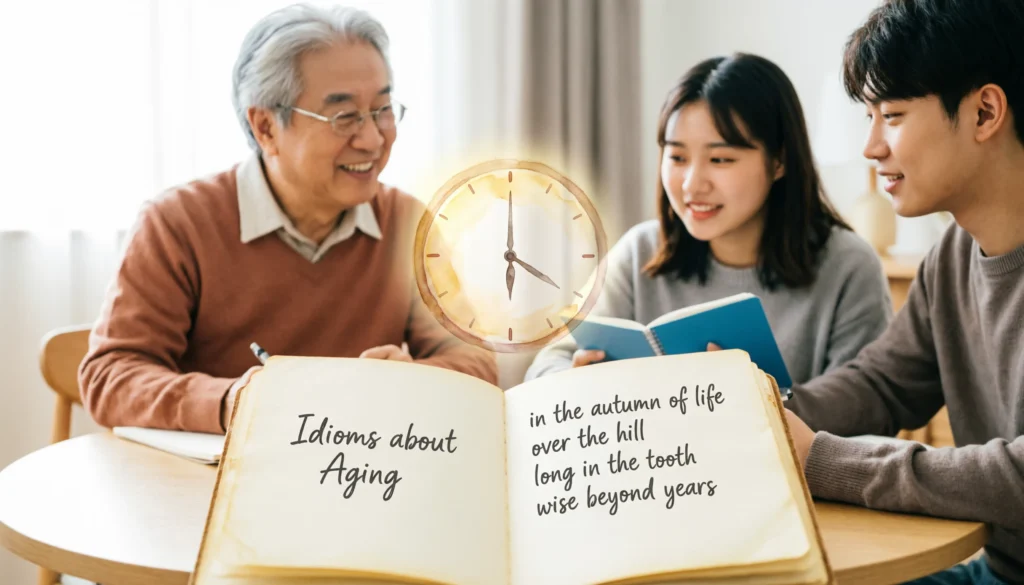
Aging is a natural part of life, and English has many idioms and expressions that describe getting older, gaining wisdom, looking young, or feeling the effects of time. These phrases help students, writers, and ESL learners talk about age in a more colorful and natural way.
Some phrases about aging sound respectful, while others sound funny or informal. A few are not true idioms in the strict grammar sense, but English speakers use them often as expressions about age, time, maturity, and experience. Learning them can make your writing and conversations sound more fluent.
What “Idioms About Aging” Mean
Idioms about aging mean phrases that describe age, growing older, maturity, or the passing of time in a figurative way.
They can help you talk about:
- Getting older in a gentle or polite way
- Looking younger or older than your real age
- Gaining wisdom through life experience
- Feeling tired, weak, or changed by time
- Remembering the past or comparing generations
- Describing someone who stays active despite age
- Adding humor to conversations about growing older
Common, Popular, Funny, Useful, and Everyday Idioms About Aging
These idioms about aging appear in daily speech, books, articles, movies, and casual conversations. Some sound warm and respectful. Others sound humorous, so use them carefully, especially when speaking about older people.
1. Over the hill
Simple meaning: Past the best or most active part of life.
Example sentence: My uncle jokes that he is over the hill, but he still runs five miles every morning.
2. Past your prime
Simple meaning: No longer at your strongest, most successful, or most energetic stage.
Example sentence: The boxer felt he was past his prime, so he decided to retire.
3. Getting on in years
Simple meaning: Becoming old.
Example sentence: My grandmother is getting on in years, but she still has a sharp mind.
4. No spring chicken
Simple meaning: Not young anymore.
Example sentence: I am no spring chicken, so I need more rest after a long trip.
5. Young at heart
Simple meaning: Having a youthful attitude despite being older.
Example sentence: My grandfather is eighty, but he is young at heart and loves trying new hobbies.
6. Age is just a number
Simple meaning: Age does not decide what someone can do or enjoy.
Example sentence: She started university at fifty because she believes age is just a number.
7. Long in the tooth
Simple meaning: Old or older than expected.
Example sentence: That computer is a little long in the tooth, but it still works well.
8. Silver fox
Simple meaning: An attractive older man with gray or silver hair.
Example sentence: Many people call the actor a silver fox because he looks stylish with gray hair.
9. Golden years
Simple meaning: The later years of life, often after retirement.
Example sentence: They moved near the beach to enjoy their golden years.
10. Ripe old age
Simple meaning: A very old age, often used with respect.
Example sentence: She lived to the ripe old age of ninety six.
11. A senior moment
Simple meaning: A short memory mistake, often linked jokingly to aging.
Example sentence: I forgot my keys again and called it a senior moment.
12. Act your age
Simple meaning: Behave in a way that suits your age or maturity level.
Example sentence: His mother told him to act his age when he started arguing like a child.
13. Come of age
Simple meaning: Become mature or legally adult.
Example sentence: The novel shows how the main character comes of age during a difficult time.
14. Wet behind the ears
Simple meaning: Young, inexperienced, or new to something.
Example sentence: The new assistant is still wet behind the ears, but he learns quickly.
15. Old as the hills
Simple meaning: Very old.
Example sentence: That joke is old as the hills, but it still makes people laugh.
Idioms About Aging With Meanings and Examples
This section gives more practical idioms and expressions about age, experience, youth, and time. You can use them in essays, stories, conversations, and classroom writing.
16. An old soul
Simple meaning: A young person who seems mature, wise, or thoughtful.
Example sentence: Even as a child, Maya seemed like an old soul.
17. Mature beyond your years
Simple meaning: Wiser or more responsible than most people your age.
Example sentence: He is mature beyond his years and handles problems calmly.
18. Grow old gracefully
Simple meaning: Accept aging with confidence, dignity, and peace.
Example sentence: She wants to grow old gracefully and stay active without chasing youth.
19. Wear well
Simple meaning: Stay attractive, strong, or impressive over time.
Example sentence: That singer has worn well and still performs beautifully.
20. Show your age
Simple meaning: Start to look old or outdated.
Example sentence: The building is beginning to show its age.
21. Feel your age
Simple meaning: Feel the physical effects of getting older.
Example sentence: After hiking all day, I really started to feel my age.
22. Old enough to know better
Simple meaning: Mature enough to understand that something is wrong.
Example sentence: You are old enough to know better than to lie about your homework.
23. Older and wiser
Simple meaning: More sensible because of age and experience.
Example sentence: After many mistakes, he became older and wiser.
24. Stand the test of time
Simple meaning: Remain useful, popular, or respected for many years.
Example sentence: Her advice has stood the test of time.
25. The sands of time
Simple meaning: The passing of time, often in a poetic way.
Example sentence: The sands of time changed the village, but its old traditions remained.
26. Time catches up with everyone
Simple meaning: Everyone grows older eventually.
Example sentence: He was a great athlete, but time catches up with everyone.
27. Put years on someone
Simple meaning: Make someone look or feel older because of stress or hardship.
Example sentence: The difficult job put years on him.
28. Not getting any younger
Simple meaning: Aging, often used when someone wants to act soon.
Example sentence: I am not getting any younger, so I want to travel while I can.
29. In your twilight years
Simple meaning: In the later years of life.
Example sentence: He spent his twilight years writing letters and reading books.
30. The bloom is off the rose
Simple meaning: Something has lost its freshness, beauty, or early excitement.
Example sentence: After many years in the same job, the bloom was off the rose.
How to Use Idioms About Aging in Sentences
Idioms about aging work best when the tone matches the situation. Some phrases sound polite, while others can sound rude if you use them carelessly.
For respectful writing, use phrases like golden years, grow old gracefully, older and wiser, and young at heart. These sound warm and positive.
For humorous conversations, phrases like no spring chicken, senior moment, and over the hill can work, but only when the person would enjoy the joke.
For academic or serious writing, avoid slangy phrases and choose clearer expressions such as come of age, mature beyond your years, stand the test of time, and the passing of time.
Idioms About Aging for Writing and Speaking
Writers use aging idioms to show character, time, mood, and personal growth. These expressions can make a sentence more vivid without adding too much explanation.
A character who is young at heart may act cheerful and curious even in old age. A person who is mature beyond their years may seem wise because of responsibility or hardship. A place that shows its age may look worn, faded, or historic.
In speaking, idioms about aging help you sound natural. Instead of saying someone is old, you can say they are getting on in years. Instead of saying a person still enjoys life, you can say they are young at heart.
Idioms About Aging for Students and ESL Learners
Students and ESL learners should learn both the meaning and tone of each phrase. Some aging idioms are safe in most contexts, while others need care.
Good phrases for school writing include:
- come of age
- older and wiser
- stand the test of time
- mature beyond your years
- grow old gracefully
Phrases to use carefully include:
- over the hill
- long in the tooth
- no spring chicken
- senior moment
- past your prime
These can sound funny between friends, but they may sound disrespectful in formal writing or when speaking about someone older.
Idioms About Aging in Conversations
Here are natural ways to use idioms about aging in everyday conversations.
Friend: Your dad still plays cricket every weekend?
You: Yes, he is young at heart.
Student: Why does this story feel so powerful?
Teacher: Because its message has stood the test of time.
Brother: I forgot where I put my phone again.
Sister: Another senior moment?
Writer: How should I describe an older but active character?
Editor: You can say she is getting on in years but still full of energy.
Friend: Are you going to start learning guitar now?
You: Yes. Age is just a number.
Similar Phrases and Expressions
Some phrases about aging are not always idioms, but they still help you talk about time, maturity, and age naturally.
Growing older
Simple meaning: Becoming older over time.
Example sentence: Growing older taught him patience.
Aging gracefully
Simple meaning: Accepting age with confidence and dignity.
Example sentence: She believes in aging gracefully rather than hiding every sign of age.
Life experience
Simple meaning: Knowledge gained through real events and challenges.
Example sentence: His life experience helped him guide younger workers.
The passing years
Simple meaning: Time as it moves forward.
Example sentence: The passing years made their friendship stronger.
A lifetime of wisdom
Simple meaning: Deep knowledge gained over many years.
Example sentence: Her advice came from a lifetime of wisdom.
In later life
Simple meaning: During older age.
Example sentence: He became more peaceful in later life.
From youth to old age
Simple meaning: Across the whole journey of life.
Example sentence: The poem follows a woman from youth to old age.
Common Mistakes
Many learners understand the meaning of aging idioms but use them in the wrong tone. The biggest mistake is using a joking phrase in a serious or respectful situation.
Do not call someone over the hill unless you know they will find it funny. Do not use senior moment in formal writing because it can sound casual or insensitive. Avoid saying someone is past their prime unless you mean their best period has clearly ended.
Another mistake is translating idioms word for word into another language. Idioms often lose meaning when translated directly. Learn them as full phrases, then practice them in natural sentences.
Also, do not confuse come of age with becoming elderly. It means becoming mature or legally adult, not becoming old.
Conclusion
Idioms about aging help English speakers talk about age, maturity, wisdom, memory, and the passing of time in a more expressive way. Some phrases, such as young at heart and golden years, sound positive and respectful. Others, such as over the hill or no spring chicken, can sound funny but need careful use. Students, writers, and ESL learners should focus on meaning, tone, and context before using these expressions. When used well, these idioms can make conversations warmer, essays stronger, and stories more natural.
FAQs
What are idioms about aging?
Idioms about aging are phrases that describe growing older, maturity, youth, wisdom, or the effects of time in a figurative way. Examples include young at heart, over the hill, and getting on in years.
Is age is just a number an idiom?
Yes, many people treat age is just a number as an idiomatic expression. It means age should not limit what someone can do, enjoy, or try.
What is a polite idiom for an old person?
Getting on in years is a polite and gentle phrase. In their golden years also sounds respectful, especially when talking about retirement or later life.
What does young at heart mean?
Young at heart means someone has a lively, cheerful, or youthful attitude even though they are older.
Is over the hill rude?
It can sound rude if used seriously or toward someone who does not like jokes about age. It works better in playful conversations with close friends or family.
What does come of age mean?
Come of age means to become mature or legally adult. It does not mean becoming elderly.
Which aging idioms are best for students?
Good choices for students include come of age, older and wiser, stand the test of time, young at heart, and mature beyond your years.

Luna Grace is a contemporary author whose writing blends emotional depth with powerful metaphors.
Her work explores healing, self-discovery, and the quiet courage found in personal growth.
With a reflective and poetic style, she turns lived experiences into meaningful insights.
At MetaphorForge, Luna Grace represents writing that resonates, comforts, and inspires transformation.