
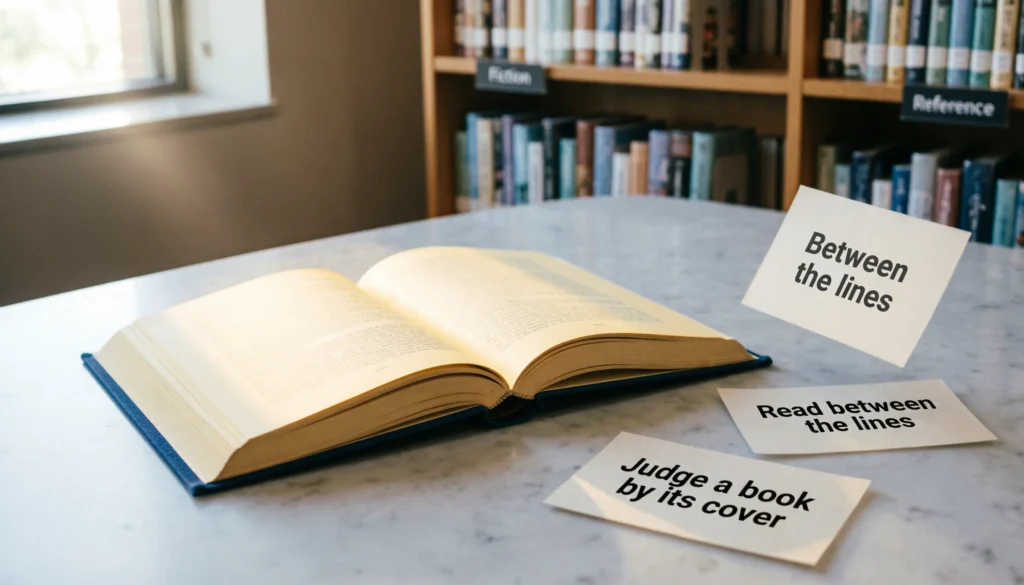
Books do more than hold stories, facts, and lessons. In English, they also shape many common expressions. Idioms about books help people talk about learning, judging, secrets, honesty, experience, and knowledge in a colorful way.
Students, writers, and ESL learners can use these phrases to sound more natural in essays, conversations, stories, and everyday speech. Some book idioms come from reading habits, while others use books as symbols for truth, wisdom, or hidden meaning. Learning them makes your English richer and easier to understand.
What “Idioms About Books” Mean
Idioms about books are expressions that use book-related words to explain ideas beyond literal reading.
They can describe a person, a situation, a secret, or a lesson in a short and memorable way.
Many book idioms connect to learning, knowledge, judgment, rules, and experience.
Writers use them to make sentences more vivid without adding long explanations.
ESL learners can use them to understand natural English in speech, films, stories, and articles.
Some phrases sound formal, while others fit casual conversation.
A few expressions about books work more like metaphors or common sayings, but they still help with the same topic.
Common, Popular, Funny, Useful, and Everyday Idioms About Books
Book idioms appear often because books connect strongly with knowledge and judgment. People say someone is an open book when that person shows feelings clearly. They say never judge a book by its cover when appearances may mislead us.
These expressions work well in school writing, friendly conversation, workplace English, and creative writing. Some sound serious, while others feel light or funny. The key is to choose the phrase that matches your tone.
Idioms About Books With Meanings and Examples
An open book
Simple meaning: A person who shows feelings, thoughts, or intentions clearly.
Example sentence: Maria is an open book, so everyone knows when she feels excited or nervous.
A closed book
Simple meaning: A subject or person that feels hard to understand.
Example sentence: Advanced grammar felt like a closed book to me until my teacher explained it simply.
Never judge a book by its cover
Simple meaning: Do not judge someone or something only by appearance.
Example sentence: The old shop looked plain, but it had amazing food, so never judge a book by its cover.
By the book
Simple meaning: To follow rules exactly.
Example sentence: The manager does everything by the book to avoid mistakes.
Throw the book at someone
Simple meaning: To punish someone as strongly as possible under the rules.
Example sentence: The school may throw the book at students who cheat in exams.
Take a leaf out of someone’s book
Simple meaning: To copy someone’s good example.
Example sentence: You should take a leaf out of Sara’s book and start revising early.
In my book
Simple meaning: In my opinion.
Example sentence: In my book, kindness matters more than popularity.
Cook the books
Simple meaning: To change financial records dishonestly.
Example sentence: The company got into trouble because someone tried to cook the books.
Balance the books
Simple meaning: To make financial records correct or equal.
Example sentence: The small business owner stayed late to balance the books.
Read someone like a book
Simple meaning: To understand someone’s feelings or thoughts easily.
Example sentence: My mother can read me like a book whenever I hide bad news.
One for the books
Simple meaning: Something unusual, impressive, or memorable.
Example sentence: That last-minute goal was one for the books.
Hit the books
Simple meaning: To study seriously.
Example sentence: I need to hit the books tonight because my test starts tomorrow morning.
Book smart
Simple meaning: Good at academic knowledge but not always practical matters.
Example sentence: He is book smart, but he still needs real work experience.
Bring someone to book
Simple meaning: To make someone answer for wrongdoing.
Example sentence: The committee wanted to bring the dishonest officer to book.
Close the book on something
Simple meaning: To end an issue, period, or discussion.
Example sentence: After the apology, they decided to close the book on the argument.
The oldest trick in the book
Simple meaning: A very common and well-known trick.
Example sentence: Pretending the homework disappeared is the oldest trick in the book.
Every trick in the book
Simple meaning: Every possible method or strategy.
Example sentence: The coach used every trick in the book to motivate the team.
On the books
Simple meaning: Officially recorded or registered.
Example sentence: The new policy is now on the books.
Off the books
Simple meaning: Not officially recorded.
Example sentence: The worker accepted an off the books payment, which caused legal problems.
A bookworm
Simple meaning: A person who loves reading.
Example sentence: My sister is a bookworm who finishes two novels every week.
How to Use Idioms About Books in Sentences
Use book idioms when they add meaning naturally. A phrase like hit the books fits study topics, while by the book fits rules, law, school policy, or workplace behavior.
Avoid placing too many idioms in one paragraph. One clear idiom often works better than several phrases together. For example, I need to hit the books sounds natural. But I need to hit the books, close the book, and take a leaf out of his book sounds crowded.
Idioms About Books for Writing and Speaking
Book idioms can make writing more expressive. In essays, phrases like never judge a book by its cover can introduce ideas about appearance and reality, In stories, read someone like a book can show emotional understanding without long description.
In speaking, these idioms help you sound fluent. You can say in my book to share an opinion gently. You can say one for the books when something surprising happens. These phrases work best when the situation clearly matches the meaning.
Idioms About Books for Students and ESL Learners
Students often meet book idioms in classrooms, novels, exams, and conversation practice. Start with the most useful ones first: hit the books, by the book, bookworm, open book, and never judge a book by its cover.
ESL learners should remember that idioms do not always mean what the words say directly. Cook the books does not mean cooking with books. It means changing financial records dishonestly. Learning the full phrase with an example sentence helps you use it correctly.
Idioms About Books in Conversations
Book idioms sound natural in everyday English when people discuss study, rules, people, and experiences.
First Friend : I have a math exam tomorrow.
Second Friend : Then you should hit the books tonight.
First Friend : Our new teacher seems very strict.
Second Friend : Maybe, but never judge a book by its cover.
First Friend : Do you think Ali is hiding something?
Second Friend : No, I can read him like a book.
First Friend : That match was unbelievable.
Second Friend : Yes, that was one for the books.
Similar Phrases and Expressions
Some expressions relate closely to idioms about books, even when they do not always count as strict idioms.
Knowledge is power
Simple meaning: Learning gives people strength and better choices.
Example sentence: Our teacher always says knowledge is power before exams.
Read between the lines
Simple meaning: Understand the hidden meaning.
Example sentence: You need to read between the lines to understand her message.
Turn the page
Simple meaning: Move on from the past.
Example sentence: After a hard year, he decided to turn the page and start again.
Start a new chapter
Simple meaning: Begin a new part of life.
Example sentence: Moving to another city helped her start a new chapter.
Written all over someone’s face
Simple meaning: Easy to see from someone’s expression.
Example sentence: His disappointment was written all over his face.
Learn the hard way
Simple meaning: Learn through mistakes or difficulty.
Example sentence: I learned the hard way that waiting until the last day causes stress.
Common Mistakes
Many learners use book idioms too literally. For example, cook the books has nothing to do with food. It refers to dishonest accounting.
Another mistake comes from using the wrong idiom for the situation. Hit the books means study, not physically hit a book. Throw the book at someone means punish strongly, not throw an actual book.
Some writers also repeat the same idiom too often. Use each phrase only where it improves the sentence. Clear meaning matters more than showing many idioms.
Conclusion
Idioms about books make English more expressive, practical, and memorable. They help students talk about study, writers describe people and situations, and ESL learners understand natural speech more easily. Phrases like hit the books, by the book, an open book, and never judge a book by its cover appear often in daily English. Learn each idiom with its meaning and a natural example sentence, not as a single isolated phrase. When you use these expressions carefully, your writing sounds clearer and your speaking feels more confident, fluent, and human.
FAQs
What are idioms about books?
Idioms about books are expressions that use book-related words to describe ideas such as learning, rules, judgment, honesty, and understanding.
What is the most common book idiom?
Never judge a book by its cover is one of the most common book idioms. It means you should not judge people or things only by appearance.
What does hit the books mean?
Hit the books means to study seriously. Students often use this phrase before exams, tests, or important school assignments.
Is bookworm a positive word?
Bookworm usually has a positive meaning. It describes someone who loves reading, although the tone depends on how someone says it.
What does by the book mean?
By the book means following rules exactly. People use it for school rules, workplace policies, law, and formal procedures.
Are book idioms useful for ESL learners?
Yes, book idioms help ESL learners understand natural English in conversations, articles, movies, and classroom discussions.
Can I use idioms about books in essays?
Yes, you can use them in essays when they fit the topic. Choose clear and widely understood idioms, and avoid overusing them.

Noah Cole is a contemporary writer known for crafting metaphors that bridge emotion and everyday experience. His work focuses on human resilience, inner conflict, and quiet transformation through vivid imagery. With a minimalist yet powerful style, he turns simple moments into lasting insights. At MetaphorForge, Noah Cole’s voice reflects clarity, depth, and meaning-driven storytelling.