
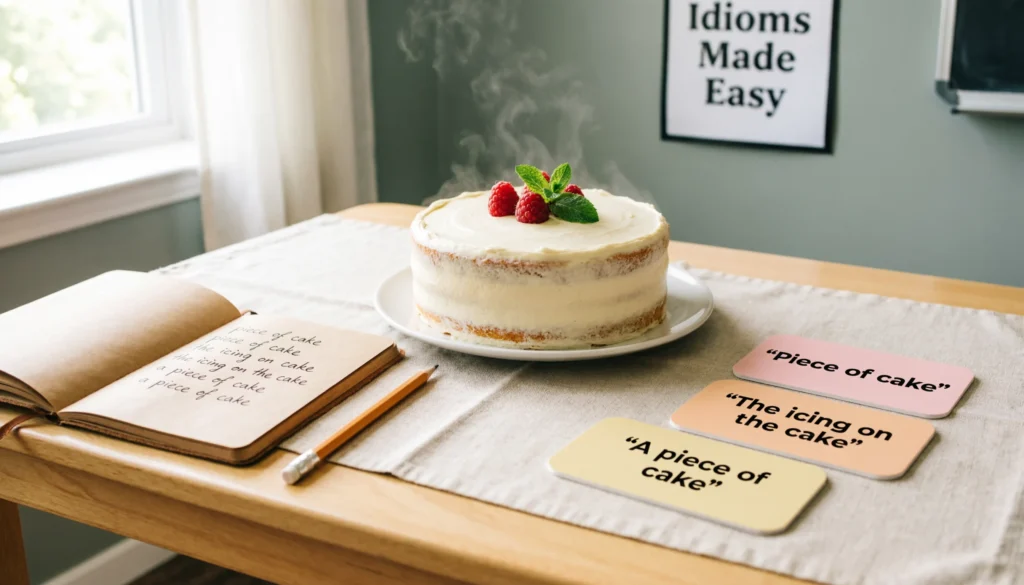
Introduction
Idioms about cake make English more colorful, friendly, and easy to remember. Cake often suggests sweetness, reward, celebration, ease, or desire, so many cake expressions describe success, comfort, greed, or simple pleasure. Students, writers, and ESL learners can use these phrases to make speech and writing sound more natural.
Some phrases are true idioms, while others work as common expressions or figurative sayings. In daily English, people use cake-related phrases in school, work, stories, conversations, and informal writing. Learning their meanings helps you understand tone, humor, and hidden meaning more clearly.
What “Idioms About Cake” Mean
Idioms about cake mean expressions that use cake as an image to explain an idea.
Idioms about cake are expressions that use cake as a symbol for simple ideas, emotions, or situations.
These phrases often describe something easy, enjoyable, rewarding, or sweet.
In many cases, cake idioms do not talk about real cake at all.
Writers use them to make sentences more colorful, natural, and memorable.
Students can learn these idioms to understand everyday English more clearly.
Some cake expressions show success, while others point to greed, comfort, or extra benefits.
A good cake idiom helps explain a thought quickly without using a long explanation.
Common, Popular, Funny, Useful, and Everyday Idioms About Cake
Piece of cake
Simple meaning: Something very easy.
Example sentence: The spelling test was a piece of cake because I studied all week.
Take the cake
Simple meaning: To be the most extreme, surprising, or impressive example.
Example sentence: Many people made mistakes, but his answer really took the cake.
Icing on the cake
Simple meaning: An extra good thing added to something already good.
Example sentence: Winning the match felt great, and the medal was the icing on the cake.
Have your cake and eat it too
Simple meaning: To want two good things at the same time when you cannot fairly have both.
Example sentence: You cannot skip practice and still expect to win because you cannot have your cake and eat it too.
Sell like hot cakes
Simple meaning: To sell very quickly.
Example sentence: The new notebooks sold like hot cakes on the first day of school.
A slice of the cake
Simple meaning: A share of something valuable, such as money, success, or opportunity.
Example sentence: Every team member wanted a slice of the cake after the project became popular.
Cakes and ale
Simple meaning: Fun, pleasure, and enjoyment in life.
Example sentence: Life is not all cakes and ale, so we must learn patience too.
Cakewalk
Simple meaning: A very easy task or victory.
Example sentence: The final round was a cakewalk for the experienced player.
Idioms About Cake With Meanings and Examples
As easy as cake
Simple meaning: Very easy to do.
Example sentence: Once I understood the formula, the homework felt as easy as cake.
The cherry on the cake
Simple meaning: A small final detail that makes something better.
Example sentence: The bright cover design became the cherry on the cake for her project.
Cake face
Simple meaning: A funny informal phrase for too much makeup on the face.
Example sentence: She laughed at the old photo and said her makeup looked like cake face.
Cake money
Simple meaning: Extra money used for treats, pleasure, or small comforts.
Example sentence: He saved a little cake money for snacks after school.
Eat cake
Simple meaning: To enjoy comfort while others may not have the same chance.
Example sentence: The story used eat cake to show how far the ruler lived from ordinary people.
Like a birthday cake in a rainstorm
Simple meaning: Something joyful that gets spoiled quickly.
Example sentence: His picnic plan collapsed like a birthday cake in a rainstorm.
Frosted with kindness
Simple meaning: Covered or filled with sweetness and care.
Example sentence: Her note felt frosted with kindness and made everyone smile.
Sweet as cake
Simple meaning: Very kind, pleasant, or lovable.
Example sentence: The new student was sweet as cake and made friends quickly.
Crumble like cake
Simple meaning: To fall apart under pressure.
Example sentence: His confidence began to crumble like cake when the questions became harder.
Cut the cake fairly
Simple meaning: To divide something in a fair way.
Example sentence: The teacher asked the group to cut the cake fairly and share the work equally.
A cake of success
Simple meaning: A reward or achievement built through effort.
Example sentence: Hard work, patience, and focus formed his cake of success.
Too much cake
Simple meaning: Too much comfort, praise, or pleasure.
Example sentence: Too much cake can make a person lazy if they stop trying.
How to Use Idioms About Cake in Sentences
Use cake idioms when you want a simple image that readers can understand quickly. These expressions work best in informal essays, classroom writing, stories, conversations, captions, and friendly explanations.
For easy tasks, use piece of cake or cakewalk, For extra rewards, use icing on the cake, For unfair desire, use have your cake and eat it too, For fast sales, use sell like hot cakes.
Natural sentence examples
The quiz was a piece of cake after two days of practice.
Her kind words were the icing on the cake after a hard week.
The tickets sold like hot cakes because the singer was famous.
He wants free time and top grades, but he cannot have his cake and eat it too.
The debate was a cakewalk for the student who had prepared well.
Idioms About Cake for Writing and Speaking
Cake idioms help writers add warmth and personality to a sentence. They also help speakers sound more natural because many English speakers use these phrases in everyday life.
In writing, choose the idiom that matches your tone. A school essay can use piece of cake in a simple example, but formal writing may need a clearer phrase like very easy. In stories, cake expressions can show humor, greed, comfort, or celebration without long explanation.
Good uses in writing
1-Use icing on the cake when a character receives an extra reward.
2-Use take the cake when something feels shocking or extreme.
3-Use sell like hot cakes when a product becomes popular quickly.
4-Use a slice of the cake when people want a share of success.
Idioms About Cake for Students and ESL Learners
Students and ESL learners should first learn the most common cake idioms because they appear often in conversations, books, and online content. Start with piece of cake, icing on the cake, take the cake, sell like hot cakes, and have your cake and eat it too.
Do not translate these phrases word for word. The meaning usually comes from the whole expression, not from each separate word. Practice them in short sentences so you can remember the situation where each phrase fits.
Easy learning table
| Phrase | Best use | Simple meaning |
|---|---|---|
| Piece of cake | School, work, tasks | Very easy |
| Icing on the cake | Rewards, success | Extra good thing |
| Take the cake | Surprise, criticism | Most extreme example |
| Sell like hot cakes | Business, products | Sell quickly |
| Have your cake and eat it too | Advice, choices | Want two impossible benefits |
| Cakewalk | Competitions, tests | Easy win or task |
Idioms About Cake in Conversations
Cake idioms sound natural in friendly conversation because they feel light and easy. People use them when talking about exams, jobs, shopping, sports, parties, and everyday plans.
Conversation examples
A: How was your math test?
B: It was a piece of cake.
A: Did your online store do well?
B: Yes, the new mugs sold like hot cakes.
A: You got the job and a bonus?
B: Yes, the bonus was the icing on the cake.
A: He wants more pay but fewer hours.
B: He wants to have his cake and eat it too.
A: That final game looked easy for your team.
B: It was almost a cakewalk.
Similar Phrases and Expressions
Many food expressions work like idioms about cake because they use taste, sweetness, or eating to explain life.
Easy as pie
Simple meaning: Very easy.
Example sentence: The puzzle looked hard, but it was easy as pie.
Bread and butter
Simple meaning: Main source of income or basic skill.
Example sentence: Teaching grammar is her bread and butter.
Bring home the bacon
Simple meaning: To earn money for a family.
Example sentence: He works hard to bring home the bacon.
Sweet deal
Simple meaning: A very good offer.
Example sentence: The student discount was a sweet deal.
Sugarcoat something
Simple meaning: To make bad news sound less serious.
Example sentence: Do not sugarcoat the mistake; explain it clearly.
Cream of the crop
Simple meaning: The best person or thing in a group.
Example sentence: The scholarship went to the cream of the crop.
Full plate
Simple meaning: A lot of responsibilities.
Example sentence: She has a full plate with school, work, and exams.
Common Mistakes
Many learners use cake idioms in the wrong situation. The phrase may sound strange if the tone does not match the meaning.
Using cake idioms too literally
Do not use piece of cake when you mean an actual slice of cake. It means something easy.
Wrong: I ate a piece of cake in my English exam.
Better: The English exam was a piece of cake.
Using formal idioms in casual ways
Cakes and ale sounds old-fashioned. Use it in literature, essays, or poetic writing, not casual chat.
Wrong: My phone charger is cakes and ale.
Better: The picnic scene shows cakes and ale after a difficult journey.
Confusing icing and cherry
Icing on the cake means an extra benefit. Cherry on the cake also means a final nice touch, but many speakers more often say cherry on top.
Wrong: The whole project was icing on the cake.
Better: The project succeeded, and the award was the icing on the cake.
Overusing idioms in one paragraph
Too many idioms can make writing sound forced. Use one strong phrase, then explain your point clearly.
Wrong: The test was a piece of cake, a cakewalk, and the icing on the cake.
Better: The test was a piece of cake because the questions matched our practice work.
Using have your cake and eat it too without conflict
This idiom needs a situation where someone wants two benefits that do not fit together.
Wrong: I studied and passed, so I had my cake and ate it too.
Better: He wants top grades without studying, but he cannot have his cake and eat it too.
Conclusion
Idioms about cake make English sweeter, clearer, and more expressive. They help students describe easy tasks, extra rewards, fast success, unfair wishes, and funny situations in a natural way. The most useful phrases include piece of cake, icing on the cake, take the cake, sell like hot cakes, and have your cake and eat it too. Writers can also use cake expressions to add humor, warmth, and personality to stories or essays. For best results, learn the meaning, use each phrase in the right context, and avoid filling every sentence with idioms.
FAQs
What are idioms about cake?
Idioms about cake are expressions that use cake to explain ideas such as ease, reward, pleasure, greed, or success. They usually do not refer to real cake.
What is the most common cake idiom?
Piece of cake is one of the most common cake idioms. It means something is very easy to do.
What does icing on the cake mean?
Icing on the cake means an extra good thing added to something already good. For example, a prize after a win can feel like the icing on the cake.
Is sell like hot cakes an idiom?
Yes, sell like hot cakes is a common idiom. It means something sells very quickly because many people want it.
What does have your cake and eat it too mean?
It means someone wants two good things at the same time, even though the situation does not allow both.
Can students use cake idioms in essays?
Yes, students can use cake idioms in informal essays, stories, examples, and creative writing. In formal essays, they should use idioms carefully and explain the idea clearly.
Are all cake phrases idioms?
No. Some are idioms, while others are figurative expressions, slang phrases, or creative comparisons. They still help writers and learners understand natural English.

Ryan Chase is a skilled writer at MetaphorForge, recognized for his powerful and meaningful metaphors. He explores themes of personal growth, emotions, and everyday life with clarity and depth. His writing turns complex feelings into simple, relatable expressions. Through his work, readers gain fresh perspectives on their own experiences.