
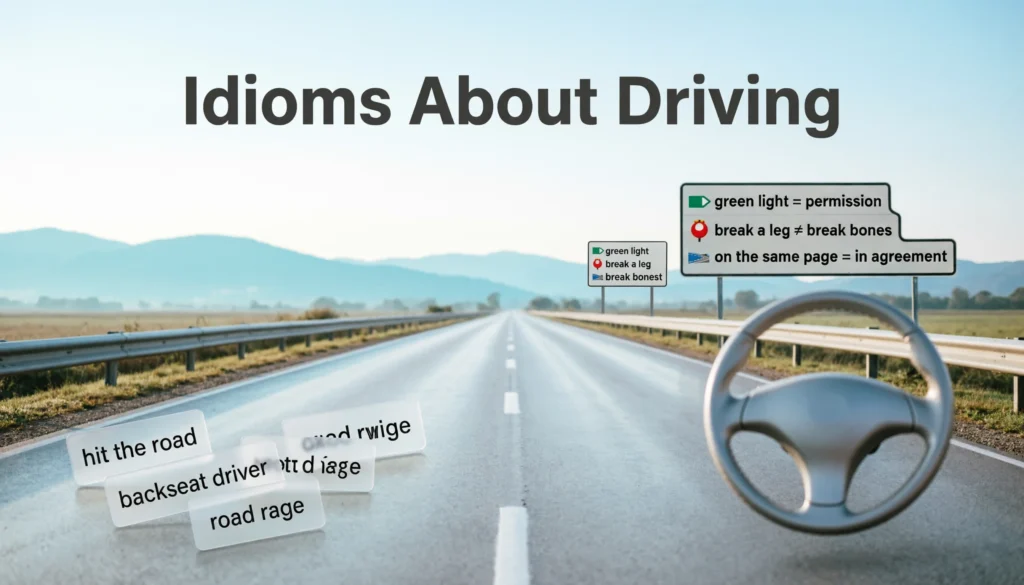
Idioms about driving use cars, roads, speed, direction, and control to describe real life situations. People use these expressions when they talk about progress, pressure, leadership, mistakes, choices, and personal goals.
These idioms help students, writers, and ESL learners make English sound more natural. You can use them in stories, essays, conversations, workplace writing, and daily speech. Many driving idioms do not describe actual driving. They often describe how someone handles life, work, problems, or decisions.
What “Idioms About Driving” Means
Idioms about driving means expressions that use driving related words to explain non literal ideas.
Common meanings include:
• Taking control of a situation
• Moving forward in life or work
• Going too fast or too slow
• Changing plans or direction
• Making a mistake
• Facing pressure or danger
• Losing control of emotions or decisions
• Leading a team, project, or conversation
• Starting a new journey or goal
These idioms often use words like road, wheel, brake, gear, lane, speed, traffic, and driver.
Common, Popular, Funny, Useful, and Everyday Idioms About Driving
Driving idioms appear often because driving feels familiar to many people. Roads can represent life paths. Speed can show progress. Brakes can show caution. The wheel can show control. That makes these expressions easy to understand once you know their real meaning.
Some idioms sound serious, such as in the driver’s seat. Others sound casual or funny, such as backseat driver. Writers also use these phrases to make sentences more visual and lively.
Idioms About Driving With Meanings and Examples
In the driver’s seat
Simple meaning: In control of a situation.
Example sentence: After the manager left, Sara was in the driver’s seat and made the final decision.
Backseat driver
Simple meaning: A person who gives unwanted advice while someone else is doing the task.
Example sentence: My brother became a backseat driver during the group project and criticized every small choice.
Drive someone crazy
Simple meaning: To annoy or irritate someone a lot.
Example sentence: The loud construction noise outside my room drives me crazy when I study.
Drive a hard bargain
Simple meaning: To negotiate firmly and try to get the best deal.
Example sentence: The buyer drove a hard bargain and got the car for a lower price.
Take the wheel
Simple meaning: To take control or responsibility.
Example sentence: When the team lost direction, Amina took the wheel and organized the whole plan.
Spin your wheels
Simple meaning: To work hard but make no real progress.
Example sentence: I studied without a plan for two hours and felt like I was just spinning my wheels.
Hit the road
Simple meaning: To leave or start a journey.
Example sentence: We packed our bags early and hit the road before sunrise.
Road to success
Simple meaning: The path or process that leads to achievement.
Example sentence: Discipline and patience helped him stay on the road to success.
At a crossroads
Simple meaning: At a point where you must make an important decision.
Example sentence: She felt at a crossroads after graduation and had to choose between work and further study.
Put the brakes on
Simple meaning: To slow down or stop something.
Example sentence: The company put the brakes on the project after costs became too high.
Shift gears
Simple meaning: To change focus, method, or direction.
Example sentence: After discussing grammar, the teacher shifted gears and moved to speaking practice.
Full speed ahead
Simple meaning: To continue quickly and confidently.
Example sentence: Once the funding arrived, the team moved full speed ahead with the new app.
Go off track
Simple meaning: To lose focus or move away from the main point.
Example sentence: The discussion went off track when everyone started talking about personal stories.
Stay in your lane
Simple meaning: To focus on your own role or area.
Example sentence: During the debate, the coach told each speaker to stay in their lane and answer only their topic.
Drive home a point
Simple meaning: To make an idea very clear.
Example sentence: The teacher used real examples to drive home the point about active voice.
A bumpy road
Simple meaning: A difficult process with many problems.
Example sentence: Starting a small business can be a bumpy road, but careful planning helps.
On the right track
Simple meaning: Doing something correctly or making good progress.
Example sentence: Your essay needs a stronger conclusion, but you are on the right track.
Running on empty
Simple meaning: Continuing with very little energy, money, or motivation.
Example sentence: After three exams in one week, I was running on empty.
Crash and burn
Simple meaning: To fail badly.
Example sentence: His presentation crashed and burned because he did not prepare.
Step on the gas
Simple meaning: To work faster or increase effort.
Example sentence: We need to step on the gas if we want to finish the assignment tonight.
Slam on the brakes
Simple meaning: To stop suddenly.
Example sentence: The school slammed on the brakes when parents complained about the new rule.
Take a detour
Simple meaning: To choose a different path or method.
Example sentence: I took a detour in my career and studied design before joining marketing.
Roadblock
Simple meaning: A problem that stops progress.
Example sentence: Lack of research became a roadblock in her final paper.
Smooth ride
Simple meaning: An easy experience with few problems.
Example sentence: The new software made the registration process a smooth ride.
In the fast lane
Simple meaning: Living or working in a fast, busy, or ambitious way.
Example sentence: Young entrepreneurs often live in the fast lane and forget to rest.
Pump the brakes
Simple meaning: To slow down, wait, or think carefully.
Example sentence: Before you quit your job, pump the brakes and make a proper plan.
Get back on the road
Simple meaning: To continue after a delay or problem.
Example sentence: After a short break, the team got back on the road and completed the report.
Hit a speed bump
Simple meaning: To face a small problem or delay.
Example sentence: Our project hit a speed bump when the internet stopped working.
Change lanes
Simple meaning: To change direction, role, or strategy.
Example sentence: He changed lanes from engineering to content writing after discovering his interest in language.
No turning back
Simple meaning: A point where you must continue because returning is not practical.
Example sentence: Once she submitted the application, there was no turning back.
How to Use Idioms About Driving in Sentences
Use idioms about driving when you want to describe control, progress, delay, effort, or change in a clear and visual way. These expressions work well in daily English because many people understand the basic idea of roads, speed, and direction.
Do not use too many idioms in one paragraph. One strong idiom can make a sentence more natural. Too many idioms can make writing look forced.
Examples:
• I need to shift gears and focus on exam preparation.
• We hit a speed bump, but the plan still looks strong.
• She is in the driver’s seat now, so everyone follows her lead.
• The teacher drove home the point with a simple example.
• After months of confusion, I finally feel on the right track.
Idioms About Driving for Writing and Speaking
Writers can use driving idioms to show movement, conflict, pressure, or personal growth. These idioms work well in essays, stories, speeches, and blog posts because they create quick images in the reader’s mind.
In speaking, driving idioms help you sound more fluent. Instead of saying the project has a small problem, you can say the project hit a speed bump. Instead of saying someone controls the situation, you can say that person is in the driver’s seat.
Good writing uses these idioms naturally. Choose the phrase that fits the situation, tone, and audience.
Idioms About Driving for Students and ESL Learners
Students and ESL learners should first learn the meaning, then practice each idiom in a simple sentence. Many driving idioms look easy, but their real meaning can differ from the literal words.
For example, backseat driver does not only mean a person sitting in the back seat of a car. It means someone who gives unwanted advice. Running on empty does not only mean a car has no fuel. It means someone feels exhausted or has very few resources left.
A useful learning method:
• Read the idiom
• Learn the simple meaning
• Say one example aloud
• Write your own sentence
• Use it in a short conversation
Idioms About Driving in Conversations
Driving idioms sound natural in everyday conversations, especially when people talk about school, work, plans, relationships, and goals.
Example conversation 1:
Person A: How is your exam preparation going?
Person B: I was spinning my wheels at first, but now I am on the right track.
Example conversation 2:
Person A: Are you still working on the website project?
Person B: Yes, but we hit a speed bump with the design. We will fix it soon.
Example conversation 3:
Person A: Why did you leave that course?
Person B: I had to shift gears and focus on something more useful for my career.
Example conversation 4:
Person A: Who is leading the presentation now?
Person B: Maria is in the driver’s seat. She knows the topic well.
Similar Phrases and Expressions
Some expressions are close to idioms about driving, even if they do not always include cars or roads. They still describe movement, direction, progress, or control.
Move forward
Simple meaning: To continue making progress.
Example sentence: After the mistake, we decided to move forward and improve the plan.
Lose direction
Simple meaning: To become confused about what to do next.
Example sentence: The essay lost direction after the introduction.
Lead the way
Simple meaning: To guide others.
Example sentence: The senior student led the way during the campus tour.
Change course
Simple meaning: To choose a different plan.
Example sentence: The company changed course after studying customer feedback.
Slow down
Simple meaning: To reduce speed, effort, or pressure.
Example sentence: You should slow down and check your answers before submitting the test.
Move at your own pace
Simple meaning: To progress at a comfortable speed.
Example sentence: Language learners improve best when they move at their own pace.
Lose control
Simple meaning: To stop managing a situation properly.
Example sentence: The meeting lost control when everyone started speaking at once.
Common Mistakes
Many learners make small mistakes when using idioms about driving. These mistakes can make sentences sound unnatural or confusing.
Using the idiom too literally
Incorrect: She is in the driver’s seat of the company car.
Better: She is in the driver’s seat of the company now.
Mixing two idioms together
Incorrect: We hit the brakes on the road to success full speed.
Better: We put the brakes on the project.
Using formal idioms in casual contexts
Drive a hard bargain fits business or negotiation. It may sound odd in a very emotional sentence.
Less natural: My friend drove a hard bargain about choosing lunch.
Better: My friend insisted on choosing the restaurant.
Overusing idioms
Too many idioms can weaken your writing. Use them when they add meaning, not just decoration.
Too much: We shifted gears, hit the road, stayed in our lane, and moved full speed ahead.
Better: We shifted gears and moved full speed ahead.
Forgetting the real meaning
Backseat driver means someone gives unwanted advice. It does not always describe a real passenger.
Correct: Stop being a backseat driver during my presentation.
Conclusion
Idioms about driving make English more expressive because they connect everyday road ideas with life, work, study, and relationships. These phrases help you talk about control, progress, pressure, mistakes, and change in a simple but powerful way. Students and ESL learners should learn each idiom with its meaning and one clear example sentence. Writers can use these expressions to make descriptions more visual and natural. The best approach is to use driving idioms carefully. Choose the phrase that fits your message, keep your sentence clear, and avoid stuffing too many idioms into one paragraph.
FAQs
What are idioms about driving?
Idioms about driving are expressions that use driving related words to explain ideas about life, progress, control, problems, or decisions. Examples include in the driver’s seat, hit the road, shift gears, and put the brakes on.
Are driving idioms only about cars?
No. Many driving idioms do not describe real cars. They often describe personal choices, school work, business plans, leadership, emotions, or life changes.
What does in the driver’s seat mean?
In the driver’s seat means in control of a situation. For example, if a student leads a group project, that student is in the driver’s seat.
What does backseat driver mean?
Backseat driver means someone who gives unwanted advice while another person handles a task. People use it for driving, work, study, and daily life.
Can students use driving idioms in essays?
Yes, students can use them in essays when the tone allows it. These idioms work best in informal essays, creative writing, speeches, blog posts, and examples.
What is a funny driving idiom?
Backseat driver often sounds funny because it describes someone who acts like a boss without actually being in control.
How can ESL learners remember driving idioms?
ESL learners can group them by meaning. For control, learn in the driver’s seat and take the wheel, For progress, learn on the right track and full speed ahead, For problems, learn speed bump and roadblock.

Luna Grace is a contemporary author whose writing blends emotional depth with powerful metaphors.
Her work explores healing, self-discovery, and the quiet courage found in personal growth.
With a reflective and poetic style, she turns lived experiences into meaningful insights.
At MetaphorForge, Luna Grace represents writing that resonates, comforts, and inspires transformation.