
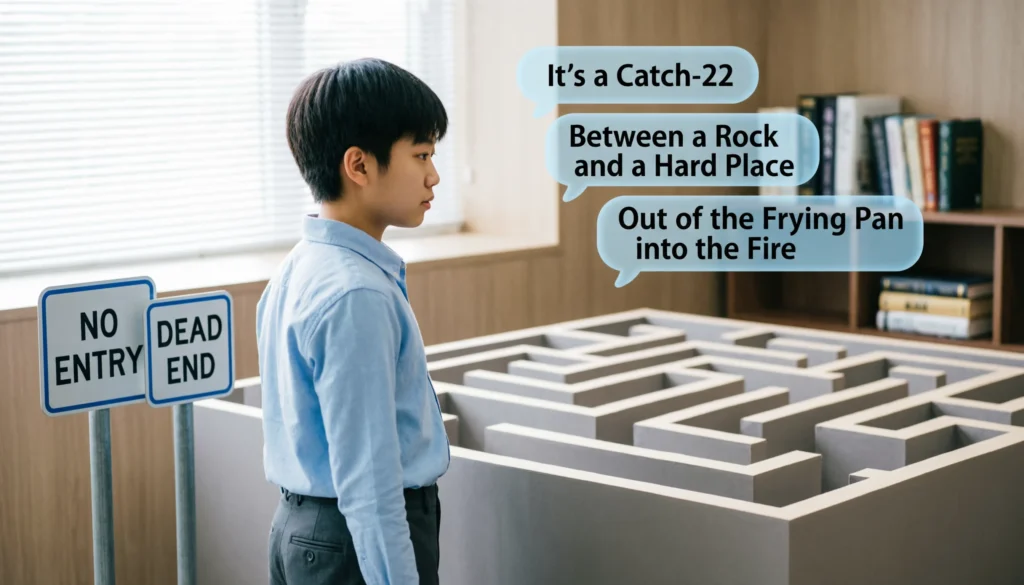
Idioms for impossible situations are phrases people use when a task, plan, or hope seems too difficult, unrealistic, or unlikely to happen. These expressions help speakers describe pressure, failure, blocked choices, and hopeless plans in a clear and memorable way.
Students, writers, and ESL learners can use these idioms to make speech and writing sound more natural. Instead of saying something is very hard again and again, you can choose a phrase that shows the exact feeling, such as no chance, no solution, too much risk, or a problem that cannot work.
What “Idioms for Impossible Situations” Mean
Idioms for impossible situations can mean:
- A task has almost no chance of success.
- A person faces two bad choices.
- A plan sounds unrealistic or too difficult.
- A problem has no easy answer.
- Someone wants something that cannot happen.
- A situation feels hopeless, blocked, or unfair.
- A goal needs more time, skill, money, or luck than available.
Common, Popular, Funny, Useful, and Everyday Idioms for Impossible Situations
Mission impossible
Simple meaning: A task that seems impossible to complete.
Example: Finishing the whole project tonight feels like mission impossible.
A lost cause
Simple meaning: Something that has no real chance of success.
Example: Fixing that broken phone is a lost cause.
Between a rock and a hard place
Simple meaning: Stuck between two bad choices.
Example: She was between a rock and a hard place when both options cost too much.
Like finding a needle in a haystack
Simple meaning: Very difficult to find.
Example: Finding one missing receipt in that office is like finding a needle in a haystack.
Out of the question
Simple meaning: Completely impossible or not allowed.
Example: Buying a new car this month is out of the question.
A tall order
Simple meaning: A very difficult demand or task.
Example: Learning a new language in one month is a tall order.
Easier said than done
Simple meaning: Something sounds simple but is hard to do.
Example: Staying calm during the exam is easier said than done.
No-win situation
Simple meaning: A situation where every choice leads to a bad result.
Example: Arguing with angry customers can become a no-win situation.
Against all odds
Simple meaning: Success despite very little chance.
Example: Against all odds, the small team won the final match.
Pie in the sky
Simple meaning: An unrealistic dream or promise.
Example: His plan to become rich overnight sounded like pie in the sky.
Chasing rainbows
Simple meaning: Trying to get something impossible or unrealistic.
Example: Waiting for perfect conditions is just chasing rainbows.
Barking up the wrong tree
Simple meaning: Looking for a solution in the wrong place.
Example: If you blame the teacher for your missing notes, you are barking up the wrong tree.
Fighting a losing battle
Simple meaning: Trying hard but still likely to fail.
Example: He was fighting a losing battle against the deadline.
Beating your head against a brick wall
Simple meaning: Trying again and again with no progress.
Example: Explaining the rule to him felt like beating my head against a brick wall.
Dead end
Simple meaning: A path or plan that cannot continue.
Example: That idea reached a dead end when we lost the funding.
Idioms for Impossible Situations With Meanings and Examples
When pigs fly
Simple meaning: Something will never happen.
Example: He will clean his room without being asked when pigs fly.
Not in a million years
Simple meaning: Something will never happen.
Example: Not in a million years would I agree to that risky deal.
A snowball’s chance in hell
Simple meaning: Almost no chance at all.
Example: That weak proposal has a snowball’s chance in hell of approval.
The odds are stacked against you
Simple meaning: Many things make success unlikely.
Example: The odds are stacked against us, but we can still try.
A bridge too far
Simple meaning: A goal that goes beyond what is possible.
Example: Asking the new team to finish everything today is a bridge too far.
A dead duck
Simple meaning: A plan or project that will fail.
Example: Without investors, the business idea became a dead duck.
A catch-22
Simple meaning: A problem where one rule blocks the solution.
Example: She needed experience to get a job, but needed a job to get experience. It was a catch-22.
Square the circle
Simple meaning: Try to do something logically impossible.
Example: The manager tried to square the circle by cutting costs and raising quality at once.
Put the cart before the horse
Simple meaning: Do things in the wrong order.
Example: Choosing a logo before making a business plan puts the cart before the horse.
Trying to boil the ocean
Simple meaning: Trying to do too much at once.
Example: Do not boil the ocean. Start with one chapter.
How to Use Idioms for Impossible Situations in Sentences
Use these idioms when you want to show difficulty, blocked choices, or unrealistic expectations. Choose the phrase that fits the exact situation.
For something that will never happen, use when pigs fly, not in a million years, or out of the question.
For a very difficult task, use a tall order, mission impossible, or easier said than done.
For a hopeless plan, use a lost cause, dead end, dead duck, or fighting a losing battle.
For two bad choices, use between a rock and a hard place or no-win situation.
Idioms for Impossible Situations for Writing and Speaking
Writers can use these idioms to show conflict, pressure, and frustration. A character who faces a no-win situation feels trapped. A student fighting a losing battle against time sounds stressed and realistic.
In speaking, these idioms make everyday English more expressive. Instead of saying this is impossible, you can say this is out of the question or this feels like mission impossible.
Idioms for Impossible Situations for Students and ESL Learners
ESL learners should first learn the meaning, then use each idiom in simple daily sentences. Do not translate idioms word by word because the literal meaning often sounds strange.
Good beginner idioms include:
Easier said than done
Simple meaning: Harder than it sounds.
Example: Speaking English every day is easier said than done.
A tall order
Simple meaning: A difficult task.
Example: Getting full marks in every subject is a tall order.
Out of the question
Simple meaning: Not possible.
Example: Going out during the storm is out of the question.
Dead end
Simple meaning: No way forward.
Example: My research reached a dead end.
Idioms for Impossible Situations in Conversations
Here are natural conversation examples:
A: Can we finish the whole assignment tonight?
B: That sounds like mission impossible.
A: Will he apologize first?
B: When pigs fly.
A: Should I accept the job or stay in college?
B: That puts you between a rock and a hard place.
A: Can we find that old file?
B: Maybe, but it is like finding a needle in a haystack.
A: Can I borrow your car for a week?
B: Sorry, that is out of the question.
Similar Phrases and Expressions
Impossible dream
Simple meaning: A dream that cannot realistically happen.
Example: Becoming famous overnight is an impossible dream.
Unrealistic expectation
Simple meaning: A demand that is not practical.
Example: Asking one person to do five jobs is an unrealistic expectation.
No easy way out
Simple meaning: No simple solution exists.
Example: After the mistake, there was no easy way out.
Hopeless case
Simple meaning: A person or thing that seems impossible to improve.
Example: My old laptop is a hopeless case.
Too good to be true
Simple meaning: So perfect that it seems false or unlikely.
Example: That free vacation offer sounds too good to be true.
Common Mistakes
Do not use idioms in very formal academic writing unless the tone allows it.
Do not mix two idioms together, such as between a needle and a hard place.
Do not use strong idioms like a snowball’s chance in hell in polite or professional writing.
Do not explain the literal meaning when the idiom already gives the idea.
Do not overuse idioms in one paragraph. One strong idiom works better than five weak ones.
Conclusion
Idioms for impossible situations help you describe difficult, hopeless, unrealistic, and blocked problems in natural English. They make writing stronger and conversations more expressive because each phrase carries a clear feeling. Some idioms show no chance, such as when pigs fly. Others show pressure, such as between a rock and a hard place. Students and ESL learners should start with simple idioms, learn their real meanings, and practice them in short sentences. Writers can use them to create conflict, humor, and emotional tension. The best idiom always matches the situation, tone, and audience.
FAQs
What are idioms for impossible situations?
They are expressions that describe tasks, goals, or problems that seem impossible, unrealistic, or extremely hard.
What is a common idiom for something impossible?
When pigs fly is a common idiom that means something will never happen.
Is mission impossible an idiom?
Yes, people use mission impossible as an informal expression for a task that seems impossible.
Can ESL learners use these idioms?
Yes. ESL learners should use simple idioms first, such as easier said than done, a tall order, and out of the question.
What idiom means two bad choices?
Between a rock and a hard place means someone must choose between two difficult or unpleasant options.
What idiom means almost no chance?
A snowball’s chance in hell means almost no chance, but it sounds informal and strong.
Are these idioms good for creative writing?
Yes. They help writers show pressure, conflict, failure, and unrealistic hopes in a natural way.
