
Introduction
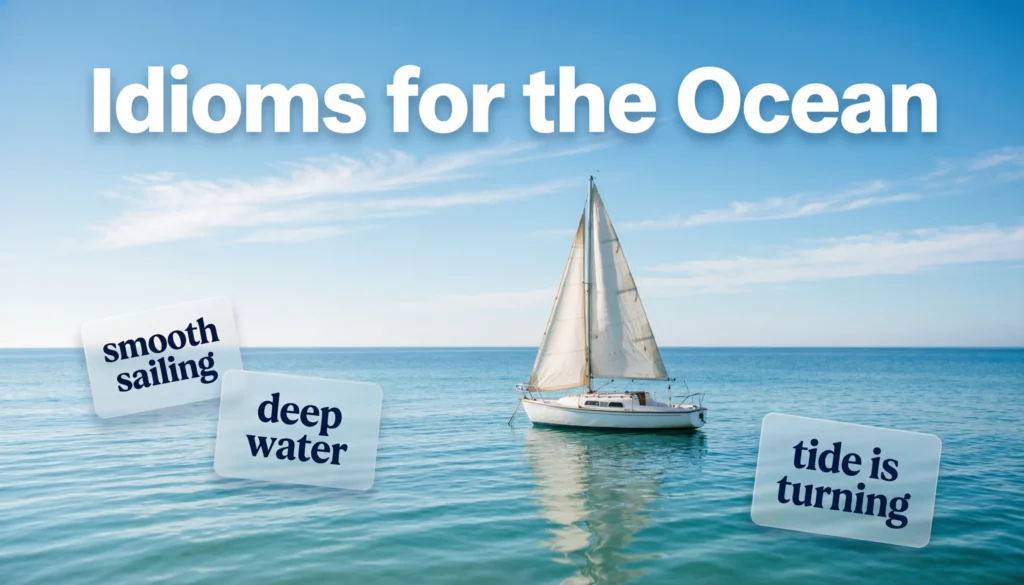
Idioms for the ocean help writers, students, and ESL learners describe feelings, problems, change, depth, freedom, danger, and uncertainty in a vivid way. The ocean often stands for something huge, powerful, mysterious, or difficult to control, so ocean-related expressions work well in both everyday speech and creative writing.
Some phrases in this topic are true idioms, while others are ocean metaphors or common sea expressions. That is natural because English often uses the sea, waves, tides, storms, and deep water to explain human life. These phrases can make your sentences more visual, emotional, and memorable.
What “Idioms for the Ocean” Means
Idioms for the ocean means expressions that use ocean, sea, waves, tides, storms, ships, or deep water to explain an idea.
They can describe:
- Difficulty – such as being in deep water
- Confusion – such as feeling all at sea
- Change – such as a rising tide
- Emotion – such as waves of sadness
- Freedom – such as sailing into open waters
- Risk – such as testing the waters
- Hope – such as calm seas after a storm
- Large amounts – such as an ocean of possibilities
These expressions do not always talk about the real ocean. Many use ocean imagery to explain life, work, school, emotions, relationships, and personal challenges.
Common, Popular, Funny, Useful, and Everyday Idioms for the Ocean
Ocean expressions appear in conversation, essays, stories, speeches, and classroom writing. Some sound serious, while others feel casual or funny. The best choice depends on your meaning.
1. In deep water
Simple meaning: In serious trouble or difficulty.
Example sentence: He forgot the project deadline, and now he is in deep water with his teacher.
2. All at sea
Simple meaning: Confused or unsure about what to do.
Example sentence: I was all at sea during the first week of my new job.
3. Test the waters
Simple meaning: Try something carefully before making a full decision.
Example sentence: She tested the waters by selling a few handmade shirts online before opening a store.
4. Make waves
Simple meaning: Cause attention, change, or trouble.
Example sentence: His new idea made waves in the school debate club.
5. Go with the flow
Simple meaning: Accept things as they happen without resisting too much.
Example sentence: During the trip, we had no fixed plan, so we decided to go with the flow.
6. A drop in the ocean
Simple meaning: A very small amount compared with what is needed.
Example sentence: One small donation helps, but it is only a drop in the ocean.
7. A sea of faces
Simple meaning: A large crowd of people.
Example sentence: The singer looked out at a sea of faces before starting the song.
8. Sail through
Simple meaning: Complete something easily.
Example sentence: She studied hard and sailed through the final exam.
9. Smooth sailing
Simple meaning: Easy progress without problems.
Example sentence: After we fixed the first bug, the rest of the project was smooth sailing.
10. Weather the storm
Simple meaning: Survive a difficult time.
Example sentence: The small business weathered the storm and became stronger after the crisis.
11. A storm in a teacup
Simple meaning: A big reaction to a small problem.
Example sentence: Their argument over the missing pen was just a storm in a teacup.
12. Between the devil and the deep blue sea
Simple meaning: Stuck between two bad choices.
Example sentence: He was between the devil and the deep blue sea: tell the truth and upset his friend, or stay quiet and feel guilty.
13. Plenty of fish in the sea
Simple meaning: Many other choices or people are available.
Example sentence: Do not worry about one failed interview; there are plenty of fish in the sea.
14. The tide is turning
Simple meaning: A situation is starting to change.
Example sentence: After months of poor results, the tide is turning for the team.
15. Ride the wave
Simple meaning: Use a trend or situation while it is successful.
Example sentence: The brand rode the wave of online shopping and grew quickly.
Idioms for the Ocean With Meanings and Examples
These ocean idioms and expressions can help you write stronger descriptions. Use them when you want your sentence to feel more natural and expressive.
16. Against the tide
Simple meaning: Going against common opinion or normal behavior.
Example sentence: She went against the tide and chose a career that most people in her town did not understand.
17. Turn the tide
Simple meaning: Change a situation in a strong or positive way.
Example sentence: One excellent speech turned the tide of the competition.
18. Lost at sea
Simple meaning: Completely confused, directionless, or unsupported.
Example sentence: Without clear instructions, the new students felt lost at sea.
19. Dive in
Simple meaning: Start something with energy and confidence.
Example sentence: Once the teacher explained the task, the students dived in and began writing.
20. Sink or swim
Simple meaning: Succeed or fail by your own effort.
Example sentence: On his first day as manager, he had to sink or swim.
21. Keep your head above water
Simple meaning: Manage to survive a difficult situation.
Example sentence: With exams and part-time work, she is just trying to keep her head above water.
22. Swim against the current
Simple meaning: Work against pressure, trends, or popular opinion.
Example sentence: He swam against the current by choosing honesty when everyone else stayed silent.
23. Cast a wide net
Simple meaning: Search in many places or try many options.
Example sentence: The company cast a wide net to find talented young designers.
24. Like a fish out of water
Simple meaning: Uncomfortable in a new or strange situation.
Example sentence: I felt like a fish out of water at the formal dinner.
25. Big fish in a small pond
Simple meaning: An important person in a small group or place.
Example sentence: He was a big fish in a small pond at his old school, but university challenged him.
26. Cry me a river
Simple meaning: A sarcastic way to say someone is complaining too much.
Example sentence: You only had to wait five minutes? Cry me a river.
27. Still waters run deep
Simple meaning: Quiet people may have deep thoughts or strong feelings.
Example sentence: She rarely speaks in class, but still waters run deep.
28. Come hell or high water
Simple meaning: No matter what happens.
Example sentence: Come hell or high water, I will finish this thesis on time.
29. Batten down the hatches
Simple meaning: Prepare for trouble or difficulty.
Example sentence: Exams start next week, so we need to batten down the hatches and revise seriously.
30. Sail close to the wind
Simple meaning: Take a risky or slightly dishonest action.
Example sentence: His jokes sailed close to the wind during the interview.
How to Use Idioms for the Ocean in Sentences
Ocean idioms work best when they match the emotion or situation. Do not add them only to sound stylish. Use them when they make the meaning clearer.
For problems, use phrases like in deep water, weather the storm, or keep your head above water, For change, use the tide is turning, turn the tide, or ride the wave. For confusion, use all at sea, lost at sea, or like a fish out of water.
Sentence examples
I felt all at sea when the teacher introduced a completely new topic.
The company is in deep water after losing its biggest client.
Her confidence helped her sail through the presentation.
The tide is turning, and more people now support the idea.
He tested the waters before investing money in the business.
She had to weather the storm after receiving harsh criticism.
Idioms for the Ocean for Writing and Speaking
Ocean expressions can make writing more visual, especially in essays, stories, speeches, and reflective paragraphs. They help readers feel size, pressure, movement, and emotion.
In creative writing, ocean phrases can show inner struggle. For example, a character may feel lost at sea after a personal loss. In academic or persuasive writing, a phrase like a drop in the ocean can show that one action is too small to solve a big problem.
In speaking, choose common phrases first. Expressions like smooth sailing, test the waters, make waves, and go with the flow sound natural in everyday conversation. More dramatic phrases, such as between the devil and the deep blue sea, suit formal writing, storytelling, or serious speech.
Idioms for the Ocean for Students and ESL Learners
Students and ESL learners should focus on meaning, context, and tone. Some ocean idioms sound casual, while others sound formal or literary.
Start with useful everyday phrases: in deep water, smooth sailing, test the waters, make waves, go with the flow, and a drop in the ocean. These appear often in school writing, workplace English, and conversations.
Also remember that many ocean phrases do not mean exactly what the words say. In deep water does not mean someone is swimming. It means someone has a serious problem. All at sea does not mean someone is on a boat. It means someone feels confused.
Easy practice examples
Use in deep water when someone has a serious problem.
Use smooth sailing when something becomes easy.
Also Use test the waters when someone tries something carefully.
Use make waves when someone causes attention or change.
Use a drop in the ocean when something is too small to make a big difference.
Idioms for the Ocean in Conversations
Ocean idioms can make casual conversations sound more fluent and expressive. They are useful when talking about school, work, business, relationships, travel, and personal goals.
Conversation examples
A: How was your first week at university?
B: Honestly, I felt all at sea at first, but I am getting used to it.
A: Are you opening the shop this year?
B: Not yet. I want to test the waters with online orders first.
A: The project looked difficult.
B: It was at the start, but after the planning stage, it was smooth sailing.
A: Do you think the team can recover?
B: Yes, the tide is turning. They played much better this week.
A: Why did everyone react so strongly?
B: I think it was a storm in a teacup.
Similar Phrases and Expressions
Ocean idioms often overlap with water, sea, sailing, and storm expressions. These phrases can give your writing more variety.
31. A wave of emotion
Simple meaning: A sudden strong feeling.
Example sentence: A wave of emotion passed through her when she saw her old school.
32. An ocean of possibilities
Simple meaning: Many chances or options.
Example sentence: Graduation opened an ocean of possibilities for the students.
33. Drowning in work
Simple meaning: Having too much work to handle.
Example sentence: I am drowning in work this week because three deadlines are due.
34. The calm before the storm
Simple meaning: A quiet time before trouble starts.
Example sentence: The office felt peaceful, but it was only the calm before the storm.
35. Chart your course
Simple meaning: Plan your direction or future path.
Example sentence: Before choosing a degree, chart your course carefully.
36. Anchor yourself
Simple meaning: Stay calm, stable, or connected to what matters.
Example sentence: During stressful times, anchor yourself with healthy routines.
37. Drift away
Simple meaning: Slowly lose focus, closeness, or direction.
Example sentence: The friends drifted away after they moved to different cities.
38. Dive deeper
Simple meaning: Study or explore something more carefully.
Example sentence: The class decided to dive deeper into the poem’s meaning.
39. A flood of memories
Simple meaning: Many memories arriving at once.
Example sentence: The old photograph brought back a flood of memories.
40. Cross that bridge when we come to it
Simple meaning: Deal with a problem when it actually happens.
Example sentence: We may need more money later, but we will cross that bridge when we come to it.
Common Mistakes
Many learners use ocean idioms too literally or place them in the wrong context. A good idiom should support the sentence, not confuse the reader.
Do not say someone is in deep water for a tiny problem. Use it for serious trouble. Do not use smooth sailing before a task begins unless you mean you expect it to be easy. Do not confuse all at sea with being physically near the sea.
Another mistake is mixing too many ocean idioms in one paragraph. For example, a sentence like I was all at sea, drowning in work, riding the wave, and sailing through the storm sounds overloaded. Choose one strong phrase and let it do the work.
Incorrect and better examples
Incorrect: I was in deep water because I lost my pencil.
Better: I was annoyed because I lost my pencil.
Incorrect: The exam was smooth sailing before I started studying.
Better: After two weeks of revision, the exam was smooth sailing.
Incorrect: She tested the waters after fully buying the company.
Better: She tested the waters before investing in the company.
Incorrect: He made waves quietly and nobody noticed.
Better: His speech made waves across the whole school.
Conclusion
Idioms for the ocean give English a powerful way to describe life, emotions, problems, change, and personal growth. They help writers create strong images and help ESL learners sound more natural in conversation. Phrases like in deep water, test the waters, smooth sailing, make waves, and the tide is turning are useful in school, work, and everyday speech. The key is to use each expression in the right context. When you choose carefully, ocean idioms can make your writing clearer, richer, and more memorable without sounding forced or confusing.
FAQs
What are idioms for the ocean?
Idioms for the ocean are expressions that use ocean, sea, waves, tides, storms, or sailing images to explain ideas. They often describe emotions, trouble, change, risk, confusion, or progress.
What is a common ocean idiom?
A common ocean idiom is in deep water. It means someone is in serious trouble or facing a difficult situation.
Is “a drop in the ocean” an idiom?
Yes, a drop in the ocean is an idiom. It means a very small amount compared with what is needed.
What does “all at sea” mean?
All at sea means confused, unsure, or unable to understand what is happening. It does not usually mean someone is physically at sea.
Can I use ocean idioms in essays?
Yes, you can use ocean idioms in essays, but use them carefully. They work well in introductions, examples, creative writing, and reflective paragraphs.
Are ocean idioms useful for ESL learners?
Yes, ocean idioms are useful for ESL learners because many appear in everyday English. Start with simple ones like smooth sailing, test the waters, and in deep water.
What is the difference between an ocean idiom and an ocean metaphor?
An ocean idiom has a fixed meaning in common English, such as in deep water. An ocean metaphor uses ocean imagery more freely, such as an ocean of possibilities.

Ryan Chase is a skilled writer at MetaphorForge, recognized for his powerful and meaningful metaphors. He explores themes of personal growth, emotions, and everyday life with clarity and depth. His writing turns complex feelings into simple, relatable expressions. Through his work, readers gain fresh perspectives on their own experiences.