
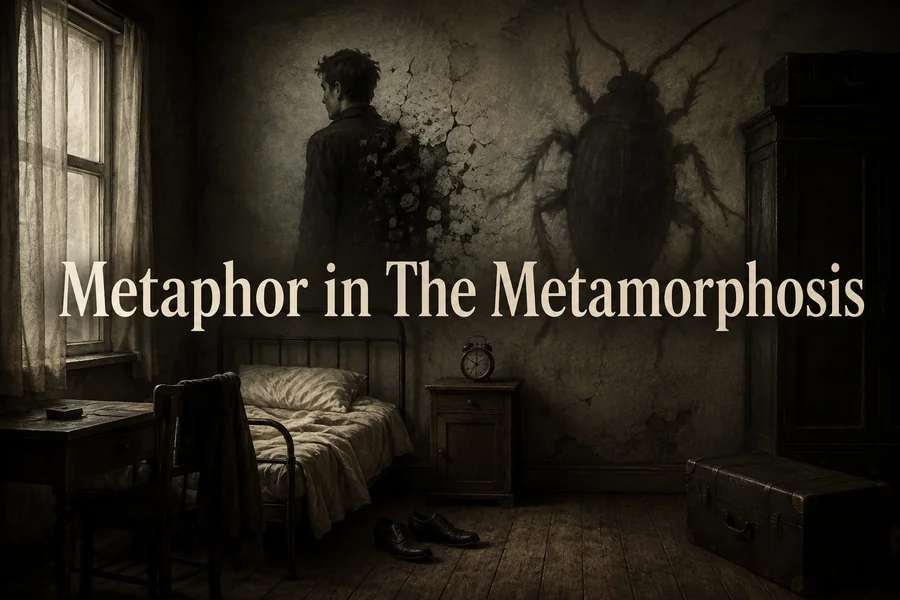
The reader never gets an explanation of why it is one morning that Gregor Samsa wakes up as an insect. It’s in the first line, and he just leaves it there. This is kind of what the book is all about. In The Metamorphosis, there isn’t really a bug. It’s about the individual when they’re no longer useful to those they’re supposed to be loved. Sure, Gregor’s body transforms overnight – but it is his family’s transformation that truly counts.
This piece is a guide through the metaphor in The Metamorphosis, minus the fill you might find in lit class. That is, what it means, why Kafka chose this image, and how you can write about it without sounding like the last five essays that your teacher marked.
Quick Answer: What Is the Metaphor in The Metamorphosis?
The metaphor of The Metamorphosis is alienation. Gregor’s metamorphosis into an insect demonstrates the rate at which a man can be driven away from his own family when he loses his job. The bug isn’t really a bug. It’s what the outside of “no longer useful” looks like.
This is a very simple one. Let’s now look at why it works.
Why an Insect, Specifically
Kafka didn’t pick a bug by accident. Bugs are small. People squash them without a second thought. Nobody feels bad stepping over one on the sidewalk. And that’s basically the arc of the whole story — Gregor’s family goes from horrified, to annoyed, to indifferent, in that order.
Before he wakes up transformed, Gregor is the only one bringing in money. He hates his job — traveling salesman, terrible boss, endless debt to pay off for his father — but he keeps showing up because the family needs the paycheck. The second he can’t work anymore, his worth to everyone in that apartment collapses. The insect body doesn’t create that collapse. It just makes it visible.
He didn’t stop being Gregor when he grew extra legs. He stopped being an income. Everyone around him started treating those as the same thing.
The Different Layers Working Underneath the Story
Peel back the metaphor in The Metamorphosis and there’s more than one thing going on at once.
There’s alienation from family first. Grete starts out bringing him food, cleaning his room, trying to help. By the final chapters she’s the one arguing hardest that “it” has to go — she won’t even call him Gregor anymore.
Then there’s alienation from society. His entire identity was built around his job, so once the job disappears, there’s no place left for him in the world Kafka’s built. It’s a pretty direct jab at how a person’s output ends up mattering more than the person.
There’s also alienation from his own body. Gregor still thinks like a man. He worries about the time, about his boss, about missing the train. But none of that matters anymore because he can’t speak and can’t work, and being trapped inside a body that won’t cooperate is its own kind of horror, separate from anything his family does to him.
And underneath all of it is guilt. Even transformed, even locked in his room, Gregor’s first thoughts are about disappointing his employer. That’s how deep the pressure to perform goes — it survives even after performing becomes physically impossible.
Put those together and you get the real point: once you stop producing, people stop loving you and start managing you.
Read More: Is Your Refrigerator Running a Metaphor
Don’t Forget — the Family Transforms Too
Most readers zero in on Gregor and miss this part. He’s not the only one changing. His family goes through their own metamorphosis, just slower, and nobody notices because it doesn’t come with a monster reveal.
At the start, the father is worn out, dependent, barely present. By the end he’s back in a uniform, aggressive, throwing apples at his own son. Grete goes from devoted teenager to the one pushing for Gregor’s removal. The mother sits somewhere in the middle the whole time, torn between guilt and fear, never quite choosing either.
Gregor shrinks. His family grows into the space he leaves behind. That’s not an accident — it’s basically Kafka’s whole argument in one image.
Fact Table: Metaphor in The Metamorphosis
| Element | What It Represents |
| Gregor’s insect body | Alienation from family and society |
| Loss of speech | Loss of identity and connection |
| His job as a traveling salesman | Pressure to produce economic value |
| Grete’s shifting attitude | How dependency reshapes relationships |
| The father’s transformation | Reclaiming control once Gregor becomes dead weight |
| The locked bedroom door | Forced isolation |
| The apple lodged in his back | Lasting damage from family rejection |
| Gregor’s death | Release from a life measured by usefulness |
| The family’s final trip out | Moving on without guilt |
Keep this table handy if you need a quick refresher before class or an essay deadline.
Writing About This in an Essay
Don’t just write “Gregor represents alienation” and move on — that’s the line every other student turns in. Point to something specific instead. The apple scene works well: his father throws it in anger, it embeds in Gregor’s back, and the wound never really heals. One image, and it’s carrying guilt, violence, and neglect all at once.
The ending is worth using too. The family feels relieved once Gregor’s dead. That’s an uncomfortable thing to read, and Kafka clearly wants it that way. He’s not interested in wrapping this up neatly.
Short Answers: Metaphor in The Metamorphosis
| Question | Short Answer |
| What does the metamorphosis symbolize? | Alienation and loss of identity once a person stops being useful to family or society. |
| Why did Kafka turn Gregor into an insect? | To show how quickly people get dehumanized once they can’t contribute financially. |
| What is the main message of The Metamorphosis? | Value tied to output, not identity, can quietly destroy relationships. |
| What does the apple represent in The Metamorphosis? | Lasting harm caused by the father’s aggression and the family’s rejection. |
| Is The Metamorphosis a metaphor for depression? | Many readers read it that way — Gregor’s isolation mirrors depressive symptoms. |
| What does Gregor’s death mean? | Release from a life defined entirely by duty and usefulness. |
Final Thought
The metaphor in The Metamorphosis isn’t really about a man turning into a bug. It’s about how fast people can become invisible once they stop being needed. Kafka doesn’t spell this out. He just shows you a family slowly forgetting who Gregor was, and lets the discomfort do the rest.
That’s what makes this story stick with readers more than a century later. It’s not a strange body. It’s the familiar cruelty hiding underneath it.
FAQs:
What is the central metaphor in The Metamorphosis?
Gregor’s insect body is a metaphor for alienation. Once he can’t provide for his family financially, they stop seeing him as a person and start seeing him as a burden.
What does Gregor Samsa’s transformation symbolize?
It symbolizes how fast identity and worth can collapse once someone stops being useful. Gregor doesn’t lose his humanity by growing extra legs. He loses it the moment he can’t work.
Why does Kafka never explain the transformation?
Kafka skips the explanation on purpose. He wants readers focused on how the family reacts, not on the biology of what happened to Gregor.
What does the insect represent in Kafka’s story?
Something small and easy to ignore. Bugs get swept aside without guilt, and that’s exactly the arc his family goes through with him.
How does Gregor’s family change throughout the novel?
They start out passive and dependent on his income. By the end, they’re back on their feet, working again, and stronger without him. His decline is basically what frees them.
What role does guilt play in The Metamorphosis?
Even trapped in his new body, Gregor worries about missing his train and disappointing his boss. That shows how deep the pressure to perform goes, even when performing is no longer possible.
What does the locked door symbolize in The Metamorphosis?
Forced isolation. It marks the point where the family stops trying to reach Gregor and starts treating him as something to keep out of sight.
Read More: Metaphor in The Landlady
