
Introduction
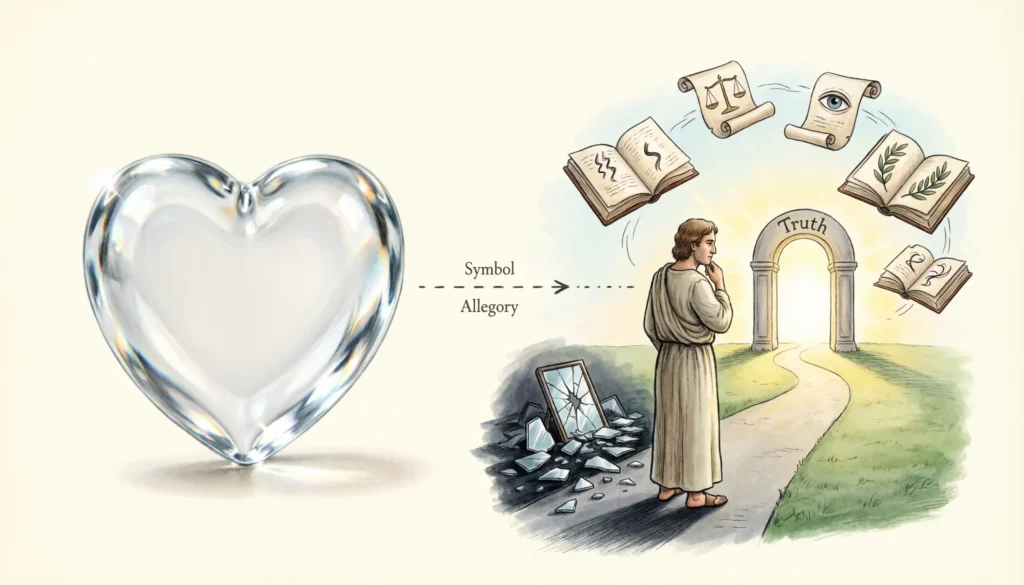
Students and writers often confuse metaphor and allegory because both involve symbolism and deeper meaning. They both help writers say something beyond the literal words on the page.
However, they work at very different levels.
A metaphor is a figure of speech that compares two things directly to create meaning or imagery.
An allegory is a whole story or extended narrative where characters, events, or settings represent deeper ideas.
In simple terms:
- Metaphor = a symbolic comparison within a sentence or passage
- Allegory = a symbolic story where the entire narrative represents something else
Understanding this difference helps students analyze literature more clearly and helps writers choose the right technique.
This guide explains both concepts in clear, practical language.
What Metaphor Means
Simple definition
A metaphor is a figure of speech that describes one thing as if it were another to highlight a shared quality.
Instead of saying something is like something else, a metaphor states the comparison directly.
Purpose
Writers use metaphors to:
- Create vivid images
- Explain ideas more clearly
- Make writing more emotional or memorable
- Compress meaning into a short phrase
How it works
A metaphor links two things that normally aren’t the same. The connection helps readers understand a quality or feeling.
Example
“Time is a thief.”
Time does not literally steal things. The metaphor suggests that time quietly takes moments of our lives.
Why it gets confused with allegory
People sometimes confuse metaphors with allegories because both use symbolism. The key difference is that a metaphor appears in a single expression or short passage, while an allegory shapes an entire story or narrative.
Read More: Metaphor Hooks
What Allegory Means
Simple definition
An allegory is a story where characters, events, and settings represent deeper ideas, moral lessons, or real-world issues.
The whole narrative works as a symbolic system.
Purpose
Writers use allegory to:
- Teach moral or political ideas
- Explore complex themes
- Criticize society indirectly
- Add deeper layers to a story
How it works
In an allegory, nearly every part of the story represents something else.
Characters may represent:
- virtues
- political groups
- human traits
- historical figures
Example
In George Orwell’s Animal Farm, the animals represent figures and groups involved in the Russian Revolution.
The farm story is entertaining on the surface, but the real meaning lies underneath the narrative.
Why it gets confused with metaphor
An allegory often contains many metaphors, so readers sometimes assume they are the same device. But an allegory works at the story level, not just at the sentence level.
Metaphor vs Allegory: The Core Difference
The main difference is scope.
A metaphor compares two things in a single expression or image.
An allegory builds an entire story around symbolic meaning.
Think of it this way:
- Metaphor = a symbolic sentence
- Allegory = a symbolic narrative
Metaphors appear inside many types of writing. Allegories shape the structure of a story itself.
Quick Comparison Table
| Feature | Metaphor | Allegory |
|---|---|---|
| Definition | A direct symbolic comparison | A story where characters and events represent deeper ideas |
| Scope | Small scale | Large scale |
| Purpose | Add imagery or meaning | Communicate themes or moral lessons |
| Length | Usually a phrase or sentence | Entire narrative |
| Structure | One comparison | Structured symbolic story |
| Meaning | Implied comparison | Layered symbolic meaning |
| Use in writing | Poetry, essays, everyday speech | Literature, fables, political satire |
| Example | “Life is a journey.” | A story where a journey represents the stages of life |
How Metaphor Works
Metaphors work through implied similarity.
A writer selects something familiar and uses it to explain something else.
For example:
“Her voice was velvet.”
The writer highlights the softness and smoothness of the voice.
Good metaphors:
- create quick mental images
- simplify abstract ideas
- add emotional tone
Because they are short and flexible, metaphors appear in:
- poetry
- novels
- speeches
- everyday conversation
How Allegory Works
Allegory works through systematic symbolism.
Instead of a single comparison, the entire narrative carries hidden meaning.
In a typical allegory:
- characters represent ideas or groups
- events mirror real-world issues
- the plot reflects a moral or political message
Readers can enjoy the story on the surface while also recognizing the deeper symbolic layer.
Many classic allegories teach lessons about:
- power
- morality
- society
- human nature
Key Differences in Simple Language
Here are the differences in the clearest terms:
Metaphor
- short comparison
- appears in a sentence or phrase
- adds imagery or emphasis
- common in everyday language
Allegory
- whole story with symbolic meaning
- built around a deeper message
- characters represent ideas
- often used in literature and fables
If metaphor is a tool, allegory is a story structure.
Read Also: Metaphor Importance
Can Metaphor and Allegory Overlap?
Yes, they often overlap.
An allegory usually contains many metaphors and symbols.
For example:
- A character might symbolize freedom.
- A journey might represent spiritual growth.
These symbolic elements function like extended metaphors, but the key difference remains:
Metaphor = individual device
Allegory = narrative framework
Examples of Metaphor
Here are a few clear examples:
1.
“The classroom was a zoo.”
Meaning: the classroom was loud and chaotic.
2.
“His mind is a steel trap.”
Meaning: he remembers things easily.
3.
“Hope is a fragile glass.”
Meaning: hope can break easily.
Each example uses a single symbolic comparison.
Examples of Allegory
Here are common types of allegories:
Moral allegory
A story where characters represent virtues and flaws.
Example idea:
A character named Greed destroys relationships while Wisdom restores peace.
Political allegory
A story that represents political systems or historical events.
Example: a kingdom falling into corruption to symbolize government failure.
Spiritual allegory
A journey story where each challenge represents spiritual growth.
These narratives teach ideas through symbolic storytelling.
Metaphor vs Allegory in Literature and Writing
Both devices play important roles in literature.
Metaphor
- adds depth to individual lines
- strengthens description
- helps readers visualize ideas
Poetry relies heavily on metaphors.
Allegory
- structures entire narratives
- communicates moral or political themes
- encourages interpretation
Many classic fables, religious stories, and political novels use allegory.
Writers choose between them depending on whether they want a quick symbolic image or a symbolic story.
Metaphor vs Allegory for Students and ESL Learners
For learners of English, metaphors often appear confusing because the meaning is not literal.
Example:
“He has a heart of stone.”
This does not describe a real stone heart. It means the person is emotionally cold.
Allegories can be easier in some ways because the story itself reveals the meaning gradually.
Helpful learning tip:
- Look for direct comparisons → likely metaphor
- Look for symbolic characters and story meaning → likely allegory
Common Mistakes and Confusion
Mistake 1: Calling every symbol an allegory
A symbol alone does not make a story an allegory.
Mistake 2: Thinking metaphors must be poetic
Metaphors appear in everyday speech all the time.
Example:
- “I’m drowning in work.”
Mistake 3: Treating allegory as just a long metaphor
An allegory is not simply a longer metaphor. It involves a full narrative system of meaning.
When to Use Metaphor and When to Use Allegory
Use metaphor when you want to:
- explain something quickly
- create imagery
- add emotional tone
- strengthen a sentence
Example:
“Ideas are seeds.”
Use allegory when you want to:
- explore big themes
- tell symbolic stories
- discuss politics or morality indirectly
- build layered narratives
Example:
A story about animals forming a government to represent political revolution.
Read More Articles: Rich With Metaphor NYT
Related Terms People Often Confuse with Them
Several literary devices often get mixed up with metaphor and allegory:
Simile
A comparison using like or as.
Example: “Life is like a journey.”
Symbolism
Using objects or images to represent ideas.
Extended metaphor
A metaphor that continues across several lines or paragraphs.
Parable
A short story that teaches a moral lesson.
Analogy
A comparison used mainly for explanation.
Understanding these related terms helps readers identify figurative language more accurately.
Conclusion
Metaphor and allegory both add deeper meaning to writing, but they operate at very different levels.
A metaphor is a direct symbolic comparison inside a sentence or phrase.
An allegory is a complete story where characters and events represent deeper ideas.
In short:
- Metaphor = figurative comparison
- Allegory = symbolic narrative
Recognizing the difference helps students analyze literature, helps writers craft stronger stories, and helps ESL learners understand figurative language more confidently.
FAQs
1. Is an allegory a type of metaphor?
Not exactly. An allegory may contain many metaphors, but it is a story structure, not just a figure of speech.
2. What is the simplest difference between metaphor and allegory?
A metaphor compares two things in a sentence, while an allegory tells a symbolic story.
3. Can a story contain both metaphor and allegory?
Yes. Many allegories include metaphors, symbolism, and other figurative devices.
4. Is allegory common in modern writing?
Yes, especially in fantasy, satire, and political fiction.
5. Are metaphors used in everyday language?
Very often. Expressions like “time flies” or “heavy heart” are metaphors.
6. Is symbolism the same as allegory?
No. Symbolism uses symbols individually, while allegory organizes an entire narrative around symbolic meaning.
