
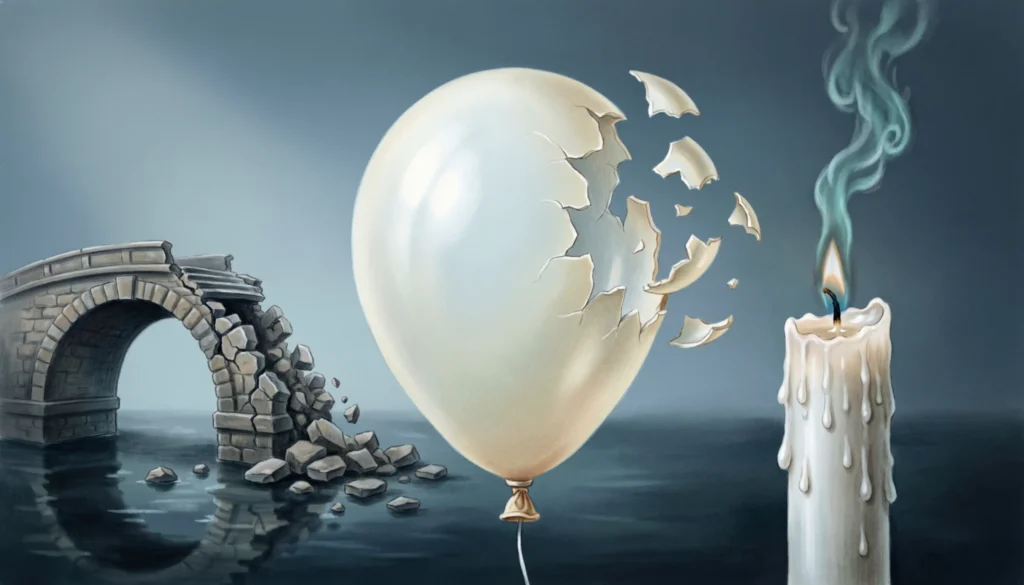
Disappointment is a common human emotion. People feel it when expectations collapse, plans fail, or results fall short. Writers and speakers often use metaphors to describe this feeling in vivid, memorable ways.
Metaphors for disappointment help readers and listeners understand emotions more clearly. They turn abstract feelings into images people can see, imagine, and relate to.
This guide explains the meaning of metaphors for disappointment and shows how students, writers, and ESL learners can use them naturally in everyday English.
What Metaphors for Disappointment Mean
A metaphor compares one thing to another to explain a feeling or idea more clearly. When people talk about disappointment, they often compare it to physical sensations, broken objects, falling movements, or fading hopes.
For example, saying “my hopes crashed like a falling tower” paints a stronger emotional picture than simply saying “I felt disappointed.”
Metaphors for disappointment make communication:
- more expressive
- easier to understand
- more engaging in writing and speaking
Writers, teachers, and speakers use these metaphors in stories, essays, conversations, and speeches.
Common, Popular, Funny, Useful, and Everyday Metaphors for Disappointment
English includes many simple metaphors that describe disappointment. Some sound dramatic, while others feel casual or even humorous.
People often connect disappointment with:
- falling or crashing
- broken dreams
- deflated objects
- empty results
- fading excitement
These images help explain how expectations suddenly collapse.
Metaphors for Disappointment with Meanings and Examples
Below are common metaphors and expressions people use to describe disappointment.
1. A Balloon That Lost Its Air
Meaning: excitement suddenly disappears
Example:
When the concert was canceled, my excitement felt like a balloon that lost its air.
2. A Door Slammed Shut
Meaning: an opportunity suddenly ends
Example:
When the company rejected my application, it felt like a door slammed shut.
3. A Cake Without Sugar
Meaning: something that should be enjoyable but isn’t
Example:
The movie looked amazing in the trailer, but the story felt like a cake without sugar.
4. A Broken Compass
Meaning: feeling lost after plans fail
Example:
After the project collapsed, I felt like a broken compass with no direction.
5. A Rain Cloud Over My Day
Meaning: something that ruins a good mood
Example:
Failing the exam placed a rain cloud over my entire day.
6. A Popped Balloon
Meaning: sudden loss of excitement
Example:
The announcement that the trip was canceled popped my balloon instantly.
7. A Train That Left the Station
Meaning: a missed opportunity
Example:
By the time I applied, the scholarship felt like a train that left the station.
8. A Fire That Went Out
Meaning: enthusiasm disappears
Example:
After hearing the bad news, my motivation felt like a fire that went out.
9. An Empty Box
Meaning: expecting something great but receiving nothing valuable
Example:
The long-awaited event turned out to be an empty box.
10. A Flat Soda
Meaning: excitement that quickly fades
Example:
The party looked exciting online, but in reality it was like drinking flat soda.
11. A Collapsing Bridge
Meaning: plans suddenly fail
Example:
When the funding stopped, our project felt like a collapsing bridge.
12. A Cloud Without Rain
Meaning: promises without results
Example:
The company’s promises turned out to be a cloud without rain.
How to Use Metaphors for Disappointment in Sentences
Using metaphors in English becomes easier when you follow a few simple tips.
1. Connect the metaphor to emotion
Explain how the situation felt.
Example:
The cancelled vacation felt like a balloon losing air.
2. Keep metaphors simple
Clear images work better than complicated comparisons.
3. Match the situation
Choose metaphors that fit the context.
Example:
A missed job opportunity can feel like a door closing.
4. Avoid mixing metaphors
Do not combine unrelated images.
Incorrect:
My hopes were a balloon that crashed like a train.
Correct:
My hopes were a balloon that suddenly popped.
Metaphors for Disappointment in Writing and Speaking
Writers often use metaphors to show emotion rather than simply stating it.
For example:
Plain sentence:
I was disappointed by the result.
Stronger version:
The result felt like watching my hopes slowly fade away.
Metaphors also improve:
- storytelling
- essays
- speeches
- creative writing
- blog articles
Speakers use them in conversations to express feelings clearly and naturally.
Metaphors for Disappointment for Students and ESL Learners
Students and ESL learners benefit from metaphors because they help explain emotions visually.
To learn them faster:
- read stories and novels
- notice metaphors in movies and songs
- practice writing short sentences
- use simple comparisons first
Example practice sentence:
My excitement for the trip was a balloon that suddenly popped.
Over time, these expressions become natural in everyday English.
Metaphors for Disappointment in Conversations
People often use metaphors casually in everyday speech.
Examples include:
- “That news popped my balloon.”
- “The plan collapsed like a house of cards.”
- “The excitement faded like a dying fire.”
These expressions make conversations more colorful and expressive.
Similar Phrases and Expressions
Some expressions describe disappointment without being full metaphors.
Let Down
Meaning: feeling disappointed
Example:
I felt let down when the event was canceled.
Fall Flat
Meaning: fail to impress
Example:
His joke fell flat during the presentation.
Miss the Boat
Meaning: miss an opportunity
Example:
I missed the boat by applying too late.
Hopes Crushed
Meaning: strong disappointment
Example:
My hopes were crushed when the team lost.
Not What I Expected
Meaning: results are disappointing
Example:
The restaurant was not what I expected.
Common Mistakes
Many learners struggle with metaphors at first. Avoid these common errors.
1. Mixing metaphors
Do not combine unrelated images.
Incorrect:
My dreams popped like a bridge collapsing.
2. Using metaphors too often
Too many metaphors make writing confusing.
3. Choosing unclear comparisons
Use images people understand easily.
4. Using metaphors in formal reports
Formal academic writing sometimes requires clearer, literal language.
Conclusion
Metaphors for disappointment help people express emotions in vivid and meaningful ways. They transform simple feelings into images that readers and listeners understand instantly.
Students, writers, and ESL learners can improve their communication by learning these expressions and using them in sentences, conversations, and creative writing.
With practice, metaphors become powerful tools that make language more engaging and memorable.
FAQs
1. What is a metaphor for disappointment?
A metaphor for disappointment compares the feeling of letdown to something else, such as a popped balloon or a fading fire.
2. Why do writers use metaphors for disappointment?
They make emotions more vivid, relatable, and memorable.
3. Are metaphors useful for ESL learners?
Yes. They help learners understand emotions and improve natural communication.
4. What is a simple metaphor for disappointment?
“A popped balloon” is a common metaphor that shows excitement suddenly disappearing.
5. Can metaphors be used in everyday conversation?
Yes. Many people use simple metaphors casually when expressing feelings.
6. Are metaphors the same as idioms?
No. Idioms have fixed meanings, while metaphors compare two things to explain an idea.
7. How can students learn metaphors easily?
Reading books, watching movies, and practicing sentences helps students understand and remember metaphors.

Luna Grace is a contemporary author whose writing blends emotional depth with powerful metaphors.
Her work explores healing, self-discovery, and the quiet courage found in personal growth.
With a reflective and poetic style, she turns lived experiences into meaningful insights.
At MetaphorForge, Luna Grace represents writing that resonates, comforts, and inspires transformation.