
Introduction
The Great Gatsby is one of the most studied novels in English literature, and its power comes from rich imagery and symbolic language. Metaphors in this novel help readers understand deeper meanings about wealth, love, illusion, and the American Dream. Instead of stating ideas directly, the author uses comparisons to paint emotional and visual pictures.
For students, writers, and ESL learners, learning these metaphors improves both reading and writing skills. You start to see how simple phrases can carry deeper meaning. This article explains the most important metaphors in a clear and practical way so you can use them confidently in your own writing and conversations.
What “metaphors in The Great Gatsby” means
- Metaphors are comparisons that describe one thing as another
- They reveal hidden meanings about characters and themes
- They make abstract ideas like dreams or hope easier to understand
- They add emotional depth and imagery to the story
- In this novel, they often represent illusion, wealth, and desire
Common, popular, and everyday metaphors in The Great Gatsby
Even though the novel is complex, many metaphors feel relatable. They connect big ideas to everyday experiences like chasing dreams, feeling lost, or judging others. For example, the idea of “light” representing hope or “dust” representing decay is something we still use today.
These metaphors work because they are simple but powerful. They help readers connect their own life experiences with the story. That is why this novel remains relevant even for modern readers and ESL learners.
Metaphors in The Great Gatsby with meanings and examples
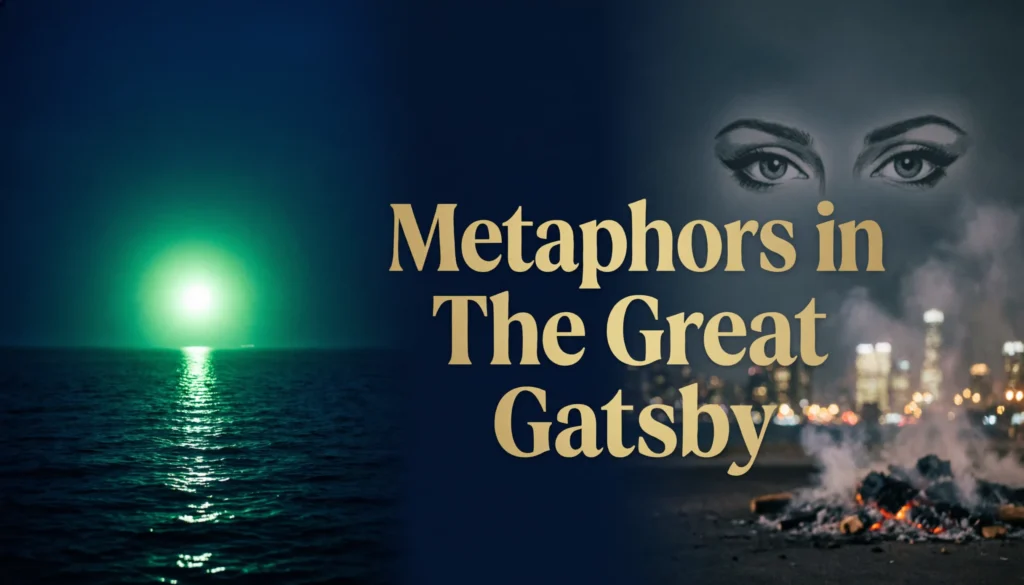
Green light
- Phrase: Green light
- Simple meaning: Hope or unreachable dreams
- Example: He kept chasing his goals like the green light across the water
Valley of ashes
- Phrase: Valley of ashes
- Simple meaning: Moral decay and emptiness
- Example: His life felt like a valley of ashes after losing everything
Eyes of Doctor T. J. Eckleburg
- Phrase: Watching eyes
- Simple meaning: Judgment or the idea of being watched
- Example: She felt like invisible eyes were judging her actions
Daisy as a voice full of money
- Phrase: Voice full of money
- Simple meaning: Wealth shaping personality and attraction
- Example: His confidence sounded like a voice full of money
Gatsby’s dream
- Phrase: Dream as a distant goal
- Simple meaning: Illusion or unrealistic ambition
- Example: His success was just a dream he could never fully reach
How to use metaphors in The Great Gatsby in sentences
You can use these metaphors in writing or speaking to sound more expressive. Focus on meaning, not memorization.
- Use “green light” when talking about goals
- Use “ashes” when describing emptiness or failure
- Use “watching eyes” for pressure or judgment
Example sentences:
- I kept moving forward toward my green light
- After the loss, everything turned into ashes
- It felt like someone was always watching me
Metaphors in The Great Gatsby for writing and speaking
Metaphors make your writing more engaging and creative. Instead of saying “I was sad,” you can say “my world turned into ashes.” This creates a stronger image in the reader’s mind.
In speaking, metaphors help you sound natural and expressive. They also make your communication more memorable. For essays, they show deeper understanding and improve your grades.
Metaphors in The Great Gatsby for students and ESL learners
Students can use these metaphors to improve essays and exam answers. Instead of writing basic explanations, you can include symbolic meaning.
ESL learners benefit because metaphors improve vocabulary and cultural understanding. Start with simple ones like “light” and “dream,” then move to more complex ideas.
Practice tip:
- Learn one metaphor at a time
- Use it in one sentence daily
- Connect it with real-life situations
Metaphors in conversations
You can use these metaphors in casual conversation too.
- Talking about goals: “That’s my green light”
- Talking about failure: “Everything turned into ashes”
- Talking about pressure: “Feels like someone is watching me”
This makes your English sound natural and fluent.
Similar phrases and expressions
- Chasing a dream
- Lost in illusion
- Walking in darkness
- Burning ambition
- Empty success
Common mistakes
- Using metaphors without understanding meaning
- Overusing metaphors in every sentence
- Mixing different metaphors incorrectly
- Using complex metaphors in simple conversations
- Forgetting context of the metaphor
Conclusion
Metaphors in The Great Gatsby play a key role in explaining its deeper themes. They turn simple ideas into powerful images that stay in the reader’s mind. From the green light representing hope to the valley of ashes symbolizing decay, each metaphor adds meaning to the story. For students and ESL learners, understanding these metaphors improves reading, writing, and speaking skills. When you start using them in your own sentences, your language becomes richer and more expressive. Keep practicing and applying them in real life to fully master their impact.
FAQs
1. What is the most important metaphor in The Great Gatsby?
The green light is the most important because it represents hope and unreachable dreams.
2. Why are metaphors used in the novel?
They help explain complex ideas like illusion, wealth, and ambition in a simple way.
3. Are metaphors important for exams?
Yes, they help you write deeper and more analytical answers.
4. Can ESL learners understand these metaphors easily?
Yes, if explained in simple language and practiced regularly.
5. How can I use these metaphors in writing?
Use them to describe emotions, goals, or situations creatively.
6. What is the valley of ashes metaphor?
It represents moral decay and the emptiness behind wealth.

Luna Grace is a contemporary author whose writing blends emotional depth with powerful metaphors.
Her work explores healing, self-discovery, and the quiet courage found in personal growth.
With a reflective and poetic style, she turns lived experiences into meaningful insights.
At MetaphorForge, Luna Grace represents writing that resonates, comforts, and inspires transformation.