
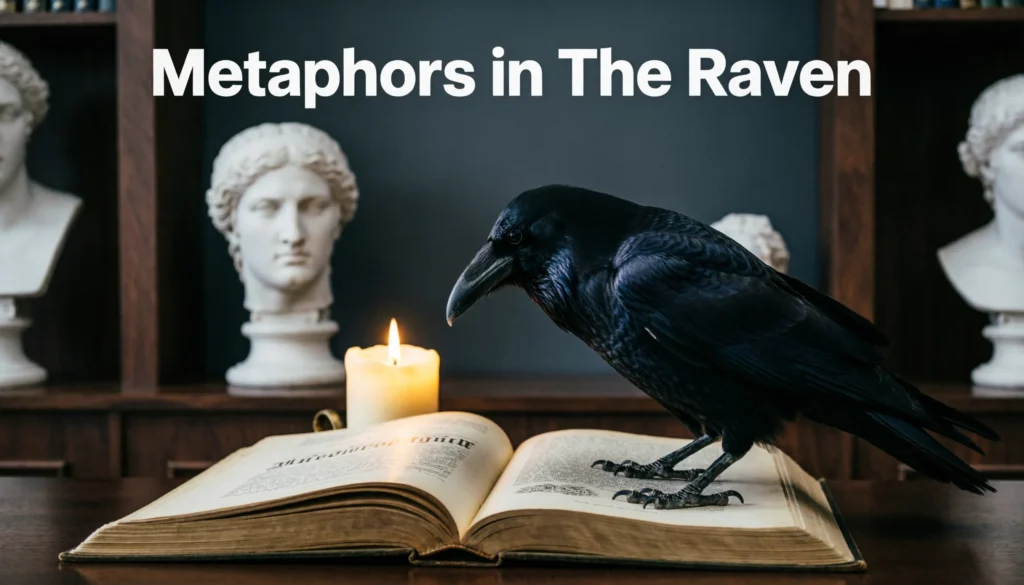
Metaphors in The Raven help readers understand grief, memory, madness, and emotional darkness in Edgar Allan Poe’s famous poem. Instead of explaining sorrow directly, Poe turns feelings into images: a raven, a shadow, a chamber, a stormy night, and the repeated word “Nevermore.”
The poem follows a lonely speaker who mourns Lenore, a lost woman he deeply loved. When the raven enters his room, it becomes more than a bird. It slowly turns into a symbol of grief, hopeless memory, and the speaker’s own troubled mind.
What “Metaphors in The Raven” Means
Metaphors in The Raven means the symbolic images Poe uses to express deeper emotional ideas.
- The raven represents grief, death, memory, and despair.
- The dark chamber represents the speaker’s lonely mind.
- The night represents sadness, fear, and emotional confusion.
- The shadow represents lasting sorrow.
- The word “Nevermore” represents finality and hopelessness.
- Lenore represents lost love, beauty, and the past.
- The bust of Pallas represents wisdom, but the raven sitting on it suggests reason has lost power.
- The poem uses metaphor to show how grief can trap a person mentally and emotionally.
Common, Popular, Funny, Useful, and Everyday Metaphors in The Raven
The Raven does not use funny metaphors in the normal comic sense, but it uses dark, memorable, and powerful metaphors that readers still talk about today. These metaphors feel useful because they help students and writers explain grief in a visual way.
For example, instead of saying “the speaker feels sad,” Poe gives us a lonely room, a midnight visitor, tapping sounds, shadows, and a bird that repeats one hopeless word. These images make grief feel alive.
The Raven
Simple meaning: The raven represents grief, death, and a painful memory that will not leave.
Example sentence: In The Raven, the bird becomes a metaphor for grief because it stays with the speaker and repeats his hopeless thoughts.
The Chamber
Simple meaning: The chamber represents the speaker’s isolated mind.
Example sentence: The dark chamber works as a metaphor for a lonely mind trapped in sorrow.
The Midnight Setting
Simple meaning: Midnight represents emotional darkness, fear, and confusion.
Example sentence: Poe uses midnight as a metaphor for the speaker’s darkest emotional state.
The Shadow
Simple meaning: The raven’s shadow represents permanent grief.
Example sentence: The shadow becomes a metaphor for sadness that the speaker cannot escape.
Nevermore
Simple meaning: “Nevermore” represents final loss and hopeless certainty.
Example sentence: The word “Nevermore” becomes a metaphor for the speaker’s belief that happiness will never return.
Metaphors in The Raven With Meanings and Examples
Metaphors in The Raven work because they connect physical objects with emotional states. Poe does not simply describe grief. He gives grief a shape, a sound, and a presence.
The Raven as Grief
Phrase: The raven
Simple meaning: Grief that returns again and again
Example sentence: The raven is a metaphor for grief because it enters the room and refuses to leave the speaker’s mind.
The bird becomes more powerful as the poem continues. At first, it seems like a strange visitor. Later, it feels like a dark messenger from the speaker’s own despair.
The Raven as Death
Phrase: The black bird
Simple meaning: A sign of death and mourning
Example sentence: The black raven acts as a metaphor for death because its color and presence suggest loss.
Ravens often connect with death in literature. Poe uses this cultural meaning to make the bird feel mysterious, serious, and frightening.
The Chamber as the Mind
Phrase: The lonely chamber
Simple meaning: The speaker’s private mental world
Example sentence: The chamber is a metaphor for the speaker’s mind because everything in it reflects his grief.
The room feels closed, quiet, and heavy. This matches the speaker’s emotional condition.
The Bust of Pallas as Reason
Phrase: The bust of Pallas
Simple meaning: Wisdom, learning, and rational thought
Example sentence: The bust of Pallas is a metaphor for reason, but the raven above it shows that grief has overpowered wisdom.
Pallas refers to Athena, the goddess of wisdom. When the raven sits above the bust, the image suggests that dark emotion now controls the speaker more than logic.
Midnight as Despair
Phrase: Midnight dreary
Simple meaning: A dark emotional point
Example sentence: Midnight is a metaphor for despair because it places the speaker in a world of darkness and uncertainty.
The poem begins at midnight, which immediately creates a mood of tiredness, fear, and sadness.
The Shadow as Lasting Pain
Phrase: The raven’s shadow
Simple meaning: Grief that remains forever
Example sentence: The raven’s shadow is a metaphor for emotional pain that stays with the speaker.
Near the end of the poem, the shadow suggests that the speaker cannot free himself from sorrow.
Lenore as Lost Beauty
Phrase: Lenore
Simple meaning: Lost love, memory, and ideal beauty
Example sentence: Lenore becomes a metaphor for everything the speaker has lost.
Lenore is more than a person in the poem. She becomes the symbol of love, happiness, and peace that the speaker can no longer reach.
The Tapping as Anxiety
Phrase: The tapping at the chamber door
Simple meaning: A troubling thought entering the mind
Example sentence: The tapping works as a metaphor for anxiety because it disturbs the speaker’s quiet grief.
The sound begins softly, but it creates tension. It feels like the speaker’s hidden fears asking to come inside.
The Door as the Boundary Between Reality and Fear
Phrase: The chamber door
Simple meaning: The line between the real world and the speaker’s imagination
Example sentence: The chamber door is a metaphor for the thin boundary between reality and fear.
When the speaker opens the door, he does not find comfort. He finds darkness, mystery, and deeper emotional trouble.
The Plutonian Shore
Phrase: Night’s Plutonian shore
Simple meaning: The world of death and the underworld
Example sentence: The Plutonian shore is a metaphor for death and spiritual darkness.
“Plutonian” connects to Pluto, the Roman god of the underworld. Poe uses it to make the raven seem connected to death.
How to Use Metaphors in The Raven in Sentences
You can use metaphors in The Raven when writing essays, class answers, literature notes, or creative analysis. The best method is simple: name the metaphor, explain what it represents, and connect it to the speaker’s grief.
Essay Sentence Examples
The raven is a metaphor for grief because it enters the speaker’s room and becomes a permanent symbol of emotional pain.
The chamber represents the speaker’s mind, showing how grief has trapped him in isolation.
The word “Nevermore” becomes a metaphor for finality, suggesting that the speaker sees no future comfort.
The raven’s shadow symbolizes lasting sorrow because it remains over the speaker at the end of the poem.
The bust of Pallas represents wisdom, but the raven’s position above it shows that grief has defeated reason.
Metaphors in The Raven for Writing and Speaking
Writers can learn a lot from Poe’s use of metaphor. He does not explain every emotion directly. He builds a full atmosphere that makes readers feel the speaker’s mental pain.
In speaking, you can describe The Raven as a poem where outer objects reflect inner emotions. The bird, room, night, and shadow all show what happens inside the speaker’s mind.
Useful Phrases for Discussion
Phrase: The raven is grief made visible
Simple meaning: The bird gives physical form to sorrow
Example sentence: The raven is grief made visible because it turns the speaker’s sadness into a living presence.
Phrase: The room is a map of the speaker’s mind
Simple meaning: The setting reflects his emotions
Example sentence: The room is a map of the speaker’s mind because its darkness and silence match his loneliness.
Phrase: Nevermore is the voice of despair
Simple meaning: The word expresses hopelessness
Example sentence: Nevermore is the voice of despair because it answers every question with final loss.
Phrase: The shadow is permanent sorrow
Simple meaning: The speaker cannot escape grief
Example sentence: The shadow is permanent sorrow because it remains after the raven has taken control of the room.
Metaphors in The Raven for Students and ESL Learners
For students and ESL learners, the easiest way to understand metaphors in The Raven is to connect each image with one feeling. Poe’s language can feel old-fashioned, but the emotional meaning remains clear.
The raven means grief. The chamber means isolation. Midnight means darkness and sadness. Lenore means lost love. “Nevermore” means no hope of return. The shadow means grief that stays.
Simple Study Table
| Metaphor | Simple Meaning | What It Shows |
|---|---|---|
| Raven | Grief and death | The speaker cannot escape sorrow |
| Chamber | Mind | The speaker feels mentally trapped |
| Midnight | Darkness and despair | The poem begins in emotional darkness |
| Lenore | Lost love | The speaker mourns the past |
| Nevermore | Hopeless finality | Comfort will not return |
| Shadow | Lasting sadness | Grief remains forever |
| Bust of Pallas | Reason | Wisdom loses power under grief |
Metaphors in The Raven in Conversations
You can use these ideas in everyday literary conversation when discussing grief, symbols, or emotional writing. The poem gives strong language for talking about how sadness can live inside a person.
Conversation Examples
Phrase: The raven is like a dark thought that will not leave
Simple meaning: The bird represents repeated grief
Example sentence: When we discuss The Raven, I think the bird is like a dark thought that will not leave.
Phrase: The speaker’s room feels like his mind
Simple meaning: The setting reflects his inner state
Example sentence: The speaker’s room feels like his mind because it is lonely, dark, and full of fear.
Phrase: Nevermore sounds like emotional defeat
Simple meaning: The word shows hopelessness
Example sentence: Every time the raven says “Nevermore,” it sounds like emotional defeat.
Phrase: The shadow shows grief staying forever
Simple meaning: The ending suggests permanent sorrow
Example sentence: The shadow shows grief staying forever because the speaker never escapes it.
Similar Phrases and Expressions
These similar phrases can help students explain metaphors in The Raven with clearer language.
A Symbol of Grief
Simple meaning: Something that represents sadness
Example sentence: The raven is a symbol of grief because it reminds the speaker of everything he has lost.
A Dark Messenger
Simple meaning: A figure that brings painful truth
Example sentence: The raven acts like a dark messenger because it brings the speaker no comfort.
A Voice of Despair
Simple meaning: A sound or word that expresses hopelessness
Example sentence: “Nevermore” becomes a voice of despair in the poem.
A Prison of Memory
Simple meaning: A mental state where someone cannot escape the past
Example sentence: The chamber becomes a prison of memory for the speaker.
A Shadow Over the Soul
Simple meaning: Deep sadness affecting a person’s inner life
Example sentence: The raven’s shadow feels like a shadow over the speaker’s soul.
A Door to Fear
Simple meaning: A moment when hidden anxiety appears
Example sentence: The tapping at the door becomes a door to fear in the poem.
A Night of the Mind
Simple meaning: Emotional darkness inside a person
Example sentence: The midnight setting creates a night of the mind for the grieving speaker.
Common Mistakes
Many students make the mistake of calling every image in The Raven a metaphor without explaining its deeper meaning. A metaphor needs a connection between the image and an idea.
Another common mistake is saying the raven only means death. The raven also represents grief, memory, despair, and the speaker’s inner torment. Its meaning grows as the poem develops.
Some readers also confuse metaphor with mood. Darkness creates mood, but when darkness represents despair or mental confusion, it becomes symbolic and metaphorical.
Students should also avoid writing vague sentences like “The raven is very deep.” A better sentence explains the idea clearly: “The raven represents grief that the speaker cannot escape.”
Conclusion
Metaphors in The Raven make Poe’s poem powerful, memorable, and emotionally intense. The raven, chamber, midnight, shadow, Lenore, and “Nevermore” all help readers see grief as something living and unavoidable. Poe uses these images to show how sorrow can enter the mind, silence reason, and trap a person in painful memory. For students, writers, and ESL learners, these metaphors offer a clear way to understand the poem’s deeper meaning. The Raven is not only a poem about a bird. It is a poem about grief becoming a permanent presence in the human soul.
FAQs
What is the main metaphor in The Raven?
The main metaphor in The Raven is the raven itself. It represents grief, death, despair, and painful memory.
What does the raven symbolize in the poem?
The raven symbolizes the speaker’s sorrow and his belief that he will never again find peace after losing Lenore.
Is “Nevermore” a metaphor?
Yes, “Nevermore” works like a metaphor for finality and hopelessness. It suggests that comfort, love, and peace will not return.
What does the chamber represent in The Raven?
The chamber represents the speaker’s isolated mind. Its darkness and silence reflect his emotional condition.
What does the raven’s shadow mean?
The raven’s shadow represents lasting grief. At the end of the poem, it shows that the speaker remains trapped in sorrow.
Why does the raven sit on the bust of Pallas?
The bust of Pallas represents wisdom. The raven sitting above it suggests that grief and despair have overpowered reason.
Are metaphors in The Raven useful for essays?
Yes, they are very useful. Students can analyze the raven, chamber, shadow, midnight, Lenore, and “Nevermore” to explain the poem’s themes.

Zara Hope is a passionate writer at MetaphorForge, known for turning complex emotions into powerful metaphors. She specializes in creative, relatable content that connects deeply with readers. With a strong command of storytelling, she brings clarity and warmth to abstract ideas. Her work inspires reflection, growth, and meaningful understanding through words.