
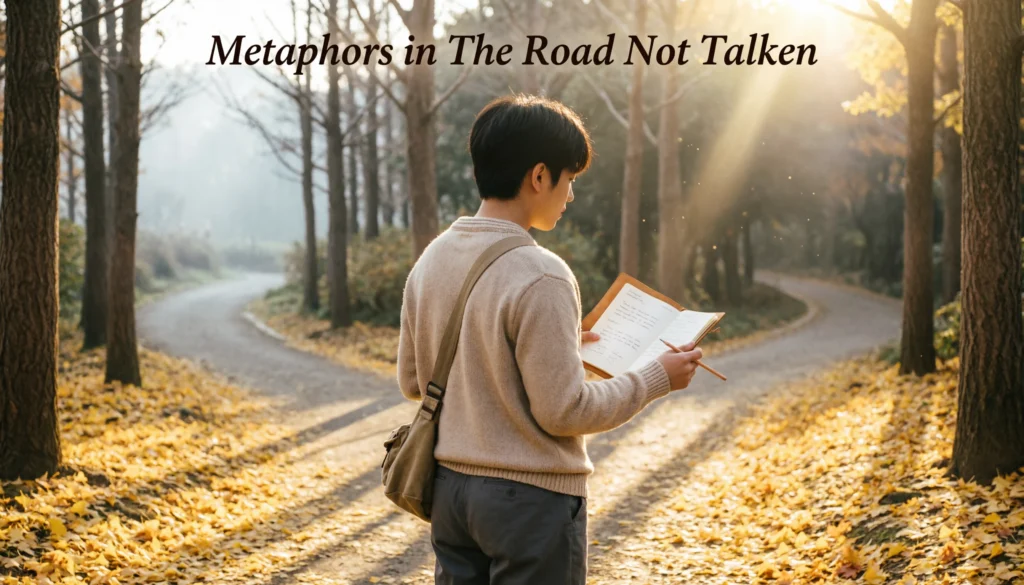
Metaphors in The Road Not Taken help readers understand choice, uncertainty, regret, and personal reflection in Robert Frost’s famous poem. The poem looks simple because it describes a traveler standing before two roads, but those roads carry a deeper meaning.
For students, writers, and ESL learners, this poem is useful because its main metaphor feels easy to picture. A road becomes more than a road. It becomes a life choice, a future path, and a symbol of how people explain their decisions later.
What “Metaphors in The Road Not Taken” Means
Metaphors in The Road Not Taken means the deeper symbolic meanings hidden inside the poem’s simple outdoor scene.
The poem uses a traveler, two roads, a yellow wood, and a future sigh to show how human beings make choices.
The two roads represent different life options.
The yellow wood suggests a moment of change or transition.
The traveler represents any person facing an important decision.
The “road not taken” represents the option left behind.
The poem does not simply say one choice is better than the other. It explores how people remember, shape, and sometimes romanticize their choices later.
Common, Popular, Funny, Useful, and Everyday Metaphors in The Road Not Taken
A fork in the road
Simple meaning: A moment when someone must choose between two different options.
Example sentence: Choosing between medicine and literature felt like a fork in the road for her.
The road less traveled
Simple meaning: An unusual or less common life choice.
Example sentence: He chose the road less traveled by starting his own small business instead of taking a regular office job.
A path in life
Simple meaning: A person’s direction, career, or future.
Example sentence: After graduation, she was unsure which path in life she should follow.
Standing at a crossroads
Simple meaning: Being at an important decision point.
Example sentence: I felt like I was standing at a crossroads when I had to choose between two jobs.
Looking back with a sigh
Simple meaning: Remembering a past choice with mixed feelings.
Example sentence: Years later, he looked back with a sigh and wondered what might have happened.
Two roads diverged
Simple meaning: Two choices became separate and could not both be followed.
Example sentence: Their dreams changed, and soon two roads diverged in their friendship.
A journey through life
Simple meaning: Life seen as movement through time and experience.
Example sentence: Every mistake became part of his journey through life.
The path not chosen
Simple meaning: The option someone left behind.
Example sentence: She sometimes thought about the path not chosen, but she did not regret her decision.
Metaphors in The Road Not Taken with Meanings and Examples
Two roads
Simple meaning: Two possible choices in life.
Example sentence: The two roads in the poem show how difficult major decisions can feel.
The yellow wood
Simple meaning: A stage of change, uncertainty, or transition.
Example sentence: The yellow wood creates a quiet mood of change before the traveler makes his choice.
The traveler
Simple meaning: A person making a life decision.
Example sentence: The traveler represents anyone who must choose without knowing the full result.
The road not taken
Simple meaning: The missed opportunity or choice left behind.
Example sentence: The road not taken becomes a symbol of the life the speaker did not live.
The grassy road
Simple meaning: A choice that seems less used, fresh, or different.
Example sentence: The grassy road suggests a path that looks slightly more inviting at first.
The worn road
Simple meaning: A common or familiar choice.
Example sentence: The worn road can represent the safer option many people have followed.
The sigh
Simple meaning: Future reflection, regret, pride, or uncertainty.
Example sentence: The sigh shows that the speaker may remember his choice with mixed emotions.
Ages and ages hence
Simple meaning: A distant future moment when someone tells the story of their choice.
Example sentence: “Ages and ages hence” suggests that people reshape their memories over time.
How to Use Metaphors in The Road Not Taken in Sentences
You can use these metaphors when writing about decisions, personal growth, career choices, relationships, or education. They work well in essays because they connect a simple image with a deeper life meaning.
For example, you can write: “The two roads symbolize the uncertainty of choice because the traveler cannot know where either path will lead.”
You can also use the metaphor in everyday writing: “Moving abroad was my road less traveled, and it changed the way I understood myself.”
When you use these expressions, keep the meaning clear. Do not use “the road less traveled” only to sound poetic. Use it when someone chooses a different, risky, or less common direction.
Metaphors in The Road Not Taken for Writing and Speaking
Writers can use metaphors from the poem to discuss personal decisions in a thoughtful way. The road image works because everyone understands movement, direction, and choice.
In speaking, these metaphors help explain complex feelings simply. Instead of saying, “I had a major life decision with long-term emotional consequences,” you can say, “I was standing at a crossroads.”
These expressions also make speeches, essays, and personal statements stronger. They show reflection without sounding too dramatic.
Useful writing examples
Phrase: A fork in the road
Simple meaning: A serious choice
Example sentence: University became a fork in the road where I had to decide who I wanted to become.
Phrase: The path not chosen
Simple meaning: A missed possibility
Example sentence: The path not chosen still shaped my thinking because it reminded me that every choice has a cost.
Phrase: A road less traveled
Simple meaning: A unique direction
Example sentence: Her decision to study art in a business-minded family became her road less traveled.
Metaphors in The Road Not Taken for Students and ESL Learners
For students, the most important point is that the poem is not only about being brave or different. Many readers think the speaker proudly chooses the better road. But Frost makes the poem more complex.
The two roads are actually quite similar. This matters because real-life choices often do not come with clear signs. People choose with limited knowledge, then later create meaning around that choice.
For ESL learners, the poem teaches how English uses travel words to describe life. Words like road, path, journey, direction, crossroads, and step often describe decisions and progress.
Easy ESL examples
Phrase: Choose your path
Simple meaning: Decide your future direction
Example sentence: After school, every student must choose a path.
Phrase: Take a different road
Simple meaning: Make an unusual choice
Example sentence: He took a different road and became a musician.
Phrase: Go your own way
Simple meaning: Make your own decision
Example sentence: She went her own way instead of following her friends.
Metaphors in The Road Not Taken in Conversations
Metaphors from The Road Not Taken appear often in daily conversation, even when people do not mention the poem directly. People use road and path language when talking about jobs, studies, relationships, and personal change.
Someone might say, “I’m at a crossroads,” when they feel confused about a decision. Another person might say, “You chose the road less traveled,” when someone takes a bold or unusual step.
These phrases sound natural because they turn abstract choices into physical movement. That makes the emotion easier to understand.
Conversation examples
Phrase: I’m at a crossroads
Simple meaning: I need to make an important decision
Example sentence: I’m at a crossroads because I don’t know whether to continue my job or start studying again.
Phrase: This is my path
Simple meaning: This is the direction I have chosen
Example sentence: Teaching may not make me rich, but this is my path.
Phrase: I took the harder road
Simple meaning: I chose the more difficult option
Example sentence: I took the harder road, but it helped me grow.
Phrase: I wonder about the road not taken
Simple meaning: I think about the choice I did not make
Example sentence: Sometimes I wonder about the road not taken and imagine a different life.
Similar Phrases and Expressions
Crossroads
Simple meaning: A point where a major decision must happen.
Example sentence: After losing his job, he found himself at a crossroads.
Turning point
Simple meaning: A moment that changes the direction of life.
Example sentence: Winning the scholarship became a turning point in her life.
Life journey
Simple meaning: The full experience of living and growing.
Example sentence: Every failure became part of his life journey.
New direction
Simple meaning: A fresh choice or different plan.
Example sentence: After ten years in banking, she moved in a new direction.
Open doors
Simple meaning: New opportunities.
Example sentence: Learning English opened doors for him.
Missed chance
Simple meaning: An opportunity someone did not take.
Example sentence: He saw the job offer as a missed chance.
Leap of faith
Simple meaning: A risky choice made with hope.
Example sentence: Starting the business was a leap of faith.
Blank page
Simple meaning: A fresh start.
Example sentence: Moving to a new city felt like a blank page.
Common Mistakes
One common mistake is saying the poem only celebrates individualism. The poem does talk about choice, but it also questions how people remember their choices.
Another mistake is assuming the two roads are completely different. The speaker says they look almost the same, which makes the decision more realistic and uncertain.
Many students also treat “the road less traveled” as a simple motivational slogan. In the poem, the phrase carries irony because the speaker later claims his choice “made all the difference,” even though the roads looked similar at the time.
ESL learners sometimes confuse literal and metaphorical meaning. The poem has real roads inside the scene, but those roads also stand for life choices.
A final mistake is ignoring the speaker’s future storytelling. The poem shows how people may turn ordinary decisions into meaningful stories later.
Conclusion
Metaphors in The Road Not Taken make Robert Frost’s poem powerful because they turn a simple walk in the woods into a deep reflection on choice. The roads, traveler, yellow wood, and sigh all connect to human life. They show that decisions often feel uncertain, and people may only understand them later. For students and ESL learners, the poem offers clear examples of how metaphor works in English. For writers, it shows how ordinary images can carry emotional weight. The poem remains popular because everyone knows what it feels like to choose one road and leave another behind.
FAQs
What is the main metaphor in The Road Not Taken?
The main metaphor is the two roads. They represent two life choices or possible futures.
What does the road not taken symbolize?
The road not taken symbolizes the choice the speaker leaves behind. It can suggest missed chances, curiosity, regret, or reflection.
Is The Road Not Taken only about making brave choices?
No. The poem is more complex. It explores choice, memory, uncertainty, and how people explain their decisions later.
What does the yellow wood mean in the poem?
The yellow wood can suggest change, transition, and a moment when the speaker must decide which direction to take.
Why do students misunderstand the poem?
Many students read it as a simple motivational poem. They often miss the irony that both roads looked almost the same.
Is “road less traveled” a metaphor?
Yes. It is a metaphor for an uncommon, independent, or different life choice.
How can ESL learners understand the poem better?
ESL learners should first understand the literal scene, then connect the roads to life decisions. This makes the metaphor easier to follow.

Noah Cole is a contemporary writer known for crafting metaphors that bridge emotion and everyday experience. His work focuses on human resilience, inner conflict, and quiet transformation through vivid imagery. With a minimalist yet powerful style, he turns simple moments into lasting insights. At MetaphorForge, Noah Cole’s voice reflects clarity, depth, and meaning-driven storytelling.