
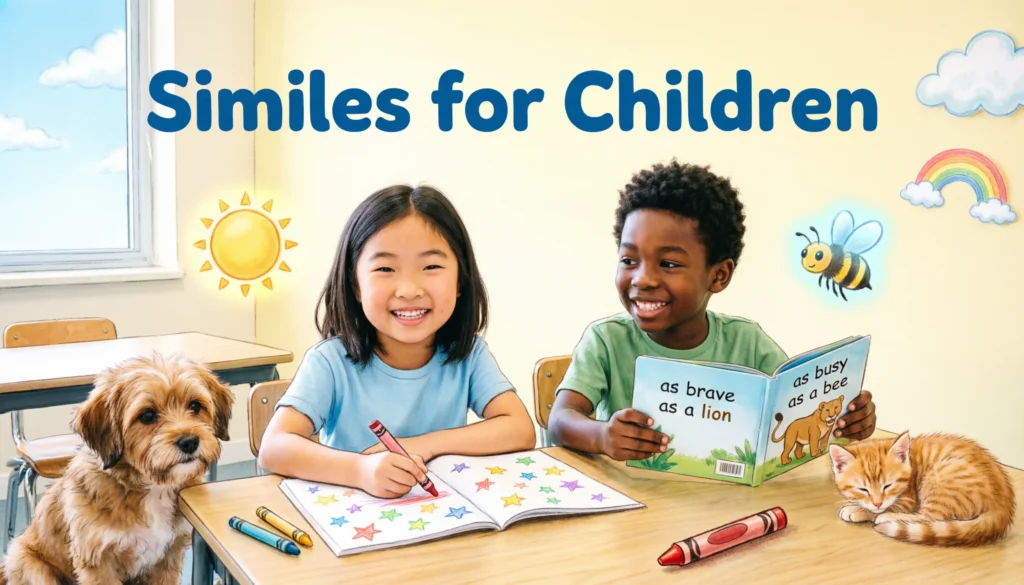
Similes for children help young learners understand ideas through simple comparisons. A simile uses words like “as” or “like” to compare one thing with another. Children enjoy these comparisons because they make language colorful, playful, and easier to remember.
Writers, teachers, students, and ESL learners can use similes to describe a child’s actions, feelings, appearance, energy, innocence, or behavior. A good simile should feel clear, kind, and natural. It should help the reader picture the child without sounding rude, forced, or confusing.
What Similes for Children Means
Similes for children are comparison phrases that describe children in a simple and vivid way. They often connect a child’s behavior or personality with something familiar.
Here is what the phrase means:
- It refers to similes used to describe children.
- It can show a child’s innocence, joy, energy, curiosity, or shyness.
- It helps students write more descriptive sentences.
- It makes stories, poems, and conversations more expressive.
- It works well for ESL learners because the comparisons feel easy to understand.
- It should stay respectful and age appropriate.
A simile for children does not always mean a simile written only for children. It can also mean a simile about children, such as “as playful as a puppy” or “as curious as a kitten.”
Common Similes for Children
Common similes work well because most readers understand them quickly. These phrases use simple images from nature, animals, family life, and everyday experience.
You can use them in school writing, creative stories, classroom activities, and spoken English. They make a sentence more visual without making it too difficult.
As playful as a puppy
Simple meaning: Very playful, active, and cheerful.
Example sentence: The children ran around the garden, as playful as puppies.
As curious as a kitten
Simple meaning: Very interested in learning or exploring.
Example sentence: Sara looked inside every box, as curious as a kitten.
As happy as a lark
Simple meaning: Very happy and full of joy.
Example sentence: The little boy was as happy as a lark when he saw the balloons.
As gentle as a lamb
Simple meaning: Very kind, soft, and calm.
Example sentence: The child held the baby bird as gentle as a lamb.
As bright as sunshine
Simple meaning: Cheerful, lively, or intelligent.
Example sentence: Her smile was as bright as sunshine.
Popular Similes for Children
Popular similes often appear in stories, classroom writing, and everyday speech. They sound familiar, so readers can understand them without much effort.
These similes help describe a child’s mood, personality, or actions in a warm and friendly way.
As sweet as candy
Simple meaning: Very sweet, kind, or lovable.
Example sentence: The little girl thanked everyone and acted as sweet as candy.
As quick as a rabbit
Simple meaning: Very fast and active.
Example sentence: He ran across the playground as quick as a rabbit.
As quiet as a mouse
Simple meaning: Very quiet or shy.
Example sentence: The child sat in the library as quiet as a mouse.
As light as a feather
Simple meaning: Very light in weight or soft in movement.
Example sentence: The toddler’s steps sounded as light as a feather.
As busy as a bee
Simple meaning: Very active and hardworking.
Example sentence: The children were as busy as bees during the art lesson.
Funny Similes for Children
Funny similes make writing more entertaining. They work well in stories, classroom examples, speeches, and playful descriptions.
You should use funny similes carefully. The goal is to sound warm and humorous, not insulting.
As messy as a paint box
Simple meaning: Very messy in a colorful or playful way.
Example sentence: After the craft activity, the children looked as messy as a paint box.
As loud as a marching band
Simple meaning: Very noisy and energetic.
Example sentence: The class became as loud as a marching band during game time.
As wiggly as a worm
Simple meaning: Unable to sit still.
Example sentence: The small boy was as wiggly as a worm during story time.
As bouncy as a rubber ball
Simple meaning: Full of energy and movement.
Example sentence: The children were as bouncy as rubber balls after lunch.
As sticky as jam
Simple meaning: Covered in something sticky or messy.
Example sentence: After eating sweets, his little fingers were as sticky as jam.
Useful Everyday Similes for Children
Everyday similes help describe normal scenes from home, school, and public places. They sound natural because they connect to familiar experiences.
Students and ESL learners can use these in simple paragraphs, diary writing, and short stories.
As sleepy as a kitten
Simple meaning: Very tired or ready to sleep.
Example sentence: After the picnic, the child was as sleepy as a kitten.
As brave as a little lion
Simple meaning: Courageous despite being young.
Example sentence: She stood on the stage as brave as a little lion.
As neat as a new notebook
Simple meaning: Very clean and tidy.
Example sentence: His school bag looked as neat as a new notebook.
As hungry as a bear cub
Simple meaning: Very hungry.
Example sentence: The children came home from school as hungry as bear cubs.
As cheerful as a song
Simple meaning: Very cheerful and pleasant.
Example sentence: Her voice sounded as cheerful as a song.
Similes for Children With Meanings and Examples
This section gives you a clear list of similes for children with meanings and natural example sentences. You can use these phrases in essays, poems, stories, conversations, and ESL practice.
Try to choose a simile that matches the exact feeling or action. A child can be playful, shy, noisy, gentle, bright, brave, or curious, so one simile will not fit every situation.
As innocent as a dove
Simple meaning: Very pure, honest, and harmless.
Example sentence: The child looked at the world as innocent as a dove.
As joyful as a birthday party
Simple meaning: Very joyful and excited.
Example sentence: The children were as joyful as a birthday party when the games began.
As soft as a teddy bear
Simple meaning: Gentle, warm, and comforting.
Example sentence: The toddler’s hug felt as soft as a teddy bear.
As small as a button
Simple meaning: Very small and cute.
Example sentence: The baby’s shoes were as small as buttons.
As wide eyed as an owl
Simple meaning: Very surprised, curious, or amazed.
Example sentence: The children watched the magic trick, as wide eyed as owls.
As fresh as morning dew
Simple meaning: Full of freshness, energy, or innocence.
Example sentence: The young students entered the classroom as fresh as morning dew.
As lively as a playground
Simple meaning: Full of movement, sound, and energy.
Example sentence: The room became as lively as a playground.
As shy as a fawn
Simple meaning: Very shy, gentle, or nervous.
Example sentence: The new student stood near the door as shy as a fawn.
As bright as a new crayon
Simple meaning: Colorful, cheerful, or full of promise.
Example sentence: Her drawing looked as bright as a new crayon.
As eager as a puppy at the door
Simple meaning: Very excited and ready to begin.
Example sentence: The children were as eager as puppies at the door before the trip.
How to Use Similes for Children in Sentences
A simile should fit the meaning of the sentence. Do not add a simile only because it sounds pretty. Use it when it helps the reader see, feel, or understand the child better.
The best similes for children use simple images. Animals, toys, weather, food, and nature often work well because students already know them.
Use similes to describe behavior
Children often show energy through movement, sound, and expression. A simile can make that behavior clearer.
Examples:
- The child jumped as bouncy as a rubber ball.
- The class worked as busy as bees.
- The little boy ran as quick as a rabbit.
Use similes to describe feelings
Feelings can seem hard to explain, especially for young learners. Similes make emotions easier to picture.
Examples:
- She felt as happy as a lark.
- He looked as shy as a fawn.
- The children were as excited as fireworks.
Use similes to describe appearance
Similes can also describe how a child looks, smiles, moves, or reacts. Keep the tone respectful and kind.
Examples:
- Her smile was as bright as sunshine.
- His eyes were as wide as an owl’s.
- The baby’s hands were as small as buttons.
Similes for Children for Writing and Speaking
In writing, similes help students avoid plain sentences. Instead of saying “the child was active,” they can write “the child was as bouncy as a rubber ball.” This gives the reader a stronger picture.
In speaking, similes make conversation more expressive. Parents, teachers, and learners can use them to describe children in a friendly and natural way.
Simple writing examples
- The children laughed like bells in the schoolyard.
- The little girl moved as light as a feather.
- The boys shouted as loud as a marching band.
- The baby slept like a tiny kitten.
- The students entered the room as cheerful as sunshine.
Simple speaking examples
- “He is as curious as a kitten today.”
- “The kids are as busy as bees.”
- “She was as brave as a little lion.”
- “They came home as hungry as bear cubs.”
- “That baby is as sweet as candy.”
Similes for Children for Students and ESL Learners
Students and ESL learners need similes that feel clear, useful, and easy to remember. Short comparisons work best because they show meaning without adding confusion.
When learning similes, focus on the image. Ask yourself what the second thing suggests. A puppy suggests playfulness. A mouse suggests quietness. Sunshine suggests happiness or brightness.
Easy similes for beginners
- As quiet as a mouse
- As busy as a bee
- As playful as a puppy
- As happy as a lark
- As gentle as a lamb
- As quick as a rabbit
- As sleepy as a kitten
- As sweet as candy
Practice tip for learners
Choose one child related word, then match it with a simple comparison.
Example:
- Happy child: as happy as a lark
- Quiet child: as quiet as a mouse
- Active child: as bouncy as a ball
- Brave child: as brave as a little lion
- Curious child: as curious as a kitten
This method helps learners build their own similes instead of memorizing every phrase.
Similes for Children in Conversations
Similes appear in daily conversations when people describe a child’s mood or behavior. They make speech warmer and more vivid.
You can use these phrases with family, friends, classmates, or teachers. Just choose gentle language, especially when speaking about real children.
Conversation examples
Parent: “The kids were as busy as bees this morning.”
Teacher: “Yes, they finished their craft work so quickly.”
Friend: “Your little brother is as curious as a kitten.”
You: “He opens every drawer he sees.”
Teacher: “Mina was as brave as a little lion on stage.”
Student: “She spoke so clearly.”
Mother: “The baby is as sleepy as a kitten.”
Father: “Let’s put him to bed.”
Student: “The class was as loud as a marching band.”
Teacher: “That means everyone had too much energy today.”
Similar Phrases and Expressions
Some phrases describe children without using a strict simile form. These expressions can still help writers talk about childhood, innocence, energy, and behavior.
A simile usually uses “like” or “as.” Similar expressions may use direct description or metaphor. Both can improve writing when used carefully.
Child related expressions
- A bundle of joy
Meaning: A very happy and lovable child.
Example: Their baby became a bundle of joy for the whole family. - Full of beans
Meaning: Full of energy.
Example: The children were full of beans after breakfast. - Bright eyed
Meaning: Alert, curious, and interested.
Example: The students looked bright eyed on the first day of school. - Little angel
Meaning: A very sweet or well behaved child.
Example: She acted like a little angel at the family dinner. - A ray of sunshine
Meaning: Someone who brings happiness.
Example: The child was a ray of sunshine in the house.
Common Mistakes When Using Similes for Children
Similes should make writing clearer, not heavier. Many students add too many comparisons in one paragraph, which makes the writing sound unnatural.
A strong simile should match the child’s action, mood, or personality. If the comparison does not fit, the sentence may confuse the reader.
Mistake 1: Using too many similes
Too many similes can make a paragraph feel crowded.
Weak example:
The child was as happy as a lark, as bright as sunshine, as sweet as candy, and as playful as a puppy.
Better example:
The child was as playful as a puppy in the garden.
Mistake 2: Choosing the wrong comparison
The comparison should match the meaning.
Weak example:
The baby cried as quiet as a mouse.
Better example:
The baby slept as quiet as a mouse.
Mistake 3: Using rude or harsh similes
Avoid similes that mock children or make them sound bad. Keep the tone kind and respectful.
Weak example:
The child was as annoying as a broken alarm.
Better example:
The child was as loud as a marching band.
Mistake 4: Making the sentence too long
A simple simile often works better than a long one.
Weak example:
The child ran like a rabbit that had just seen something in the field and wanted to escape quickly.
Better example:
The child ran as quick as a rabbit.
Mistake 5: Mixing similes and metaphors carelessly
A simile compares with “like” or “as.” A metaphor says one thing is another thing.
Simile:
The child was as bright as sunshine.
Metaphor:
The child was sunshine in the room.
Both can work, but do not mix them in a confusing way.
More Similes for Children
This list gives extra options for students, writers, and ESL learners. Use them when you want fresh phrases for essays, poems, stories, and classroom work.
Like birds learning to fly
Simple meaning: Growing, learning, or trying something new.
Example sentence: The children practiced reading like birds learning to fly.
Like flowers in spring
Simple meaning: Fresh, lively, and growing.
Example sentence: The children grew in confidence like flowers in spring.
Like stars in the night
Simple meaning: Bright, special, or noticeable.
Example sentence: The children’s eyes shone like stars in the night.
Like butterflies in a garden
Simple meaning: Light, active, and cheerful.
Example sentence: The girls danced like butterflies in a garden.
Like bells in the morning
Simple meaning: Clear, cheerful, and lively.
Example sentence: Their laughter rang like bells in the morning.
Like tiny explorers
Simple meaning: Curious and ready to discover new things.
Example sentence: The children moved through the museum like tiny explorers.
Like sunbeams through a window
Simple meaning: Warm, bright, and happy.
Example sentence: Their smiles came into the room like sunbeams through a window.
Like ducks in a pond
Simple meaning: Moving together in a cute or funny way.
Example sentence: The children followed their teacher like ducks in a pond.
Conclusion
Similes for children make writing brighter, clearer, and more enjoyable. They help students, writers, and ESL learners describe childhood in a simple but expressive way. A good simile can show energy, innocence, curiosity, shyness, joy, or bravery in just a few words. Phrases like “as playful as a puppy,” “as quiet as a mouse,” and “as curious as a kitten” work because readers understand the images quickly. Use these similes with care, kindness, and purpose. When the comparison fits the child’s action or feeling, your sentence becomes stronger, warmer, and easier to picture.
FAQs
What are similes for children?
Similes for children are comparison phrases that describe children or help children learn figurative language. They often use “like” or “as,” such as “as playful as a puppy.”
What is a good simile for a happy child?
A good simile for a happy child is “as happy as a lark.” You can also say “as cheerful as sunshine” or “as joyful as a birthday party.”
What is a simple simile for a quiet child?
“As quiet as a mouse” is one of the simplest and most common similes for a quiet child. It works well in school writing and daily speech.
Can ESL learners use similes for children?
Yes, ESL learners can use these similes to build vocabulary and improve descriptive writing. Short similes with familiar images work best for beginners.
Are similes and metaphors the same?
No, they are different. A simile uses “like” or “as” to compare two things. A metaphor says one thing is another thing without using “like” or “as.”
How many similes should I use in one paragraph?
Use one or two strong similes in a paragraph. Too many similes can make your writing sound crowded or unnatural.
What is a funny simile for children?
A funny simile for children is “as bouncy as a rubber ball.” It describes a child with lots of energy in a playful and friendly way.
Mia Belle is a skilled content writer at MetaphorForge, celebrated for her elegant use of language and vivid metaphors. She crafts emotionally rich pieces that make complex ideas easy to grasp. With a refined storytelling style, she connects deeply with readers. Her work reflects creativity, insight, and clarity.