
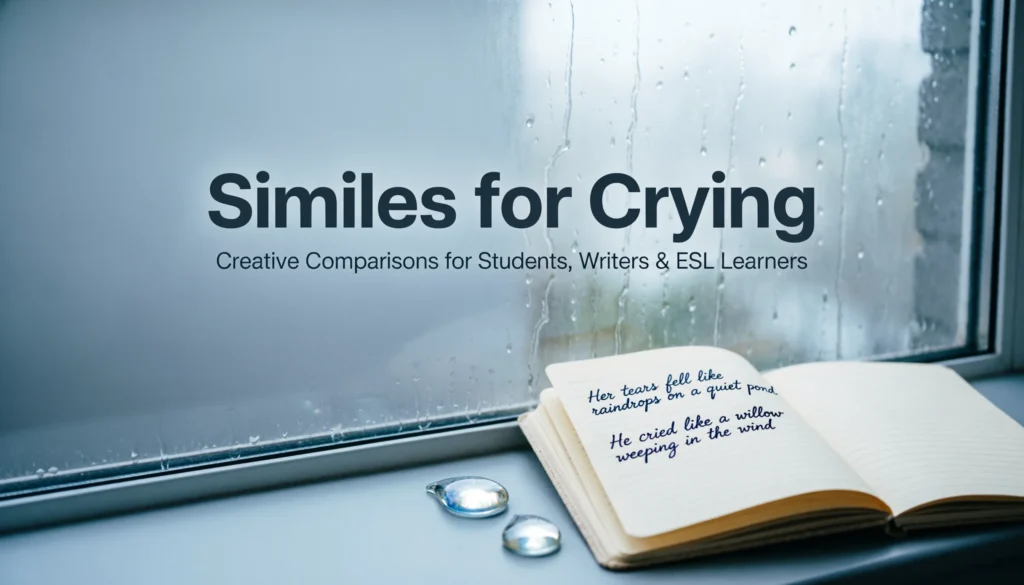
Crying can show sadness, relief, fear, pain, joy, or deep emotion. Good similes for crying help writers describe tears in a way readers can feel and understand. Instead of saying “she cried,” you can say she cried like rain on a window or sobbed like a lost child.
These comparisons work well for students, story writers, poets, and ESL learners. They make emotional writing clearer, stronger, and more natural. In this guide, you will learn common, popular, funny, useful, and everyday similes for crying with simple meanings and example sentences.
What Similes for Crying Mean
Similes for crying compare the act of crying to something familiar. They usually use “like” or “as” to create a clear picture in the reader’s mind.
- They describe how someone cries.
- They show the strength of emotion.
- They help readers imagine tears, sobs, or sadness.
- They make writing more expressive than plain words.
- They can sound serious, poetic, funny, or casual.
- They help students and ESL learners build better emotional vocabulary.
Common Similes for Crying
Common similes for crying are useful in school writing, stories, and daily speech. These phrases feel easy to understand because they use simple images like rain, babies, rivers, and broken hearts.
Crying Like a Baby
Simple meaning: Crying loudly and openly.
Example sentence: After losing the final match, he cried like a baby in the locker room.
Crying Like Rain
Simple meaning: Crying with many tears.
Example sentence: Tears fell from her eyes like rain after she heard the sad news.
Crying Like a Child
Simple meaning: Crying in a helpless or emotional way.
Example sentence: He cried like a child when his old dog died.
Crying Like the Sky Opened Up
Simple meaning: Crying heavily and suddenly.
Example sentence: She cried like the sky opened up when she read the letter.
Crying Like a Broken Heart
Simple meaning: Crying with deep sadness.
Example sentence: He cried like a broken heart after the farewell.
Popular Similes for Crying
Popular similes often appear in songs, poems, stories, and emotional scenes. They help writers create a strong mood without making the sentence too difficult.
Crying Like a River
Simple meaning: Crying a lot.
Example sentence: She cried like a river after saying goodbye to her best friend.
Tears Flowing Like a Stream
Simple meaning: Tears moving smoothly and continuously.
Example sentence: Tears flowed like a stream down his cheeks.
Sobbing Like a Lost Child
Simple meaning: Crying with fear, sadness, or confusion.
Example sentence: The little boy sobbed like a lost child in the crowded market.
Weeping Like a Widow
Simple meaning: Crying with deep grief.
Example sentence: She wept like a widow at the funeral.
Crying Like a Rain Cloud
Simple meaning: Crying in a gloomy or emotional way.
Example sentence: He sat alone and cried like a rain cloud.
Funny Similes for Crying
Funny similes for crying can work in lighthearted writing, jokes, comic scenes, or playful conversations. Use them when the situation is not deeply serious.
Crying Like Someone Cut Onions
Simple meaning: Crying with watery eyes.
Example sentence: He cried like someone cut onions during the movie scene.
Crying Like a Kid Who Lost Candy
Simple meaning: Crying over something small or disappointing.
Example sentence: My brother cried like a kid who lost candy when his game crashed.
Crying Like a Soap Opera Star
Simple meaning: Crying in a dramatic way.
Example sentence: She cried like a soap opera star after missing the bus.
Crying Like a Leaky Tap
Simple meaning: Crying nonstop but not too loudly.
Example sentence: He cried like a leaky tap after his team lost.
Crying Like His Ice Cream Fell
Simple meaning: Crying over a small loss.
Example sentence: Tom cried like his ice cream fell when he got a low score.
Useful Everyday Similes for Crying
Everyday similes sound natural in conversations, essays, and simple stories. They are easy for ESL learners because the images are familiar.
Crying Like It Was the End of the World
Simple meaning: Crying with extreme emotion.
Example sentence: She cried like it was the end of the world when her friend moved away.
Crying Like His Heart Hurt
Simple meaning: Crying because of emotional pain.
Example sentence: He cried like his heart hurt after the argument.
Crying Like a Storm
Simple meaning: Crying loudly and intensely.
Example sentence: The child cried like a storm after falling down.
Crying Like Water Pouring Out
Simple meaning: Crying with many tears.
Example sentence: Tears came like water pouring out when she saw the old photo.
Crying Like a Wounded Animal
Simple meaning: Crying with pain and helplessness.
Example sentence: He cried like a wounded animal after hearing the truth.
Similes for Crying With Meanings and Examples
These similes can help you choose the right emotional tone. Some sound gentle, some sound dramatic, and some sound poetic.
| Simile for crying | Simple meaning | Example sentence |
|---|---|---|
| Crying like rain | Many tears | She cried like rain after the goodbye. |
| Crying like a baby | Loud and open crying | He cried like a baby after the accident. |
| Tears like rivers | Heavy crying | Tears ran like rivers down her face. |
| Sobbing like a lost child | Helpless crying | She sobbed like a lost child in the dark room. |
| Crying like a storm | Strong emotional crying | He cried like a storm all night. |
| Weeping like a willow | Soft, graceful sadness | She wept like a willow beside the window. |
| Crying like a broken doll | Fragile and helpless crying | The girl cried like a broken doll on the floor. |
| Tears falling like pearls | Beautiful or delicate tears | Her tears fell like pearls in the candlelight. |
| Crying like a rain cloud | Sad and gloomy crying | He cried like a rain cloud after the fight. |
| Crying like a leaky faucet | Continuous crying | The toddler cried like a leaky faucet. |
How to Use Similes for Crying in Sentences
A good simile should match the emotion, character, and scene. Do not add a dramatic simile to a small moment unless you want a funny effect.
Use these tips:
- Use gentle similes for quiet sadness.
- Use strong similes for grief or shock.
- Use funny similes for light scenes.
- Avoid mixing too many images in one sentence.
- Keep the sentence natural and easy to read.
Examples in Sentences
Phrase: She cried like rain on a cold window.
Simple meaning: She cried softly and sadly.
Example sentence: After reading the note, she cried like rain on a cold window.
Phrase: He sobbed like his world had ended.
Simple meaning: He cried with extreme sadness.
Example sentence: He sobbed like his world had ended when his best friend left.
Phrase: Tears fell like tiny glass beads.
Simple meaning: Tears looked clear and delicate.
Example sentence: Tears fell like tiny glass beads as she listened to the song.
Phrase: The child cried like thunder.
Simple meaning: The child cried very loudly.
Example sentence: The child cried like thunder when he dropped his toy.
Similes for Crying for Writing and Speaking
In writing, similes help readers feel the emotion. In speaking, they help people understand your reaction quickly. A strong simile can make a sentence more memorable.
For serious writing, choose emotional and clear images. For casual speaking, choose simple comparisons that people know.
Writing Examples
Phrase: Her tears fell like rain on dry earth.
Simple meaning: Her crying showed deep relief or sadness.
Example sentence: Her tears fell like rain on dry earth after years of holding pain inside.
Phrase: He cried like a man carrying too much grief.
Simple meaning: He cried because he felt emotionally heavy.
Example sentence: He cried like a man carrying too much grief when the truth came out.
Phrase: She wept like the night itself had broken.
Simple meaning: She cried in a poetic and dramatic way.
Example sentence: She wept like the night itself had broken after the final goodbye.
Speaking Examples
Phrase: I cried like a baby.
Simple meaning: I cried a lot.
Example sentence: I cried like a baby during that movie.
Phrase: She cried like crazy.
Simple meaning: She cried a lot or very emotionally.
Example sentence: She cried like crazy after hearing the news.
Phrase: He cried like someone stole his favorite thing.
Simple meaning: He cried over disappointment.
Example sentence: He cried like someone stole his favorite thing when his phone broke.
Similes for Crying for Students and ESL Learners
Students and ESL learners should start with simple similes before trying poetic ones. Simple comparisons help you write clear emotional sentences without sounding confusing.
Try to connect the simile with the feeling. “Crying like rain” fits sadness. “Crying like thunder” fits loud crying. “Tears like pearls” fits soft or beautiful sadness.
Easy Similes for Learners
Phrase: Crying like a baby
Simple meaning: Crying loudly.
Example sentence: The boy cried like a baby after he fell.
Phrase: Tears like rain
Simple meaning: Many tears.
Example sentence: Her tears fell like rain.
Phrase: Crying like a child
Simple meaning: Crying openly.
Example sentence: He cried like a child when he lost the letter.
Phrase: Crying like a storm
Simple meaning: Crying strongly.
Example sentence: She cried like a storm after the bad news.
Phrase: Tears like water
Simple meaning: Tears flowing freely.
Example sentence: Tears came like water from his eyes.
Similes for Crying in Conversations
People use crying similes in conversation to explain emotions quickly. Some sound serious, while others sound playful or exaggerated.
Choose your words carefully. A funny crying simile may sound rude if someone feels truly hurt.
Conversation Examples
Phrase: He cried like a baby.
Simple meaning: He cried a lot.
Example sentence: He cried like a baby when the movie ended.
Phrase: She cried like her heart broke.
Simple meaning: She felt deep emotional pain.
Example sentence: She cried like her heart broke after the breakup.
Phrase: I cried like someone cut onions.
Simple meaning: I had watery eyes or cried lightly.
Example sentence: I cried like someone cut onions during that wedding speech.
Phrase: They cried like it was the last goodbye.
Simple meaning: They cried with strong sadness.
Example sentence: They cried like it was the last goodbye at the airport.
Similar Phrases and Expressions
Some phrases are not exact similes, but they describe crying in a useful way. Writers can use them to add variety and avoid repeating the same sentence pattern.
Bursting Into Tears
Simple meaning: Starting to cry suddenly.
Example sentence: She burst into tears when she saw her result.
Breaking Down
Simple meaning: Losing emotional control and crying.
Example sentence: He broke down after trying to stay strong all day.
Fighting Back Tears
Simple meaning: Trying not to cry.
Example sentence: She fought back tears during the speech.
Choking Back Sobs
Simple meaning: Trying to control crying sounds.
Example sentence: He choked back sobs while reading the letter.
Eyes Filled With Tears
Simple meaning: Someone is about to cry.
Example sentence: Her eyes filled with tears when she heard his apology.
Tears Welled Up
Simple meaning: Tears slowly appeared in the eyes.
Example sentence: Tears welled up as he remembered his childhood home.
Crying Her Eyes Out
Simple meaning: Crying a lot.
Example sentence: She cried her eyes out after losing her pet.
Common Mistakes When Using Similes for Crying
Similes can improve writing, but weak or mismatched comparisons can make emotion feel awkward. Good emotional writing needs control and clarity.
Avoid these mistakes:
- Do not use too many crying similes in one paragraph.
- Do not choose a funny simile for a serious death or grief scene.
- Do not make the comparison too strange for the reader.
- Do not repeat “crying like a baby” too often.
- Do not use poetic similes in casual dialogue unless the character speaks that way.
- Do not confuse similes with metaphors. A simile uses “like” or “as.”
Weak Example
She cried like rain, like a river, like a storm, and like a broken cloud.
Better Example
She cried like rain against the window, quiet but endless.
Conclusion
Similes for crying help writers describe sadness, pain, relief, fear, and deep emotion in a clearer way. A simple phrase like “crying like rain” can show many tears, while “sobbing like a lost child” can show helplessness. Students and ESL learners should begin with easy similes and then try more creative ones. Writers should match each simile with the tone of the scene. Funny similes work best in light moments, while poetic similes fit stories and poems. When used carefully, these comparisons make emotional writing feel vivid, natural, and memorable.
FAQs
What are similes for crying?
Similes for crying are comparisons that describe how someone cries. They often use “like” or “as,” such as “crying like rain” or “sobbing like a child.”
What is a good simile for crying a lot?
A good simile for crying a lot is “crying like a river.” It shows that many tears are flowing.
What is a funny simile for crying?
A funny simile for crying is “crying like someone cut onions.” It works well for light or humorous situations.
What is a sad simile for crying?
A sad simile for crying is “weeping like a broken heart.” It shows deep emotional pain.
Can I use similes for crying in school essays?
Yes, you can use them in school essays, stories, and poems. Choose simple and clear similes so your writing sounds natural.
Are crying similes useful for ESL learners?
Yes, they help ESL learners describe emotions with more detail. They also teach common English comparison patterns.
What is the difference between a simile and a metaphor for crying?
A simile uses “like” or “as,” such as “tears fell like rain.” A metaphor says something directly, such as “her tears were rain.”

Mia Belle is a skilled content writer at MetaphorForge, celebrated for her elegant use of language and vivid metaphors. She crafts emotionally rich pieces that make complex ideas easy to grasp. With a refined storytelling style, she connects deeply with readers. Her work reflects creativity, insight, and clarity.