
There’s a moment in every summer day — usually around two in the afternoon — when the world just stops. The air thickens. The road shimmers. Even the birds go quiet.
Most people say “it was hot.” And that’s fine. But it doesn’t do anything.
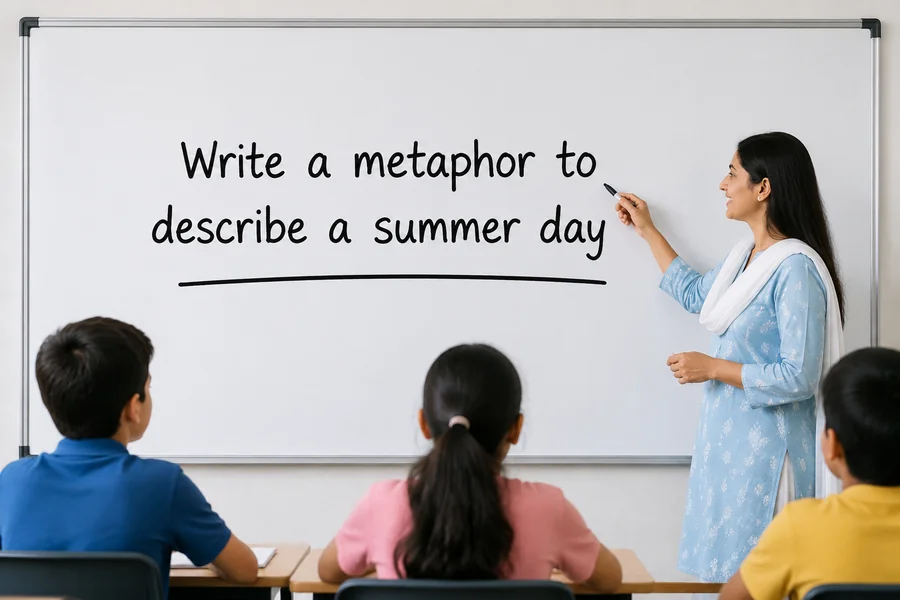
That’s where metaphors come in. And if you’re trying to write a metaphor to describe a summer day, you’re already thinking like a writer — you just need the right tools to pull it off.
This guide is practical metaphors for summer. No fluff. Real examples you can actually use.
What Does It Mean to Write a Metaphor to Describe a Summer Day?
Real quick — a metaphor says one thing is another. Not “like” another. Is.
- Simile: The day felt like a furnace.
- Metaphor: The day was a furnace.
That one-word difference changes the weight of the sentence. The metaphor commits. It doesn’t hedge. And when it’s done right, the reader feels it before they even finish reading.
Summer is one of the easiest seasons to write metaphors for — because it hits all five senses at once. Heat on skin. Cicadas in the trees. The smell of cut grass and sunscreen. There’s a lot to work with.
How to Write a Metaphor to Describe a Summer Day (3 Steps, No Jargon)
Don’t overcomplicate this. Here’s what actually works:
Step 1 — Pick one feeling, not five. Heat, stillness, noise, brightness, weight. One. The more focused you are, the stronger the metaphor.
Step 2 — Find something from real life that shares that feeling. A furnace shares heat. A feast shares abundance. A held breath shares pressure. Think about things you’ve actually touched or been near.
Step 3 — Write: “A summer day is a ____.” Finish it. Don’t edit yourself yet. Write five versions. Then cut to the one that makes you stop reading for a second.
That pause? That’s the metaphor working.
12 Summer Metaphors to Describe a Summer Day
These aren’t pulled from a list of clichés. Each one targets something specific.
| No. | The Metaphor | What It’s Really Saying |
| 1 | A summer day is an open furnace — air moves in and comes out hotter | Relentless, inescapable heat |
| 2 | The afternoon was a slow burn nobody asked for | Gradual, building intensity |
| 3 | Summer is a generous host — warmth spread across everything, no invitation needed | Abundance, openness |
| 4 | The day was a drum left in direct sun — tighter and louder by noon | Tension, pressure, sound |
| 5 | The heat was a hand pressed flat on the back of your neck | Physical weight that doesn’t move |
| 6 | The sky was a dome of pressed glass — clear, sealed, letting nothing through | Still air, no wind, no escape |
| 7 | Summer was a slow-burning candle — full flame at noon, soft wax by six | Time melting, day winding down |
| 8 | The afternoon was a kitchen where someone forgot the stove | Dry, persistent, room-filling warmth |
| 9 | A summer day is a debt the earth owes the sun, paid back one hour at a time | Elemental, slow, inevitable |
| 10 | The day was an old radio left on — warm, humming, never fully off | Low-grade constant energy |
| 11 | Summer is a match that burns bright and leaves nothing behind | Fleeting, fast, gone before you notice |
| 12 | The air was a weight you wore, not something you breathed | Heavy humidity, full-body heat |
Summer Day Metaphors: Full Fact Table
| Detail | What to Know |
| Definition | A metaphor for summer directly says the day is something else — no “like” or “as” |
| Most common comparisons | Furnace, oven, golden blanket, feast, slow fire, pressed weight |
| Best sensory entry point | Heat and stillness — hardest to describe, easiest to feel |
| Metaphor vs. simile | Metaphor: “The day was a furnace.” / Simile: “The day felt like a furnace.” |
| Classic literary use | Shakespeare, Sonnet 18 — comparing a person’s beauty to a summer’s day |
| Best use cases | Descriptive essays, poetry, personal narratives, social captions, creative writing |
| Biggest mistake writers make | Piling three metaphors on top of each other — one good one beats four weak ones |
| Ideal length | One sentence, sometimes two — shorter usually hits harder |
| Tone options | Heavy/hot, slow/nostalgic, free/energetic, tense/building |
| NLP-related terms | Figurative language, sensory writing, descriptive imagery, literary devices |
Read More: Idioms for Scared Explained
Write a Metaphor to Describe a Summer Day by Mood
Not every summer day feels the same. Here’s how to match your metaphor to what you’re actually trying to say.
When Summer Feels Punishing
“The day sat on the city like something that refused to leave.”
“By noon, breathing felt like an effort nobody signed up for.”
“The heat didn’t arrive — it was already there when you woke up.”
When Summer Feels Wide Open and Free
“Summer was a wild kid — no shoes, no plan, no curfew.”
“The season was a running engine. Always warm. Always moving.”
“Those months were a door held wide open — nobody wanted to be the one to close it.”
When Summer Feels Like a Memory
“The whole thing felt like a photograph you keep looking at — warm at the edges, soft in the middle.”
“July was a time machine nobody built on purpose.”
“Summer tasted like something you can’t name — you just know when it’s gone.”
When Summer Feels Short
“Summer is a match. Bright for a second. Then nothing.”
“The season was a breath held too long — eventually, October exhaled for all of us.”
“August is summer, checking its watch.”
Common Mistakes When You Write a Metaphor to Describe a Summer Day
These will kill a good metaphor before the reader even finishes the sentence.
Stacking metaphors. “The day was a furnace swimming in a river of gold light under a burning crown.” That’s three different images crashing into each other. One is enough.
Reaching for the obvious. “The sun was a ball of fire” — yes, technically. But it’s been written ten thousand times. Go one step past your first instinct.
Going vague. “Summer was beautiful” is not a metaphor. It’s an opinion. Tether it to something concrete — an object, a sensation, a situation.
Writing for the page, not the reader. Read your metaphor out loud. If you’d feel embarrassed saying it to someone, rewrite it.
Quick Answers
| Question | Short Answer |
| What is a metaphor to describe a summer day? | “A summer day is an open furnace — warm, heavy, and impossible to escape.” |
| What is a metaphor for hot weather? | Hot weather is a furnace with no off switch, or a slow burn pressed down on everything. |
| How do you describe a summer day in writing? | Focus on one sensation — heat, stillness, or sound — and compare it to something the reader already knows. |
| What is a simile for a summer day? | “The summer day felt like a warm blanket held too tight” — using “like” makes it a simile, not a metaphor. |
| How do you write a metaphor for beginners? | Say “X is a Y.” Pick two things that share one quality. Write one clear, committed sentence. |
| What literary device describes summer in Sonnet 18? | Shakespeare uses metaphor and direct comparison — linking human beauty to the qualities of a summer day. |
| What is a metaphor for summer heat? | “Summer heat is a hand that doesn’t let go” — constant, physical, inescapable. |
| What words best describe a summer day? | Still, full, loud, slow, open, pressing, bright — sensory words that place the reader inside the moment. |
Full Paragraph: Write a Metaphor to Describe a Summer Day in Action
Here’s what it looks like when these ideas work together as real writing — no padding, no decoration:
The summer day was an open oven. Heat came up from the pavement as much as it came down from the sky, and the city didn’t know where to put itself. By two o’clock, the whole street had slowed to nearly nothing — dogs flat on concrete, birds gone quiet, even the traffic lights blinking like they were tired. Then around six, one breath of air moved in off the water. Just one. The kind that makes you look up. And for a moment, the whole day was unclenched.
No “blazing,” no “scorching,” no “searing rays.” Just concrete, specific things — and a metaphor doing its job quietly.
Read More: Idioms for School
Final Word
When you sit down to write a metaphor to describe a summer day, don’t start by looking things up. Start with a real memory — one afternoon, one specific heat, one moment when time felt like it had stopped.
Then ask yourself: what else feels exactly like this?
That answer is your metaphor. It was always there. You just had to get honest enough to find it.
FAQs:
Q: What makes a summer metaphor actually land?
It hits one specific sensation and ties it to something familiar. The more concrete, the harder it lands.
Q: Can I use more than one metaphor in a paragraph?
Yes — but space them out. Back-to-back metaphors compete. Use one, let it breathe, then bring in another.
Q: Is “the sun is a ball of fire” a real metaphor?
Yes. But it’s worn out. Your reader won’t feel anything. Push to the second or third idea that comes to you.
Q: How do I test if my metaphor is strong?
Read it out loud. If you pause — good. If you skim past it — rewrite.
Q: Can students use these in school essays?
Absolutely. Metaphors work in descriptive writing, personal narratives, and creative assignments. Match the tone to the rest of the piece.
Q: Metaphor vs. personification — what’s the difference?
Metaphor: “Summer is a furnace.” Personification: “Summer breathed heat into every corner.” Both are useful. They do different things.
