
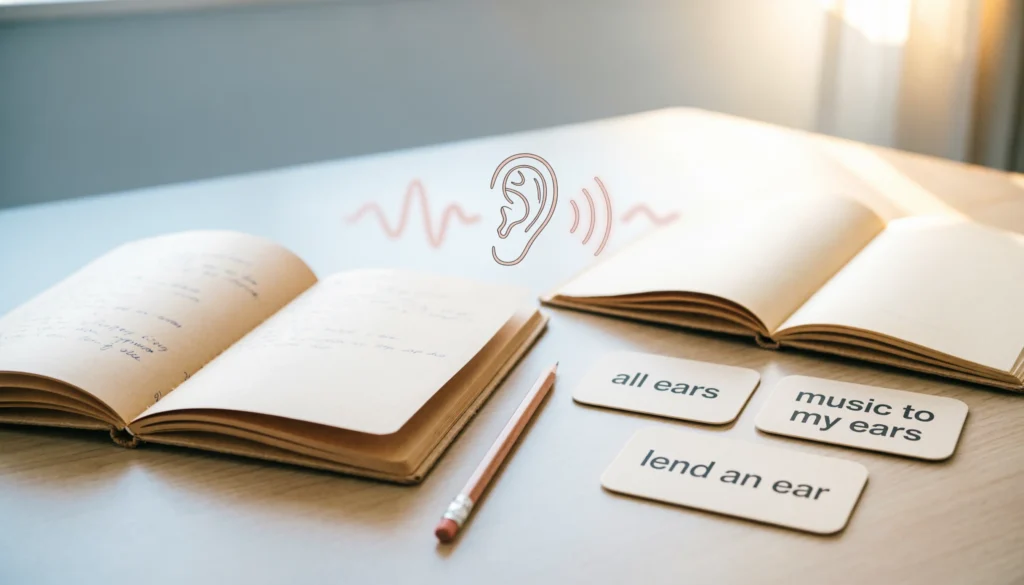
Idioms about ears are common English expressions that describe listening, hearing, attention, gossip, advice, secrets, and communication. These phrases do not always refer to real ears. Instead, they use the idea of hearing to explain how people receive information, ignore warnings, listen carefully, or react to news.
Students, writers, and ESL learners can use these idioms to make English sound more natural. Many of them appear in daily conversations, stories, workplace talks, and informal writing. Learning their meanings helps you understand native speakers and choose better expressions when you talk about listening, rumors, advice, or private information.
What “Idioms About Ears” Mean
Idioms about ears usually connect to listening, attention, or information.
They can mean:
- Listening carefully to someone
- Ignoring advice or warnings
- Hearing gossip or secret news
- Being interested in what someone says
- Receiving criticism or complaints
- Staying alert for important information
- Pretending not to hear something
- Listening to music or sounds with pleasure
- Understanding a person through tone or speech
These idioms help English speakers talk about communication in a vivid and natural way.
Common, Popular, Funny, Useful, and Everyday Idioms About Ears
English has many ear related idioms that people use in normal speech. Some sound serious, while others sound funny or informal. You may hear them at school, at work, in family conversations, or in movies.
1. All Ears
Simple meaning: listening very carefully and with full interest.
Example sentence: Tell me what happened at the meeting because I am all ears.
2. Play It by Ear
Simple meaning: decide what to do later, depending on the situation.
Example sentence: We do not need a fixed plan for Saturday, so let us play it by ear.
3. Lend an Ear
Simple meaning: listen kindly to someone.
Example sentence: She always lends an ear when her friends need support.
4. Keep an Ear Out
Simple meaning: listen carefully for a sound, message, or update.
Example sentence: Keep an ear out for the delivery driver while I finish cooking.
5. Turn a Deaf Ear
Simple meaning: ignore someone’s request, advice, or complaint.
Example sentence: The manager turned a deaf ear to the staff’s concerns.
6. Fall on Deaf Ears
Simple meaning: fail to get attention or support.
Example sentence: His warnings about the broken machine fell on deaf ears.
7. In One Ear and Out the Other
Simple meaning: quickly forgotten or ignored after hearing.
Example sentence: I explained the rule twice, but it went in one ear and out the other.
8. Music to My Ears
Simple meaning: very pleasing or happy to hear.
Example sentence: Hearing that the exam was postponed was music to my ears.
9. Wet Behind the Ears
Simple meaning: young, inexperienced, or new to something.
Example sentence: He is talented, but he is still wet behind the ears in this job.
10. Up to One’s Ears
Simple meaning: deeply involved in something or very busy.
Example sentence: I am up to my ears in assignments this week.
11. Have Someone’s Ear
Simple meaning: have someone’s attention or influence.
Example sentence: The advisor has the director’s ear, so people listen to his suggestions.
12. Bend Someone’s Ear
Simple meaning: talk to someone for a long time, often about a problem.
Example sentence: My neighbor bent my ear for an hour about parking issues.
13. Give Someone an Earful
Simple meaning: strongly complain to someone or criticize them.
Example sentence: My father gave me an earful after I came home late.
14. Prick Up One’s Ears
Simple meaning: suddenly listen with interest.
Example sentence: The students pricked up their ears when the teacher mentioned a surprise quiz.
15. By Ear
Simple meaning: play or understand music without written notes.
Example sentence: She can play many songs by ear.
Idioms About Ears With Meanings and Examples
This section gives more ear idioms in a clear format. These examples can help you use each phrase naturally in writing and speaking.
16. A Word in Your Ear
Simple meaning: a private comment or quiet piece of advice.
Example sentence: Can I have a word in your ear before the meeting starts?
17. To the Ear
Simple meaning: based on how something sounds.
Example sentence: The poem sounds smooth to the ear because of its soft rhythm.
18. Easy on the Ear
Simple meaning: pleasant to listen to.
Example sentence: Her voice is easy on the ear, which makes her a great narrator.
19. Hard on the Ears
Simple meaning: unpleasant or painful to listen to.
Example sentence: The loud alarm was hard on the ears.
20. Ear to the Ground
Simple meaning: staying alert for news, trends, or hidden information.
Example sentence: Good journalists keep their ear to the ground.
21. Walls Have Ears
Simple meaning: be careful because someone may hear your private words.
Example sentence: Do not discuss the surprise here because walls have ears.
22. Make One’s Ears Burn
Simple meaning: make someone feel that others are talking about them.
Example sentence: My ears were burning because everyone kept mentioning my name.
23. Cannot Believe One’s Ears
Simple meaning: feel shocked by what one hears.
Example sentence: I could not believe my ears when she announced the result.
24. Smile From Ear to Ear
Simple meaning: smile very widely because of happiness.
Example sentence: He smiled from ear to ear after winning the prize.
25. Grin From Ear to Ear
Simple meaning: show a very big smile.
Example sentence: The child grinned from ear to ear when he saw the birthday cake.
26. Out on One’s Ear
Simple meaning: forced to leave a place, job, or group.
Example sentence: The rude customer was thrown out on his ear.
27. Cauliflower Ear
Simple meaning: a damaged or swollen ear, often linked with boxing or wrestling.
Example sentence: The old fighter had cauliflower ear from years in the ring.
28. Dog Eared
Simple meaning: a book or paper with folded, worn, or damaged corners.
Example sentence: She carried a dog eared notebook full of poem ideas.
29. Have Big Ears
Simple meaning: listen to things that are private or not meant for you.
Example sentence: Do not discuss the gift near the children because they have big ears.
30. Be a Good Ear
Simple meaning: be someone who listens well.
Example sentence: My sister is a good ear when I need honest advice.
How to Use Idioms About Ears in Sentences
Idioms about ears work best when the situation involves listening, news, attention, advice, sound, or private information. You should choose the phrase that matches the tone of the sentence.
Use all ears when someone listens with interest.
Example: I am all ears if you have a better idea.
Use fall on deaf ears when advice or warnings get ignored.
Example: The safety reminder fell on deaf ears.
Use music to my ears when news makes someone happy.
Example: The words no homework were music to my ears.
Use play it by ear when plans may change.
Example: We will check the weather and play it by ear.
Use walls have ears when people need privacy.
Example: Speak quietly because walls have ears in this office.
Idioms About Ears for Writing and Speaking
Writers can use ear idioms to show character, mood, and communication style. For example, a nervous character may keep an ear out for footsteps. A tired worker may say they are up to their ears in tasks. A happy student may describe good news as music to my ears.
Speakers use these idioms because they sound natural and expressive. In conversation, all ears feels friendly, bend someone’s ear feels informal, and turn a deaf ear sounds serious. Choose idioms carefully so your sentence matches the situation.
For formal writing, use these idioms only when they fit the tone. In essays, simple phrases like listen carefully or ignore advice may work better. In stories, dialogue, blog posts, and personal writing, idioms about ears can make language more lively.
Idioms About Ears for Students and ESL Learners
Students and ESL learners should learn ear idioms through context, not memorization alone. Many of these phrases do not mean what the individual words suggest. For example, play it by ear does not mean using your ear to play something unless you talk about music. In daily conversation, it usually means deciding later.
Start with the most common phrases first: all ears, play it by ear, music to my ears, lend an ear, and in one ear and out the other. These idioms appear often and work in many situations.
A good learning method is to group them by meaning:
Listening: all ears, lend an ear, keep an ear out
Ignoring: turn a deaf ear, fall on deaf ears
Good news: music to my ears
Planning: play it by ear
Privacy: walls have ears
Experience: wet behind the ears
This grouping helps you remember the idioms faster and use them with confidence.
Idioms About Ears in Conversations
Idioms about ears often appear in everyday speech. Here are natural conversation examples.
Conversation 1
A: I have something important to tell you.
B: Go ahead. I am all ears.
Conversation 2
A: What time should we leave tomorrow?
B: Let us play it by ear and see how busy the roads are.
Conversation 3
A: I warned them about the problem last week.
B: Sadly, your warning fell on deaf ears.
Conversation 4
A: The teacher said the test is next week, not tomorrow.
B: That is music to my ears.
Conversation 5
A: Can we talk about this here?
B: Better not. Walls have ears.
Conversation 6
A: Why are you smiling from ear to ear?
B: I just got accepted into my first choice university.
Similar Phrases and Expressions
Some expressions relate to ears, listening, attention, and sound, even when they do not work exactly like idioms.
Listen Closely
Simple meaning: pay careful attention to what someone says.
Example sentence: Listen closely because the instructions are important.
Hear Someone Out
Simple meaning: listen to someone’s full explanation before judging.
Example sentence: Please hear me out before you make a decision.
Pay Attention
Simple meaning: focus on something.
Example sentence: Pay attention to the teacher’s explanation.
Tune In
Simple meaning: listen or focus on something.
Example sentence: Tune in to the announcement after lunch.
Shut Out the Noise
Simple meaning: ignore distractions.
Example sentence: She shut out the noise and focused on her writing.
Catch Every Word
Simple meaning: hear and understand everything someone says.
Example sentence: The room was so quiet that I caught every word.
Hear Through the Grapevine
Simple meaning: hear news through gossip or informal sources.
Example sentence: I heard through the grapevine that our team may get a new manager.
Common Mistakes With Idioms About Ears
Many learners make small mistakes when using idioms about ears. These mistakes can make a sentence sound unnatural.
Using the Literal Meaning Only
Do not translate every word directly. All ears does not mean someone has many ears. It means the person is ready to listen.
Incorrect: I became all ears physically.
Correct: I was all ears when she started telling the story.
Confusing Play It by Ear With Music Only
Play it by ear can mean playing music without notes, but it often means deciding later.
Incorrect: We will play it by ear with a guitar tomorrow.
Correct: We will play it by ear and decide after lunch.
Using Deaf Ear Carelessly
Turn a deaf ear and fall on deaf ears are common idioms, but they can sound strong. Use them for serious ignoring, not small mistakes.
Better: The company turned a deaf ear to repeated complaints.
Mixing Idioms Together
Do not combine two idioms unless you know the result sounds natural.
Incorrect: I am all ears to the ground.
Correct: I am all ears.
Correct: Keep your ear to the ground.
Overusing Idioms
Too many idioms can make writing feel forced. Use one strong idiom where it adds meaning.
Weak: I was all ears, then kept an ear out, and the news was music to my ears.
Better: I was all ears when she shared the good news.
Choosing the Wrong Tone
Some idioms sound casual. Bend someone’s ear works in informal speech, but it may not fit formal academic writing.
Casual: He bent my ear about his travel plans.
Formal: He spoke at length about his travel plans.
More Useful Idioms About Ears
31. Be Up to the Ears in Something
Simple meaning: have too much work, trouble, or responsibility.
Example sentence: She is up to the ears in exam preparation.
32. Have an Ear for Something
Simple meaning: have a natural ability to hear, understand, or judge sound.
Example sentence: He has an ear for languages and learns accents quickly.
33. No Ear for Music
Simple meaning: lack skill in hearing musical notes or rhythm.
Example sentence: I enjoy singing, but I have no ear for music.
34. Get an Earful
Simple meaning: receive strong complaints or criticism.
Example sentence: He got an earful from his coach after missing practice.
35. Reach Someone’s Ears
Simple meaning: become known to someone.
Example sentence: The news soon reached the principal’s ears.
36. Whisper in Someone’s Ear
Simple meaning: speak quietly and privately to someone.
Example sentence: She whispered in his ear so no one else could hear.
37. Not Believe Your Ears
Simple meaning: feel surprised or shocked by what you hear.
Example sentence: I did not believe my ears when they called my name as the winner.
38. To My Ear
Simple meaning: in my opinion, based on sound.
Example sentence: To my ear, the second sentence sounds more natural.
39. Ring in One’s Ears
Simple meaning: remain strongly in someone’s memory as a sound or phrase.
Example sentence: Her final words rang in my ears all night.
40. Ear Splitting
Simple meaning: extremely loud.
Example sentence: The speaker made an ear splitting noise during the concert.
Conclusion
Idioms about ears make English more expressive because they connect listening with attention, advice, privacy, gossip, happiness, and experience. Phrases like all ears, play it by ear, music to my ears, and fall on deaf ears appear often in real conversations. Students and ESL learners should learn these idioms through examples so they understand both meaning and tone. Writers can use them to make dialogue and descriptions feel more natural. The best approach is simple: learn the common idioms first, practice them in short sentences, and use them only when they fit the context clearly.
FAQs
What are idioms about ears?
Idioms about ears are English expressions that use the idea of ears, hearing, or listening to explain attention, advice, gossip, sound, privacy, or reaction. Examples include all ears, play it by ear, and music to my ears.
What does all ears mean?
All ears means someone is listening carefully and with interest. For example, I am all ears means I am ready to listen closely to what you want to say.
Is play it by ear an idiom?
Yes, play it by ear is a common idiom. It means to decide what to do later based on the situation. It can also mean playing music without written notes, depending on the context.
What does fall on deaf ears mean?
Fall on deaf ears means advice, warnings, or requests get ignored. For example, Her complaint fell on deaf ears means no one paid attention to her complaint.
What does music to my ears mean?
Music to my ears means something sounds very pleasing or makes someone happy. People often use it when they hear good news.
Are idioms about ears useful for ESL learners?
Yes, these idioms help ESL learners understand everyday English, movies, books, and casual conversations. They also make speaking and writing sound more natural when used correctly.
Can I use ear idioms in formal writing?
You can use them in formal writing if they fit the tone, but use them carefully. In academic or professional writing, plain words like listen, ignore, or consider may sound clearer.

Noah Cole is a contemporary writer known for crafting metaphors that bridge emotion and everyday experience. His work focuses on human resilience, inner conflict, and quiet transformation through vivid imagery. With a minimalist yet powerful style, he turns simple moments into lasting insights. At MetaphorForge, Noah Cole’s voice reflects clarity, depth, and meaning-driven storytelling.