
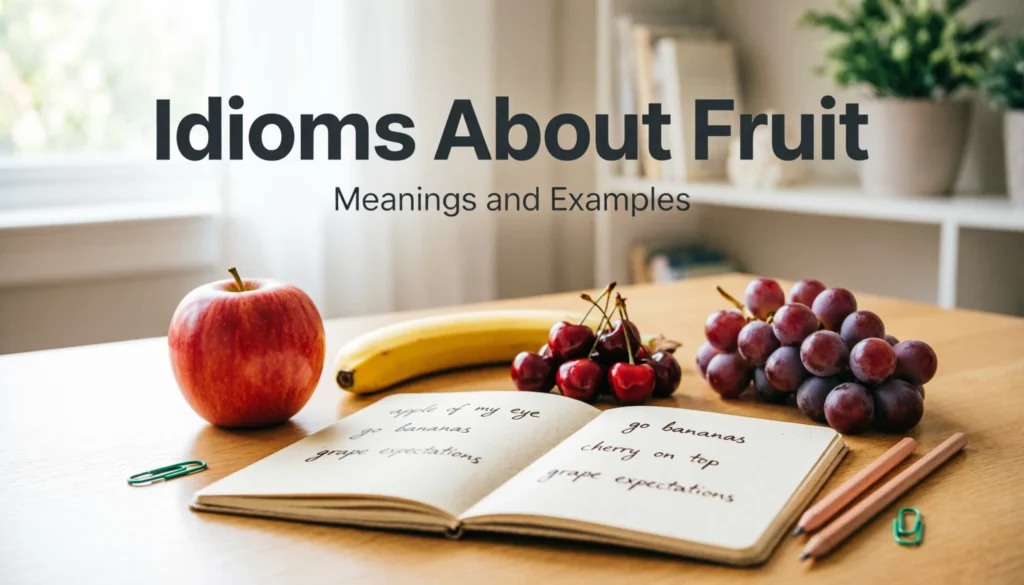
Introduction
Idioms about fruit are colorful expressions that use fruit words to explain people, behavior, situations, success, failure, or emotions. English speakers often use fruit idioms in daily conversations, stories, school writing, and casual speech because they make ideas easier to picture.
For students, writers, and ESL learners, these idioms can help build natural vocabulary. Some fruit idioms sound funny, while others carry serious meanings. Learning them with examples makes them easier to remember and use correctly in real sentences.
What “Idioms About Fruit” Mean
Idioms about fruit usually mean:
- Expressions that include fruit words but do not always talk about real fruit
- Phrases used to describe personality, choices, results, problems, or success
- Everyday sayings that make English sound more natural and expressive
- Useful phrases for speaking, writing, storytelling, and conversation
- Figurative language that helps readers understand ideas through familiar images
Common, Popular, Funny, Useful, and Everyday Idioms About Fruit
Apple of my eye
Simple meaning: A person who is deeply loved or valued.
Example sentence: Her little son is the apple of her eye.
Bad apple
Simple meaning: A person who has a bad influence on others.
Example sentence: One bad apple in the group kept causing problems.
Compare apples and oranges
Simple meaning: To compare two things that are too different.
Example sentence: Comparing a small local shop with a global company is like comparing apples and oranges.
The apple does not fall far from the tree
Simple meaning: A child often behaves like a parent.
Example sentence: He is calm and hardworking like his father, so the apple does not fall far from the tree.
Go bananas
Simple meaning: To become very excited, angry, or silly.
Example sentence: The children went bananas when the teacher announced a free games day.
Top banana
Simple meaning: The most important person in a group.
Example sentence: She became the top banana after leading the project successfully.
Second banana
Simple meaning: A person who supports the main leader.
Example sentence: He did not mind being second banana because he enjoyed helping the team win.
Sour grapes
Simple meaning: Pretending something is not good because you cannot have it.
Example sentence: He said the prize was not important, but it sounded like sour grapes.
Low-hanging fruit
Simple meaning: The easiest task, goal, or opportunity.
Example sentence: Fixing the spelling errors was low-hanging fruit before improving the whole essay.
Cherry-pick
Simple meaning: To choose only the best or most useful parts.
Example sentence: The writer cherry-picked examples that supported her argument.
Life is a bowl of cherries
Simple meaning: Life feels easy, pleasant, or enjoyable.
Example sentence: During summer vacation, life felt like a bowl of cherries.
The cherry on top
Simple meaning: An extra good thing added to something already nice.
Example sentence: Winning the final match was the cherry on top of a great season.
Peach of a person
Simple meaning: A very kind, pleasant, or helpful person.
Example sentence: Our neighbor is a peach of a person who always helps everyone.
Everything is peachy
Simple meaning: Everything is fine or going well.
Example sentence: Do not worry about the plan because everything is peachy.
Plum job
Simple meaning: A very desirable or rewarding job.
Example sentence: She got a plum job at a publishing company after graduation.
Bear fruit
Simple meaning: To produce good results.
Example sentence: His months of practice finally began to bear fruit.
Forbidden fruit
Simple meaning: Something tempting because it is not allowed.
Example sentence: For some students, using phones in class feels like forbidden fruit.
Fruit of your labor
Simple meaning: The reward or result of hard work.
Example sentence: The award was the fruit of her labor after years of study.
Ripe for change
Simple meaning: Ready for improvement or a new direction.
Example sentence: The old school system was ripe for change.
As cool as a cucumber
Simple meaning: Very calm, especially under pressure.
Example sentence: She stayed as cool as a cucumber during the interview.
In a pickle
Simple meaning: In a difficult or awkward situation.
Example sentence: I was in a pickle when I forgot both my wallet and my phone.
Full of beans
Simple meaning: Very energetic and lively.
Example sentence: The puppy was full of beans after its morning nap.
Spill the beans
Simple meaning: To reveal a secret.
Example sentence: Please do not spill the beans about the surprise party.
Not worth a hill of beans
Simple meaning: Not valuable or not important.
Example sentence: His rude comments are not worth a hill of beans.
Cool beans
Simple meaning: A casual way to say great, fine, or okay.
Example sentence: You finished the poster early? Cool beans.
Idioms About Fruit With Meanings and Examples
Fruit idioms can describe people, feelings, success, mistakes, and choices. Many of them work well in school essays, creative writing, dialogue, and informal speech.
Fruit idioms for people
Apple of my eye
Simple meaning: Someone deeply loved.
Example sentence: His granddaughter is the apple of his eye.
Bad apple
Simple meaning: Someone who creates trouble.
Example sentence: A bad apple can damage the mood of the whole team.
Peach of a person
Simple meaning: A kind and pleasant person.
Example sentence: My new teacher is a peach of a person.
Top banana
Simple meaning: The main leader.
Example sentence: Everyone knew Maria was the top banana in the club.
Second banana
Simple meaning: A helper or supporting person.
Example sentence: He played second banana but still helped the project succeed.
Fruit idioms for success and results
Bear fruit
Simple meaning: To bring good results.
Example sentence: Her careful planning started to bear fruit.
Fruit of your labor
Simple meaning: The result of hard work.
Example sentence: The published book was the fruit of his labor.
Cherry on top
Simple meaning: A final extra benefit.
Example sentence: The free dessert was the cherry on top of a wonderful dinner.
Plum job
Simple meaning: A very good job.
Example sentence: He found a plum job with flexible hours.
Low-hanging fruit
Simple meaning: An easy goal or simple task.
Example sentence: The team handled the low-hanging fruit before solving harder issues.
Fruit idioms for emotions and behavior
Go bananas
Simple meaning: To act excited, angry, or silly.
Example sentence: The fans went bananas after the last-minute goal.
Sour grapes
Simple meaning: Disliking something because you cannot get it.
Example sentence: Calling the contest boring after losing sounded like sour grapes.
Everything is peachy
Simple meaning: Everything is fine.
Example sentence: She smiled and said everything was peachy.
As cool as a cucumber
Simple meaning: Calm and relaxed.
Example sentence: He looked as cool as a cucumber before the speech.
Full of beans
Simple meaning: Full of energy.
Example sentence: The children were full of beans at the picnic.
How to Use Idioms About Fruit in Sentences
Use fruit idioms when you want your English to sound more natural, expressive, or conversational. They work best when the meaning fits the situation clearly.
In casual speech, you can say someone went bananas, spilled the beans, or stayed as cool as a cucumber. In writing, you can use phrases like bear fruit, low-hanging fruit, or fruit of your labor because they sound useful and mature.
Do not overuse idioms in one paragraph. One strong idiom often works better than three forced expressions. Also, match the idiom to the tone. Cool beans sounds casual, while bear fruit works better in essays or formal writing.
Idioms About Fruit for Writing and Speaking
Fruit idioms can make writing more vivid, but they need careful placement. In stories, they can show personality, In essays, they can explain results or comparisons, In conversations, they can make speech sound relaxed and native.
Writers can use bad apple for a harmful character, forbidden fruit for temptation, and cherry on top for a pleasing final detail. Speakers can use in a pickle, go bananas, and spill the beans in everyday talk.
For school writing, choose idioms that sound clear and not too slangy. Bear fruit, compare apples and oranges, and fruit of your labor are safer choices for essays.
Idioms About Fruit for Students and ESL Learners
Students and ESL learners should learn fruit idioms by meaning, not by word-by-word translation. For example, bad apple does not mean spoiled fruit in most conversations. It means a troublesome person.
The easiest way to remember these idioms is to group them by topic. Some describe people, such as apple of my eye and bad apple, Some describe results, such as bear fruit and fruit of your labor, Some describe emotions, such as go bananas and sour grapes.
Practice with short sentences first. After that, use them in conversations, paragraphs, and short stories. This method helps the idioms feel natural instead of memorized.
Idioms About Fruit in Conversations
Here are simple conversation examples that show how fruit idioms sound in real life.
Conversation 1
A: Did you hear that Sara got the scholarship?
B: Yes, all her hard work finally bore fruit.
Conversation 2
A: I forgot my homework and my laptop.
B: You are really in a pickle today.
Conversation 3
A: Why did he say the award was useless?
B: It sounds like sour grapes because he wanted to win.
Conversation 4
A: The concert tickets are free.
B: Cool beans. Let us go.
Conversation 5
A: Please do not tell anyone about the gift.
B: Do not worry. I will not spill the beans.
Similar Phrases and Expressions
Some expressions are not always strict idioms, but they still use fruit-related language in a figurative way.
Fresh as a daisy
Simple meaning: Looking clean, lively, or energetic.
Example sentence: She looked fresh as a daisy after a good night of sleep.
Sweet as honey
Simple meaning: Very kind, gentle, or pleasant.
Example sentence: The nurse was sweet as honey with the children.
A juicy story
Simple meaning: An interesting story full of exciting details.
Example sentence: The reporter found a juicy story about the missing painting.
Ripe opportunity
Simple meaning: A good chance that is ready to use.
Example sentence: The new market was a ripe opportunity for small businesses.
Sweet deal
Simple meaning: A very good offer or arrangement.
Example sentence: Getting two books for the price of one was a sweet deal.
Bitter truth
Simple meaning: A painful but real fact.
Example sentence: The bitter truth was that they needed more practice.
Seed of doubt
Simple meaning: A small thought that creates uncertainty.
Example sentence: His strange answer planted a seed of doubt in her mind.
Common Mistakes
Many learners make mistakes with fruit idioms because they translate them literally. The phrase apple of my eye does not mean someone owns an apple. It means someone is loved deeply.
Another mistake is using casual idioms in formal writing. Cool beans and go bananas sound informal, so they fit friendly conversations better than academic essays. In formal writing, use bear fruit, fruit of your labor, or compare apples and oranges.
Students also confuse sour grapes with general sadness. Sour grapes means someone acts like they do not want something after they fail to get it. It does not simply mean disappointment.
Avoid mixing too many idioms together. A sentence like he went bananas over sour grapes and spilled the beans sounds unnatural. Use one idiom at a time unless you are writing comedy.
Conclusion
Idioms about fruit make English more expressive, memorable, and fun to use. They help students, writers, and ESL learners describe people, emotions, success, problems, and choices in a lively way. Some idioms, such as bear fruit and fruit of your labor, work well in formal writing. Others, such as go bananas, cool beans, and spill the beans, fit casual conversation. The key is to understand the meaning, learn a natural example, and use each phrase in the right context. With regular practice, fruit idioms can become a useful part of your everyday English.
FAQs
What are idioms about fruit?
Idioms about fruit are expressions that use fruit words to give a figurative meaning. For example, bad apple means a troublesome person, not a real apple.
What is the most common fruit idiom?
One of the most common fruit idioms is apple of my eye. People use it to describe someone they love deeply or value greatly.
Is go bananas an idiom?
Yes, go bananas is an idiom. It means to become very excited, angry, silly, or out of control, depending on the situation.
Can I use fruit idioms in essays?
Yes, but choose the right idiom. Bear fruit, fruit of your labor, and compare apples and oranges work better in essays than very casual phrases like cool beans.
What does sour grapes mean?
Sour grapes means someone pretends something is not valuable because they cannot have it or did not win it.
Are all fruit expressions idioms?
No, some fruit expressions are metaphors, slang, or common figurative phrases. They can still help learners understand natural English.
How can ESL learners memorize fruit idioms?
ESL learners can group fruit idioms by topic, learn one example sentence for each phrase, and practice using them in short conversations.

Adam Brooks is an American author and storyteller known for expressing human emotions and inner struggles through powerful metaphors.
His writing style is simple, emotionally rich, and deeply relatable.
He focuses on emotional truth rather than just storytelling.
At MetaphorForge, his work encourages readers to reflect, feel, and grow.