
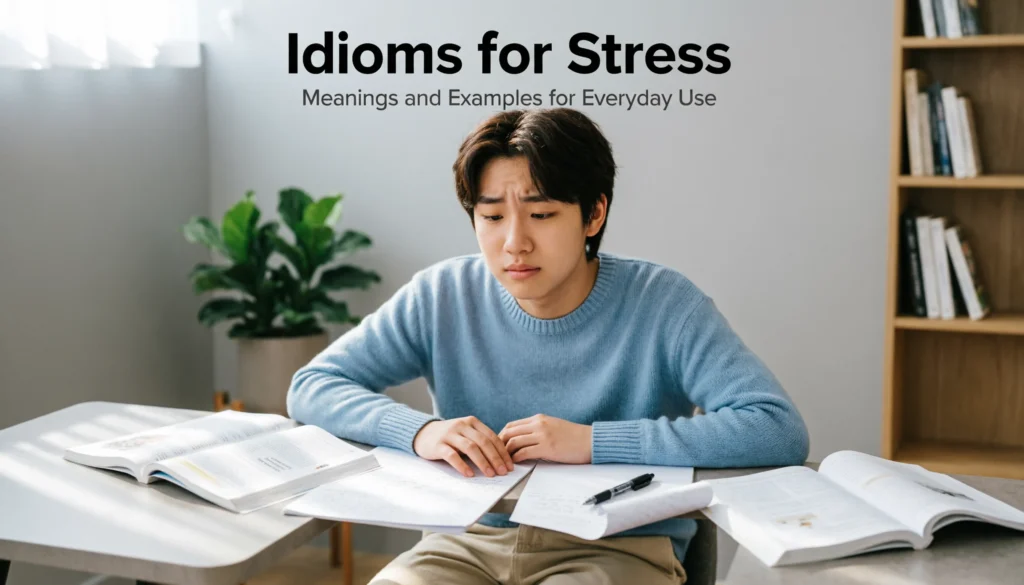
Stress can feel hard to explain, especially when someone feels worried, tired, nervous, or under pressure. Idioms for stress help students, writers, and ESL learners describe those feelings in a more natural and expressive way.
These phrases appear in everyday speech, school writing, workplace conversations, stories, and informal messages. Some idioms sound serious, while others sound funny or casual. Learning them helps you speak with more confidence and write with more emotion.
What “Idioms for Stress” Means
Idioms for stress means common English expressions that describe pressure, worry, tension, fear, or emotional overload.
These idioms can show:
• A person feels worried
• A person has too much work
• A person feels mentally tired
• A situation creates pressure
• Someone feels close to losing patience
• Someone feels nervous before an event
• Someone needs rest or support
For example, when someone says they are under a lot of pressure, they mean they feel stressed because of a difficult task, deadline, exam, or responsibility.
Common Idioms for Stress
Stress idioms often appear in daily English because people talk about school, work, family problems, money, exams, and deadlines all the time. These expressions make feelings easier to understand.
Under pressure
Simple meaning: Feeling stress because of responsibility, danger, or high expectations.
Example sentence: She felt under pressure before her final exam.
Stressed out
Simple meaning: Very worried, tense, or mentally tired.
Example sentence: I felt stressed out after working all weekend.
At the end of your rope
Simple meaning: Feeling unable to deal with more problems.
Example sentence: He was at the end of his rope after three sleepless nights.
Pulling your hair out
Simple meaning: Feeling extremely frustrated or stressed.
Example sentence: I was pulling my hair out while trying to fix the computer.
A lot on your plate
Simple meaning: Having many tasks or responsibilities.
Example sentence: She has a lot on her plate this week.
Burned out
Simple meaning: Feeling exhausted after too much work or stress.
Example sentence: The teacher felt burned out after months of extra classes.
Running on empty
Simple meaning: Continuing while having very little energy left.
Example sentence: After the long shift, he was running on empty.
Popular Idioms for Stress With Meanings and Examples
Popular idioms for stress work well in both speaking and writing. They help describe how pressure builds inside a person or situation.
Crack under pressure
Simple meaning: To fail or lose control because of stress.
Example sentence: He did not crack under pressure during the interview.
Feel the heat
Simple meaning: To feel pressure because of criticism, deadlines, or expectations.
Example sentence: The team began to feel the heat before the project deadline.
Lose your cool
Simple meaning: To become angry or upset because of stress.
Example sentence: She tried not to lose her cool during the argument.
On edge
Simple meaning: Nervous, tense, or easily upset.
Example sentence: Everyone felt on edge before the results came out.
Tied up in knots
Simple meaning: Very nervous or worried.
Example sentence: His stomach felt tied up in knots before the speech.
Carry the weight of the world
Simple meaning: To feel responsible for too many serious problems.
Example sentence: She looked like she carried the weight of the world on her shoulders.
Reach breaking point
Simple meaning: To reach the limit of what someone can handle.
Example sentence: The constant noise pushed him to breaking point.
Funny Idioms for Stress
Funny stress idioms can make tense situations sound lighter. Writers often use them in casual scenes, friendly conversations, or humorous descriptions.
Going bananas
Simple meaning: Becoming very stressed, angry, or crazy with frustration.
Example sentence: I was going bananas after losing my keys again.
Going nuts
Simple meaning: Feeling extremely stressed or annoyed.
Example sentence: The loud music was making me go nuts.
Losing your marbles
Simple meaning: Acting confused or overwhelmed because of stress.
Example sentence: I thought I was losing my marbles during exam week.
Climbing the walls
Simple meaning: Feeling restless, stressed, or trapped.
Example sentence: He was climbing the walls while waiting for the test results.
Like a chicken with its head cut off
Simple meaning: Acting in a panicked or disorganized way.
Example sentence: She ran around like a chicken with its head cut off before the guests arrived.
Freaking out
Simple meaning: Becoming very worried, scared, or stressed.
Example sentence: He was freaking out about the driving test.
Useful Everyday Idioms for Stress
Everyday idioms for stress help you sound natural in normal conversations. These phrases suit school, home, work, and social situations.
Take a toll
Simple meaning: To harm someone emotionally, mentally, or physically over time.
Example sentence: Lack of sleep started to take a toll on her health.
Get on your nerves
Simple meaning: To annoy or stress someone.
Example sentence: The constant noise got on my nerves.
Bottled up
Simple meaning: Keeping stress, anger, or sadness inside.
Example sentence: He kept his worries bottled up for weeks.
Let off steam
Simple meaning: To release stress or anger in a safe way.
Example sentence: She went for a run to let off steam.
Blow off steam
Simple meaning: To reduce stress by doing something active or relaxing.
Example sentence: They played football after school to blow off steam.
Need a breather
Simple meaning: To need a short rest from stress or work.
Example sentence: I need a breather after studying for three hours.
Take a step back
Simple meaning: To pause and look at a stressful situation calmly.
Example sentence: He took a step back before making a decision.
Idioms for Stress With Meanings and Examples
These idioms for stress give writers and learners more choices. Each phrase shows a slightly different kind of pressure.
In over your head
Simple meaning: In a situation that feels too difficult to handle.
Example sentence: She felt in over her head during the advanced math class.
Between a rock and a hard place
Simple meaning: Stuck between two difficult choices.
Example sentence: He felt between a rock and a hard place when both options seemed risky.
Walking on eggshells
Simple meaning: Acting very carefully because a situation feels tense.
Example sentence: Everyone was walking on eggshells after the argument.
Have a meltdown
Simple meaning: To lose emotional control because of stress.
Example sentence: The child had a meltdown after a long and tiring day.
Bite off more than you can chew
Simple meaning: To accept more work than you can manage.
Example sentence: I bit off more than I could chew by joining three clubs.
Be snowed under
Simple meaning: To have too much work to do.
Example sentence: The manager was snowed under with emails.
Up to your neck
Simple meaning: Deeply involved in work, problems, or stress.
Example sentence: He was up to his neck in assignments.
On your last nerve
Simple meaning: Extremely annoyed or stressed.
Example sentence: The repeated delays were getting on my last nerve.
How to Use Idioms for Stress in Sentences
You can use idioms for stress when you describe feelings, problems, pressure, or busy situations. Choose the idiom that matches the exact feeling.
Use under pressure when someone faces expectations.
Example: The goalkeeper stayed calm under pressure.
Use burned out when someone feels tired after long effort.
Example: Many students feel burned out near the end of the term.
Use on edge when someone feels nervous or tense.
Example: She felt on edge before the interview.
Use a lot on your plate when someone has many duties.
Example: He has a lot on his plate with work and family.
Use let off steam when someone releases stress.
Example: I listen to music to let off steam after class.
Idioms for Stress for Writing and Speaking
Stress idioms can make writing more vivid and speaking more natural. In writing, they help readers understand a character’s emotional state without a long explanation.
In speaking, they help you describe your mood quickly. For example, saying I am stressed out sounds more natural than saying I have a strong feeling of mental pressure.
Writers can use idioms carefully in stories, essays, dialogue, and personal reflections. ESL learners should first learn the simple meaning, then practise each idiom in short natural sentences.
Good idioms for writing
Carry the weight of the world
Simple meaning: Feeling deep emotional pressure.
Example sentence: After the bad news, she looked like she carried the weight of the world.
Walking on eggshells
Simple meaning: Being careful in a tense situation.
Example sentence: The family walked on eggshells during dinner.
Reach breaking point
Simple meaning: Feel unable to continue handling stress.
Example sentence: The pressure made him reach breaking point.
Good idioms for speaking
Stressed out
Simple meaning: Very worried or tense.
Example sentence: I am stressed out about tomorrow’s test.
Need a breather
Simple meaning: Need a short rest.
Example sentence: I need a breather before we continue.
Get on my nerves
Simple meaning: Annoy or stress me.
Example sentence: These repeated calls get on my nerves.
Idioms for Stress for Students and ESL Learners
Students often need stress idioms for exams, homework, presentations, and class discussions. ESL learners also hear these phrases in films, books, podcasts, and everyday English.
Start with simple idioms such as stressed out, under pressure, and a lot on my plate. These phrases appear often and fit many situations.
Exam stress idioms
Under pressure
Simple meaning: Feeling stress because of expectations.
Example sentence: Students feel under pressure during final exams.
Tied up in knots
Simple meaning: Very nervous.
Example sentence: My stomach was tied up in knots before the oral test.
On edge
Simple meaning: Nervous and tense.
Example sentence: The whole class felt on edge before the results.
Homework and study stress idioms
Snowed under
Simple meaning: Having too much work.
Example sentence: I am snowed under with homework tonight.
Running on empty
Simple meaning: Studying with little energy left.
Example sentence: She was running on empty after studying all night.
Bite off more than you can chew
Simple meaning: Take on too many tasks.
Example sentence: He bit off more than he could chew by taking extra classes.
Idioms for Stress in Conversations
Stress idioms sound natural in daily conversation when you use them with the right tone. Some phrases sound casual, while others sound more serious.
Conversation example 1
A: You look tired today.
B: I am stressed out because I have three deadlines.
Conversation example 2
A: Why are you so quiet?
B: I have a lot on my plate right now.
Conversation example 3
A: Do you want to go for a walk?
B: Yes, I need to let off steam.
Conversation example 4
A: Are you ready for the interview?
B: I feel on edge, but I prepared well.
Conversation example 5
A: You seem frustrated.
B: This computer problem is making me pull my hair out.
Similar Phrases and Expressions for Stress
Not every stress phrase works as a strict idiom. Some are expressions, collocations, or metaphorical phrases, but they still help describe pressure clearly.
Mental pressure
Simple meaning: Stress caused by worry, responsibility, or expectations.
Example sentence: The competition created mental pressure for the players.
Emotional strain
Simple meaning: Stress that affects feelings and mood.
Example sentence: The family problem caused emotional strain.
Too much to handle
Simple meaning: More than someone can manage.
Example sentence: The workload became too much to handle.
Feel overwhelmed
Simple meaning: Feel unable to manage everything.
Example sentence: She felt overwhelmed by the number of tasks.
Feel tense
Simple meaning: Feel tight, nervous, or uneasy.
Example sentence: He felt tense before the meeting.
Feel drained
Simple meaning: Feel very tired emotionally or physically.
Example sentence: After the argument, she felt drained.
Need some space
Simple meaning: Need time alone to calm down.
Example sentence: He needed some space after a stressful day.
Common Mistakes When Using Idioms for Stress
Many learners understand stress idioms but use them in the wrong situation. These mistakes can make a sentence sound unnatural.
Using serious idioms for small problems
Do not use at the end of my rope for a tiny problem like losing a pencil. Use it for strong stress.
Better example: I was at the end of my rope after weeks of pressure.
Mixing idioms together
Avoid mixing two idioms into one strange phrase.
Incorrect: I am under my rope.
Correct: I am under pressure.
Correct: I am at the end of my rope.
Using funny idioms in formal writing
Phrases like going bananas and losing your marbles sound casual or funny. They do not fit formal essays unless you discuss tone or dialogue.
Better formal choice: The pressure caused serious emotional strain.
Forgetting the context
Some idioms describe anger, some describe tiredness, and some describe worry. Choose the one that matches the feeling.
1-For tiredness, use burned out or running on empty.
2-For worry, use on edge or tied up in knots.
3-For too much work, use snowed under or a lot on your plate.
Overusing idioms
Too many idioms can make writing feel crowded. Use one strong idiom, then explain the feeling in plain language.
Better example: She felt burned out after months of study and needed proper rest.
Conclusion
Idioms for stress help you describe pressure, worry, tiredness, and emotional tension in a clear and natural way. Students can use them in essays, conversations, and exam writing. Writers can use them to show character emotions, conflict, and mood. ESL learners can use them to sound more fluent in everyday English. The best approach is to learn each phrase with its simple meaning and practise it in real sentences. Start with common idioms like under pressure, stressed out, burned out, and a lot on your plate, then add more expressive phrases as your confidence grows.
FAQs
What are idioms for stress?
Idioms for stress are common English phrases that describe worry, pressure, tension, or emotional overload. Examples include stressed out, under pressure, burned out, and at the end of your rope.
What is a common idiom for feeling stressed?
A common idiom for feeling stressed is stressed out. It means someone feels worried, tense, or mentally tired because of too much pressure.
Can students use stress idioms in essays?
Yes, students can use stress idioms in essays, especially in personal writing, creative writing, and informal topics. For formal essays, use them carefully and avoid overly casual phrases.
What idiom means having too much work?
The idiom snowed under means having too much work. A lot on your plate also means someone has many tasks or responsibilities.
What does burned out mean?
Burned out means emotionally or physically exhausted after too much work, study, pressure, or responsibility over time.
What is a funny idiom for stress?
Going bananas is a funny idiom for stress. It means someone feels very frustrated, annoyed, or overwhelmed.
What idiom means very nervous?
Tied up in knots means very nervous or worried. People often use it before exams, speeches, interviews, or important events.

Eva Rose is a modern author known for emotionally rich and metaphor-driven writing.
Her work focuses on self-growth, resilience, and inner strength.
She transforms complex emotions into clear, relatable insights.
At MetaphorForge, her writing inspires reflection and personal growth.