
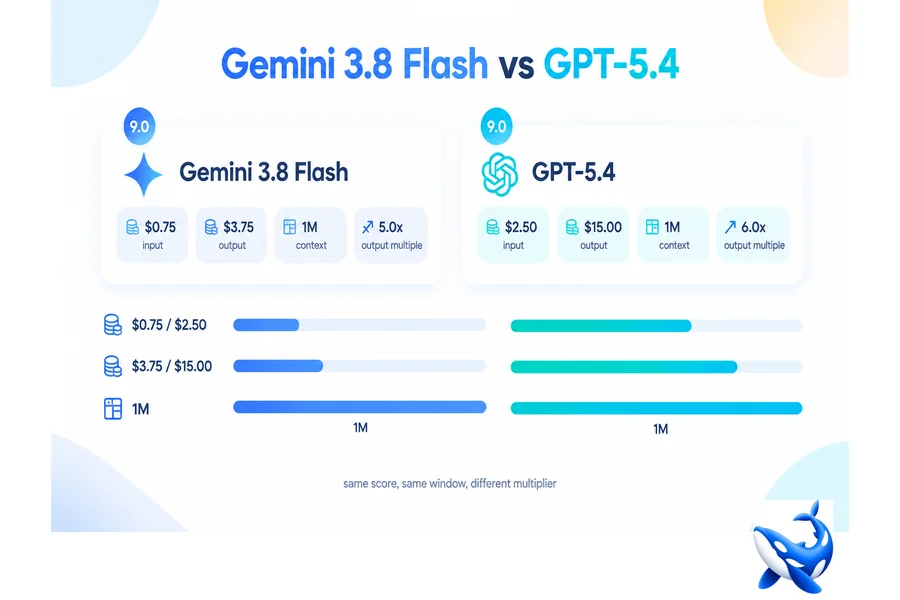
Every pair in our twelve-model set comes down to a different row, and this one comes down to the row directly under the output price. Gemini 3.8 Flash and GPT-5.4 both score 9.0 on our composite and both carry a 1M context window, so on OrcaRouter the Gemini 3.8 Flash vs GPT-5.4 comparison has nothing on the quality or capacity rows to break the tie. What is left is price — and the price story has two layers, because the output-to-input multiple differs on top of the base rates.
The cards, and the row under the output line
Read on 2026-10-13:
| metric | Gemini 3.8 Flash | GPT-5.4 | gap |
| input, per million tokens | $0.75 | $2.50 | Flash is 3.3x cheaper |
| output, per million tokens | $3.75 | $15.00 | Flash is 4.0x cheaper |
| output-to-input multiple | 5.0x | 6.0x | Flash bills more gently |
| context window | 1M | 1M | identical |
| composite quality, 0–10 | 9.0 | 9.0 | tie |
Three rows decide this page and they all run the same direction. The cheaper card is cheaper on both price lines, and it also carries the gentler multiple — five times input for generated tokens against six — so the output gap widens rather than narrows as a workload writes more. The rows that could have rescued GPT-5.4 are dead heats: same 1M window, same 9.0 composite. There is no column here where the premium card leads.
What the multiple does to a four-times gap
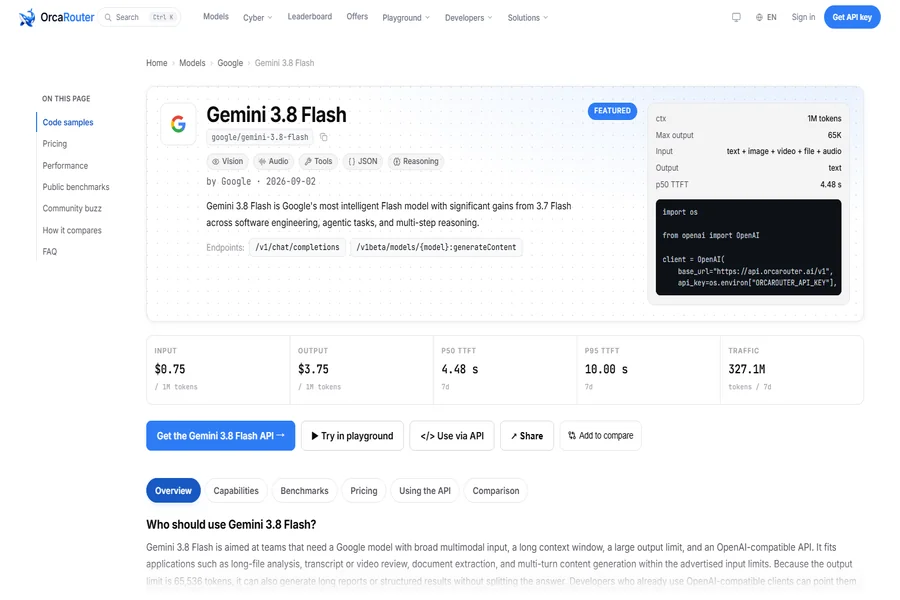
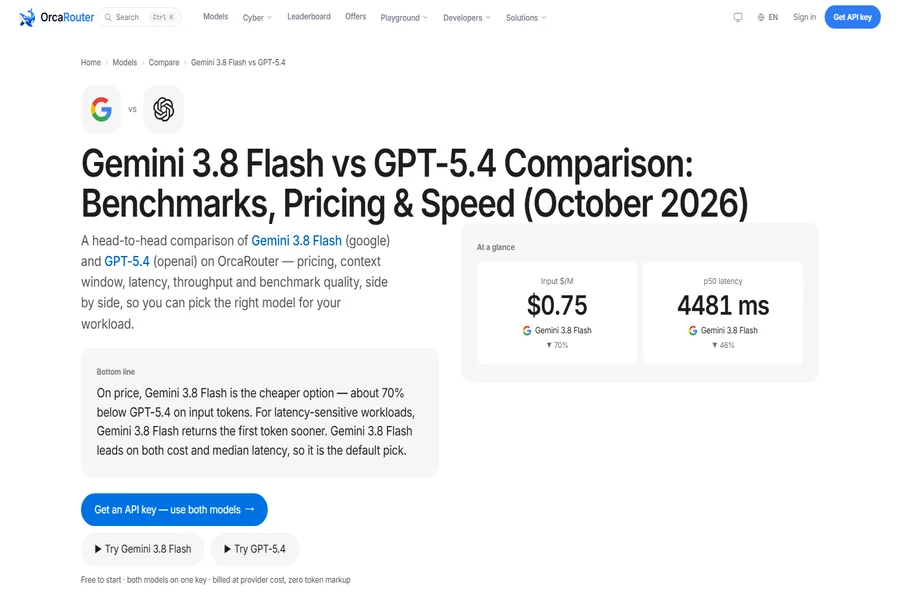
Start with the base rates, then layer the multiple on top, because on this pair the second step does real work. On a read-heavy pipeline — long documents in, short structured answers out — nearly every token hits the input line, where the difference is $0.75 against $2.50, a factor of 3.3. That is already wide.
Move toward write-weighted traffic and both the base gap and the multiple push the same way. Generated tokens cost $3.75 against $15.00, a factor of four, and GPT-5.4’s sixth-of-input multiple means its output line compounds faster than Flash’s as output grows as a share of the bill. Reasoning chains, agent traces and long-form generation all sit on that extreme, and on those workloads the effective gap drifts past four toward the ratio implied by the multiples — six against five on top of a base output rate that is already four times higher.
That is the opposite of how a trade normally resolves. Usually the cheaper card charges more for output relative to input, and a write-heavy workload erodes its advantage. Here the cheaper card is gentler at both ends, so there is no mix at which GPT-5.4 catches up on price.
The tie that removes the other two rows
Our composite quality column is ours: a 0–10 figure we compute from four families of evaluation we run against each endpoint — reasoning, code generation, long-context retrieval and instruction following — averaged into one number. It is not a third-party leaderboard, and no other team can reproduce it on their own harness.
Across the twelve models we price, the entire field fits inside two points: three cards at 8.0, six at 9.0, three at 10.0. Both of these cards sit in the crowded middle band. A tie at 9.0 establishes one narrow thing — on the four families we run, neither card buys a measured capability advantage — and it does not claim the two models behave alike, because an average across families flattens the shape of a failure. Two cards can both score 9.0 with entirely different weak spots, and the composite will not tell you which of them wins your hardest input.
What the tie does do here is remove the argument that normally justifies paying more. A premium is defensible when it buys a higher composite, a wider window, or a gentler rate. On this page it buys none of the three, and the 1M-against-1M row removes capacity as a fallback as well.
Four times on output, priced on a matched pair
The clean way to hold both price rows at once is a balanced pair. Read a million tokens and write a million through each card. Gemini 3.8 Flash bills $4.50. GPT-5.4 bills $17.50. The difference is $13.00 on a single matched pair — the more expensive card costs close to four times as much, and the multiple widens that further on write-heavy traffic rather than closing it.
Thirteen dollars is the number to weigh against whatever GPT-5.4 is being bought for, and the honest answer is that on this page there is nothing in the columns to weigh it against. That does not make the purchase wrong; it makes it a purchase for reasons the table does not measure.
Where the more expensive card still earns its place
Two of those reasons are real and neither is on the page.
The first is integration. A team already running GPT-class endpoints has prompts, structured-output schemas, retry behaviour and evaluation baselines tuned to that family, and a near-four-times price difference does not automatically survive the cost of rebuilding those against a different vendor. Migration between vendors is never the string change the API surface suggests — the accumulated quirks in a working system are the expensive part, and they are invisible on a comparison page.
The second is that the cheaper card is not free of its own trade-offs just because it is cheap. Flash-class endpoints are built for throughput and cost, and a 9.0 is a real production band rather than a compromise — six of our twelve models sit there. But the same averaging that makes the band crowded also means a 9.0 tells you nothing about which family a card is strongest in, and a pipeline with one hard requirement should test that requirement rather than read it off a composite.
The takeaway
Gemini 3.8 Flash and GPT-5.4 tie at 9.0 on our composite and both carry 1M context windows, so this pair resolves entirely on price. Flash is cheaper on both lines — $0.75 against $2.50 on input, $3.75 against $15.00 on output — and it also carries the gentler 5.0x output multiple against GPT-5.4’s 6.0x, so the gap widens on write-heavy traffic instead of narrowing. On a matched million-in, million-out pair the bills are $4.50 and $17.50.
Because the cheaper card is gentler at both ends, there is no token mix at which the more expensive one catches up on cost, and there is no column on the page — quality, capacity, or multiple — where it leads. The case for it rests on integration cost and ecosystem rather than on the table, and on a pair this lopsided that case deserves to be priced explicitly before it is assumed. For new work, the comparison has already answered it. Both endpoints are live at list price behind a single key.
