
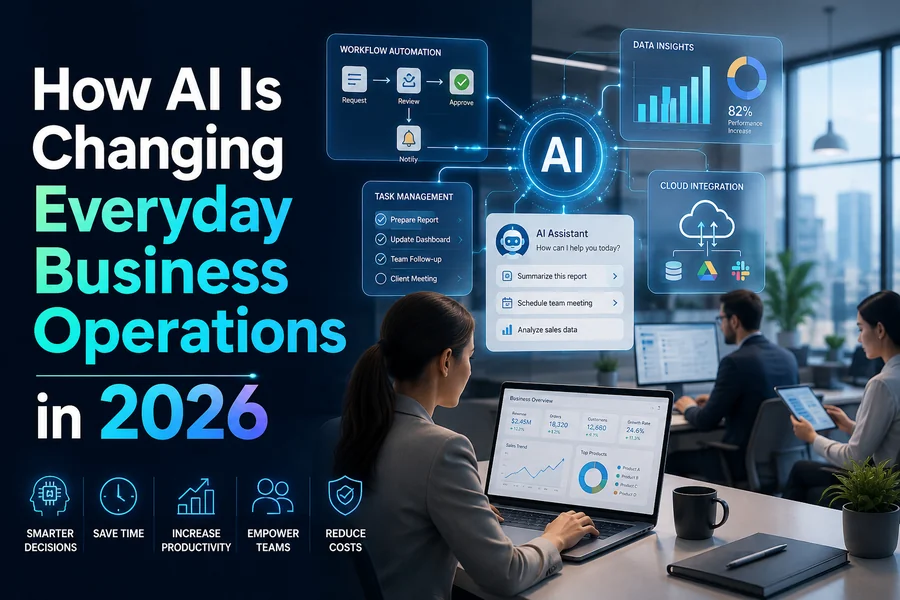
Artificial intelligence in 2026 refers to software systems that handle routine business tasks with little or no human input, from scheduling and data entry to customer support and inventory tracking. AI is not a standalone department or initiative but is embedded within the everyday tools that employees currently use such as email, spreadsheets and project management applications. It operates in the background to accelerate decisions, minimise manual error and release employees to concentrate on judgmental work. For the majority of businesses, this is the way they do business, and is not just some future add-on.
Why Businesses Are Adopting AI Faster Than Before
But AI tools were expensive and needed teams and long setup times a few years ago. That barrier has been mostly removed. Today, AI capabilities can be integrated into current software via cloud-based platforms, and a small retail store or mid-sized law firm can begin implementing them within days.
Another factor is cost! The cost of AI subscriptions has dropped in comparison to the number of hours saved, making them easier to justify the investment. There’s no need for business owners to justify the use of AI – there’s only a justification for doing things by hand.
A generational change is also taking place in companies. Younger workers take for granted smart tools, not a special treat. If a new employee is introduced to a company that still uses manual spreadsheets for tasks that AI can do, it is a sign of the company being behind and that impacts the hiring process and retention.
Everyday Operations Where AI Now Plays a Role
AI is no longer just for one department anymore. It’s connected to almost every aspect of a contemporary company:
- Customer service – Chatbots and AI assistants can manage frequently asked questions, leaving human agents to deal with more complex matters.
- Scheduling and logistics – AI forecasting delivery times, optimizing routes, and managing staff schedules according to demand.
- Finance and bookkeeping – Unusual transactions are flagged by automated systems, and the process of invoice handling is expedited.
- Hiring and HR – Resumes screened and interviews scheduled are increasingly automated with AI, but human involvement remains at the end of the day.
- Marketing – AI can create content outlines, test ad variations, and assess the effectiveness of ad campaigns.
The interesting thing is that these tools run so quietly. They are frequently not considered ‘AI’ anymore and are simply a component of the software that employees use regularly.
How AI Is Reshaping Decision-Making
The largest change will not be seen with the naked eye. That’s the way decisions are made. Managers no longer have to wait for a weekly report to get an answer to their questions, now they can ask questions and get an answer in seconds with real-time data.
This transformation alters the tempo of business. With this feature, a retail manager can change the price the same day sales change, rather than at the end of the month. A supply chain team should be able to divert shipments before a delay becomes an emergency.
However, the faster is not always the best. There are companies that have found out the hard way and have rushed to make decisions based on the output of the AI, without reading the context. The tools are good at finding patterns, but they’re not quite experienced enough. More successful businesses in 2026 are leveraging AI to guide decisions, rather than eliminate decision-making.
The Human Side of AI Adoption
Incorporating AI into everyday work is not just a technical endeavor. It is a people process as well. Employees must be trained for not only using new tools, but using them at the right time and in the right place, and checking their work.
There are some fears that AI will take the place of human workers. While that fear is partly warranted in most situations, the nature of the work does change. Today, a customer service representative has less time to answer simple questions and more time to give empathy and judgment to troublesome complaints. A different skill set, and companies who fail to recognize this change may experience increased employee turnover.
Also, leadership is a factor here. If managers are clearly stating why they are introducing an AI tool, and what the tool is intended to achieve, employees respond better to the change. If AI is deployed without an explanation, resistance to it quickly arises and adoption deadlocks, regardless of the quality of the technology.
Common Mistakes Businesses Make With AI
Not all AI implementations are successful. Some common errors become evident from multiple industries:
- Creating a workflow without first looking at it – If it’s an inefficient process, automating it just makes the process more efficient but inefficient!
- AI-generated output taken at face value – If AI-generated data or content is not subject to verification by a human, it can result in expensive mistakes.
- Failure to train staff – The best AI tool is as effective as your team if they don’t know how to use it.
- Neglecting data quality – AI systems rely on the quality of the data they have. The outputs are messy if the data is messy or old.
The key to avoiding these pitfalls is to take a step back at the beginning. Companies that dedicate the time to streamline their processes before implementing AI are likely to achieve better outcomes than those that implement AI without thorough process mapping.
What to Expect in the Near Future
In the future, AI will likely be even less apparent in business operations than it currently is. Tools will continue to evolve, but they will also be integrated within software solutions rather than be a separate product.
It’s anticipated that smaller companies will catch up with larger businesses, as many AI tools are now affordable for scaling down. This is an equalizer in many respects, because it wasn’t just large corporations that could afford custom automation systems 10 years ago.
The regulation is also lagging behind. Clarification around data privacy and AI accountability will impact the future of business usage of AI. Businesses that develop a better data culture today will find it easier to adapt to upcoming compliance regulations.
Final Thought
AI has moved from being a competitive advantage to being a basic expectation in business operations. Not every company doing well in 2026 is utilizing the most cutting-edge technology, but they are using it well, with processes and trained staff. The tools perform repetitive tasks. The judgement calls are still in people’s hands.
But for any business attempting to keep up, the intent isn’t to take advantage of all of the new features of AI that are developed. The key is to pinpoint areas where AI truly adds value to everyday workflows and those where human effort remains crucial. That balance is more important than the technology itself, and it is the difference between a business that is successful, and one that is merely “on the hook.
