
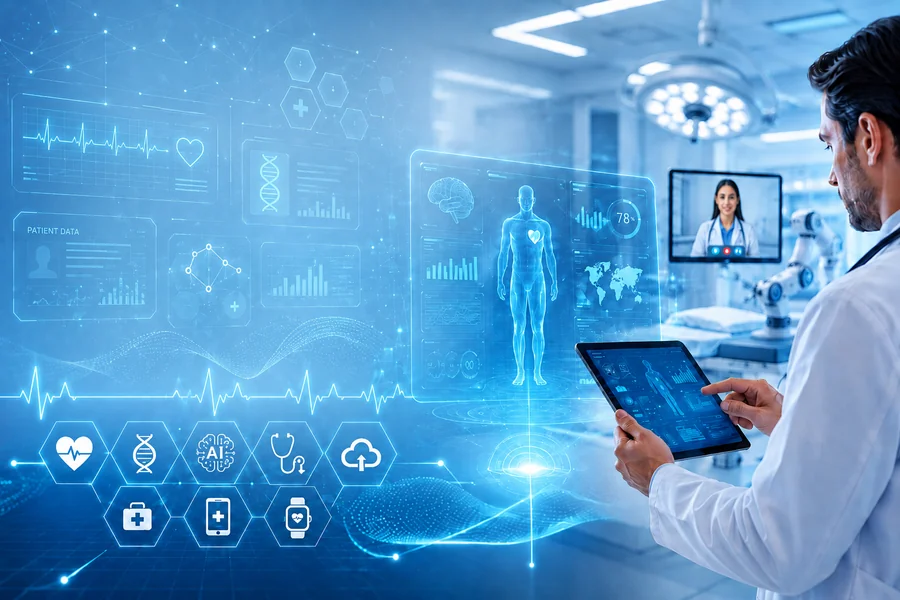
In the modern healthcare space, technology is transforming the way things are done, making diagnosis quicker, treatment more accurate & care more accessible for all. Digital innovation is assisting doctors to identify diseases earlier, customize treatment strategies & connect with patients in remote regions. It’s not all about new technologies. It’s about creating a healthcare system that is faster, cheaper and puts patients at the heart of every decision.
The Rise of Telemedicine and Virtual Care
Ten years ago, a visit to the doctor required a day off of work, waiting in the waiting room, and hoping that it would not drag out too long. That model is rapidly changing. With telemedicine, patients can seek medical advice from a doctor remotely via their cell phone or computer, reducing the amount of travel time and providing services to people living in rural or underserved regions.
It was particularly evident during the COVID-19 pandemic when the virtual visit from a specialty became a common requirement virtually overnight. Many patients still opt for video appointments today for follow up and basic health checkups, as well as mental health, and wellness services. Doctors benefit too. They can handle the greater number of patients, lower no-show rates and track recovery without having to make a physical visit for every minor update.
Telemedicine is not a substitute for conventional health care. Just getting rid of the needless elements of friction that a system with no friction doesn’t require.
Artificial Intelligence in Diagnosis and Treatment
Going from science fiction to everyday clinical use, AI has become a reality. Today, AI algorithms are capable of analyzing medical scans, identifying irregularities, and assisting radiologists in identifying diseases, such as cancer, fractures, or internal bleeding, with high levels of accuracy.
It doesn’t imply that doctors are being replaced by machines. Rather, AI serves as a second pair of eyes, eyes that never grow tired, and one that can analyze thousands of scans in the time it takes for a human to analyze a handful. Speed is important, particularly in emergency situations where early detection can mean the difference between life and death.
The benefits of AI in healthcare encompass:
- Forecasting the likelihood of developing conditions such as sepsis or heart failure before they manifest themselves completely
- Helping to discover new drugs by analyzing molecular data faster than laboratory analysis
- Making administrative tasks easier, like scheduling, billing, and medical coding.
- Tailoring treatment recommendations to a patient’s genetic and health history
The outcome is a healthcare system which responds more rapidly and less mistakes are made by the health system at the preventable level.
Wearable Devices and Remote Patient Monitoring
Fashioned watches and fitness trackers had been all in regards to the steps counted. They can now track your heart rhythm, oxygen levels in the blood, quality of sleep and even irregular heartbeats that could signal atrial fibrillation.
Wearable devices have something that’s valuable for patients with chronic conditions such as diabetes or hypertension: continuous data rather than a single snapshot at a doctor’s visit. It is now possible to monitor a patient’s blood glucose level daily instead of just a few times per month.
Doctors can make quicker treatment decisions and can detect warning signs before they escalate into emergencies, all thanks to this flow of information. It also empowers patients with more control over their health, as they can see the live data and not have to wait to have a checkup to determine their health status.
The concept is being applied on a grander scale in hospitals with remote patient monitoring, where patients are monitored at home after discharge and messages sent to care staff if it’s not going according to plan. This helps to lower readmission rates and improve recovery for patients.
Electronic Health Records and Data Integration
Until recently, patient records were spread out among paper files, fax machines and disjointed systems. When a patient changed doctors or went to a specialist, there was a true concern for important medical history being lost.
Electronic Health Records (EHRs) have done just that. History, test results, allergies and medications can be accessed by any authorized provider instantly now. This will minimize medical mistakes, re-testing and allow physicians to make informed decisions promptly – particularly in emergency situations where every minute matters.
Data integration also enables a healthcare system to identify bigger trends. Health authorities can monitor and trace disease outbreaks, scientists can analyze treatment effectiveness in thousands of individuals, and hospitals can allocate resources where they’re needed most in real-time.
This kind of connectivity can give rise to legitimate issues of privacy and data security, of course. As patient information becomes increasingly interconnected, healthcare organizations are increasingly prioritizing encryption and compliance measures in order to ensure the security of patient data.
Robotics and Precision Surgery
Another field where technology has had an impact is surgical robotics. Robotic-assisted surgery offers the surgeon the ability to perform complex surgeries with greater precision and smaller incisions than can be achieved with traditional surgery.
Smaller incisions also result in less bleeding, less pain to the patient and quicker recovery. The technology is used to augment rather than replace the surgeon’s skill and is operated by the surgeon. It’s like providing a highly experienced surgeon with more assured hands and a better view than taking away the choice from his hands.
Today, this technology is applied in surgical techniques such as hip replacement to cardiac surgery and some cancer therapy. Hospitals are starting to use them, not only the major medical centers, as the tools get more sophisticated.
Challenges That Come With Rapid Technological Change
But not all this change is easy to navigate. With the increasing digitization of healthcare comes new challenges as well as benefits.
The most immediate issues are:
- Data privacy risks, as there is greater risk of cyberattacks as more information becomes digital,
- Access to telehealth services is unequal, some patients don’t have a reliable internet connection or a smartphone to use telehealth services.
- Scalability, because they are quite complex and need to be implemented on a wide scale by healthcare providers
- Lack of Training, because medical staff require time and resources to be able to effectively learn the new systems,
These obstacles don’t outweigh the advantages, but serious care must be taken regarding the transition to digital healthcare. Technology is best suited when combined with well thought out policy, appropriate training and systems that are patient centric.
Final Thought
Technology isn’t taking the place of the human side of healthcare. It’s improving that human side of the thing. Healthcare systems are better able to respond quickly to both individual health needs and larger public health trends; patients have greater involvement in their own healthcare and doctors can catch issues earlier.
There are still challenges on the road ahead, including but not limited to data security and equal access, but the path is set and now clear. Healthcare is going more connected, more personalized and more responsive than ever before. The tools will continue to change, but the aim remains the same – improved outcomes for the people who need them the most.
