
Idioms for Business With Meanings

Idioms for business with meanings and examples for students, writers, and ESL learners.

Introduction Idioms for business are useful expressions that people use in offices, meetings, emails, interviews, sales talks, and professional writing. These phrases help speakers explain money, risk, growth, teamwork, competition, deadlines, and decision-making in a natural way. For students, writers, and ESL learners, business idioms can make English sound more fluent and practical. Instead of … Read more


Idioms for Goodbye With Meanings & Examples

Idioms for goodbye with farewell expressions, meanings, and examples for students and ESL learners.

Introduction Idioms for goodbye help speakers end conversations in a natural, friendly, emotional, or playful way. Instead of saying only goodbye, people often use short expressions that show mood, relationship, and situation. These phrases work well in daily speech, stories, messages, essays, and ESL practice. Some sound casual, some sound warm, and some feel dramatic … Read more

Idioms for Speaking With Meanings & Examples

Idioms for speaking with meanings and examples for students writers and ESL learners

Introduction Idioms for speaking help writers, students, and ESL learners describe the way people talk, explain ideas, argue, gossip, stay silent, or speak with confidence. These expressions make English sound more natural because native speakers often use them in daily conversations, stories, essays, and informal writing. Learning these idioms also helps you understand tone. Some … Read more

Idioms for Support With Examples

Students helping each other while learning idioms for support with meanings and examples.

Idioms for support help you talk about help, care, encouragement, teamwork, and protection in a more natural way. Students, writers, and ESL learners can use these expressions to describe how people stand by each other during hard times, school projects, work problems, or personal challenges. Good support idioms make writing stronger because they show emotion … Read more

Idioms for Technology

Idioms for technology with laptop, phone, digital icons, and English learning notes.

Introduction Technology changes the way people study, work, write, and talk. Because of this, English has many useful expressions connected with computers, machines, phones, the internet, and digital life. These idioms for technology help you describe problems, progress, confusion, speed, updates, and modern habits in a natural way. Some phrases are true idioms, while others … Read more

Idioms for Tired With Meanings and Examples

Idioms for tired with examples for students, writers, and ESL learners.

Introduction Idioms for tired help you describe low energy in a more natural and expressive way. Instead of saying I am tired again and again, you can use phrases like worn out, dead on my feet, running on empty, or ready to drop. These expressions make your writing and speaking sound more fluent. Students, writers, … Read more

Idioms for Vacation With Meanings And Examples

Idioms for vacation shown with travel items, beach colors, and a relaxed holiday theme.

Vacation brings a break from daily work, school, stress, and routine. Idioms for vacation help you describe travel, rest, adventure, and free time in a more natural way. Students, writers, and ESL learners can use these phrases to make speaking and writing sound more fluent. Many vacation expressions do not only describe a trip. They … Read more

Similes for a Person: Meanings and Examples

Similes for a person with visual comparisons for personality and character traits.

Similes for a person help you describe someone by comparing them with something familiar. A simile usually uses the words “like” or “as.” Writers use these comparisons to show personality, appearance, mood, behavior, strength, kindness, confidence, or weakness in a clear and memorable way. For students, writers, and ESL learners, these similes make descriptions easier … Read more

Similes for Books with Examples

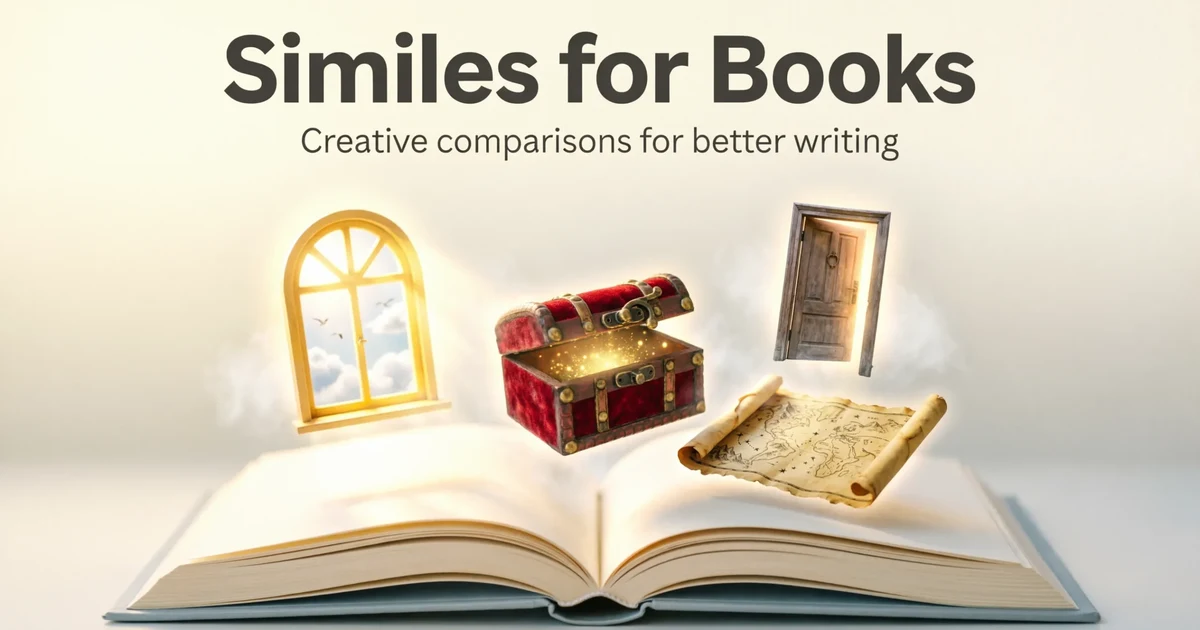
Open book with creative symbols showing similes for books, including a window, map, doorway, and treasure chest.

Books can feel exciting, mysterious, comforting, heavy, funny, or full of wisdom. That is why writers often compare books to everyday things. A good simile helps readers understand what kind of book someone means without using a long explanation. Similes for books are useful for students, writers, and ESL learners because they make descriptions clearer … Read more