
Introduction
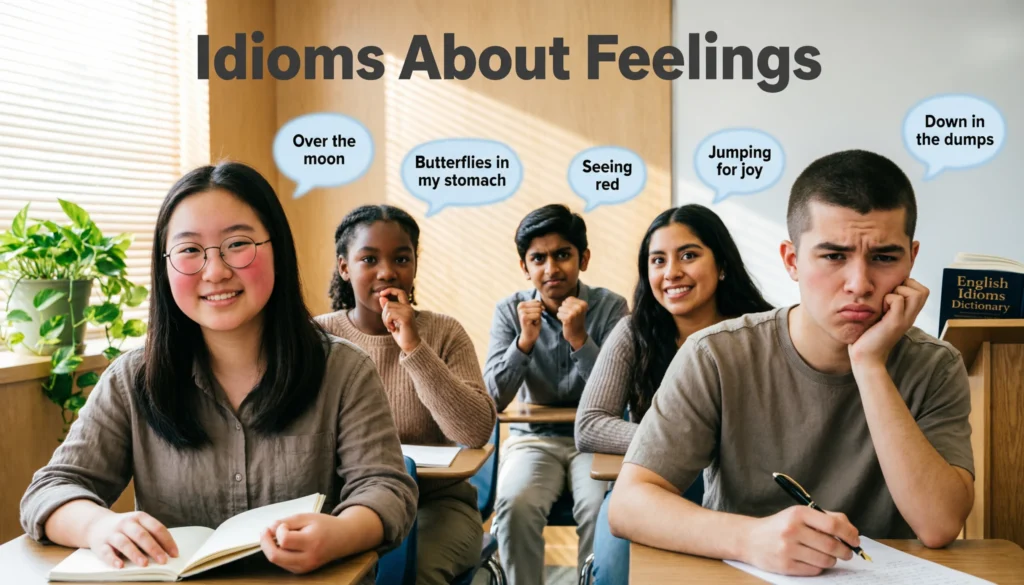
Idioms about feelings help people express emotions in a clear but interesting way. Instead of saying someone is very happy, English speakers may say they are on cloud nine. Instead of saying someone is nervous, they may say they have butterflies in their stomach.
These idioms are useful for students, writers, and ESL learners because emotions appear in daily conversations, stories, emails, essays, and social situations. When you understand these expressions, you can speak more naturally and understand native English better.
What “Idioms About Feelings” Mean
Idioms about feelings are expressions people use to describe emotions in a more natural, colorful, and memorable way.
They can help you talk about:
- Happiness, sadness, anger, fear, love, worry, and excitement
- Strong emotions that are hard to explain with one simple word
- Everyday moods in speaking and writing
- Emotional reactions in stories, essays, conversations, and messages
- Human experiences in a more creative and expressive style
Common, Popular, Funny, Useful, and Everyday Idioms About Feelings
Feelings can change quickly, and English has many idioms for those emotional moments. Some idioms sound serious, while others sound light, funny, or informal. These expressions help you describe moods without using the same simple words again and again.
1. On cloud nine
Simple meaning: Extremely happy.
Example sentence: She was on cloud nine after hearing that she got the scholarship.
2. Over the moon
Simple meaning: Very pleased or excited.
Example sentence: My brother was over the moon when his team won the final.
3. Down in the dumps
Simple meaning: Sad or low in mood.
Example sentence: He felt down in the dumps after failing his driving test.
4. Have butterflies in your stomach
Simple meaning: Feel nervous or excited.
Example sentence: I had butterflies in my stomach before the speech.
5. See red
Simple meaning: Become very angry.
Example sentence: She saw red when someone scratched her new car.
6. Be in high spirits
Simple meaning: Feel cheerful and energetic.
Example sentence: The students were in high spirits on the last day of school.
7. Feel blue
Simple meaning: Feel sad.
Example sentence: He felt blue after his best friend moved away.
8. Be on edge
Simple meaning: Feel nervous, tense, or worried.
Example sentence: Everyone was on edge before the exam results came out.
9. Be scared stiff
Simple meaning: Feel extremely frightened.
Example sentence: I was scared stiff when I heard footsteps outside at night.
10. Have a heavy heart
Simple meaning: Feel deep sadness or sorrow.
Example sentence: She left the city with a heavy heart.
Idioms About Feelings With Meanings and Examples
These idioms about feelings can help you describe emotional states in a more accurate and natural way. They work well in conversations, creative writing, personal essays, and storytelling.
11. Wear your heart on your sleeve
Simple meaning: Show your feelings openly.
Example sentence: He wears his heart on his sleeve, so everyone knows when he is upset.
12. Be torn
Simple meaning: Feel unable to choose between two things.
Example sentence: She was torn between studying abroad and staying close to her family.
13. Have mixed feelings
Simple meaning: Feel both positive and negative emotions at the same time.
Example sentence: I have mixed feelings about leaving my old school.
14. Be beside yourself
Simple meaning: Feel overwhelmed by emotion.
Example sentence: He was beside himself with worry when his dog went missing.
15. Be full of beans
Simple meaning: Feel lively and energetic.
Example sentence: The children were full of beans after breakfast.
16. Be fed up
Simple meaning: Feel annoyed because something has continued for too long.
Example sentence: I am fed up with all these delays.
17. Be in two minds
Simple meaning: Feel unsure about a decision.
Example sentence: I am in two minds about accepting the new job.
18. Get carried away
Simple meaning: Become too excited and lose control.
Example sentence: We got carried away while decorating the classroom.
19. Be green with envy
Simple meaning: Feel very jealous.
Example sentence: She was green with envy when she saw his new bike.
20. Be worried sick
Simple meaning: Feel extremely worried.
Example sentence: His parents were worried sick when he did not answer his phone.
How to Use Idioms About Feelings in Sentences
Use idioms about feelings when you want your sentence to sound more expressive. They are especially useful when a simple word like happy, sad, nervous, or angry does not fully show the emotion.
In formal writing, use common idioms carefully. In casual writing, stories, and speaking, they can make your English sound more natural.
Examples in Sentences
21. My heart sank
Simple meaning: I suddenly felt disappointed or sad.
Example sentence: My heart sank when I saw the low score on my test.
22. Jump for joy
Simple meaning: Feel extremely happy.
Example sentence: The kids jumped for joy when they saw the presents.
23. Be boiling with anger
Simple meaning: Feel very angry.
Example sentence: He was boiling with anger after hearing the unfair decision.
24. Be shaking like a leaf
Simple meaning: Feel very afraid or nervous.
Example sentence: She was shaking like a leaf before her first stage performance.
25. Cry your eyes out
Simple meaning: Cry a lot.
Example sentence: He cried his eyes out after watching the sad movie.
26. Be tickled pink
Simple meaning: Feel very pleased.
Example sentence: Grandma was tickled pink when we surprised her.
27. Feel like a million dollars
Simple meaning: Feel very good, confident, or healthy.
Example sentence: After a good night’s sleep, I felt like a million dollars.
28. Be under a cloud
Simple meaning: Feel unhappy, suspicious, or troubled.
Example sentence: He has been under a cloud since the argument.
Idioms About Feelings for Writing and Speaking
Writers use idioms about feelings to show emotion instead of telling it directly. Speakers use them to sound more fluent and natural. For example, saying my heart sank gives a stronger emotional picture than saying I was disappointed.
These idioms also help readers and listeners understand tone. A character who is on cloud nine feels very different from a character who is down in the dumps.
Useful Idioms for Emotional Writing
29. A lump in your throat
Simple meaning: A tight feeling in your throat caused by sadness or emotion.
Example sentence: I had a lump in my throat during the farewell speech.
30. Heart skips a beat
Simple meaning: Feel sudden excitement, fear, or surprise.
Example sentence: My heart skipped a beat when I heard my name announced.
31. Be at your wit’s end
Simple meaning: Feel extremely stressed and unsure what to do.
Example sentence: The mother was at her wit’s end after trying everything to calm the baby.
32. Be crushed
Simple meaning: Feel deeply disappointed or hurt.
Example sentence: He was crushed when his application was rejected.
33. Be walking on air
Simple meaning: Feel extremely happy.
Example sentence: She was walking on air after her engagement.
34. Feel numb
Simple meaning: Feel unable to react because of shock or sadness.
Example sentence: He felt numb after hearing the bad news.
Idioms About Feelings for Students and ESL Learners
Students and ESL learners should learn idioms about feelings because these phrases appear often in books, films, conversations, exams, and everyday English. You do not need to memorize every idiom at once. Start with the most common ones, then practice them in your own sentences.
The best way to learn them is by grouping them by emotion. Learn happy idioms together, sad idioms together, and angry idioms together. This makes them easier to remember.
Happy Feelings
35. Be on top of the world
Simple meaning: Feel extremely happy and successful.
Example sentence: He felt on top of the world after winning the prize.
36. Grin from ear to ear
Simple meaning: Smile widely because you are very happy.
Example sentence: She was grinning from ear to ear on her birthday.
37. Light up
Simple meaning: Suddenly look happy or excited.
Example sentence: His face lit up when he saw his old friend.
Sad Feelings
38. Be heartbroken
Simple meaning: Feel very sad because of loss or disappointment.
Example sentence: She was heartbroken after losing her pet.
39. Feel low
Simple meaning: Feel sad or depressed.
Example sentence: I felt low after a difficult week.
40. Be in tears
Simple meaning: Cry or feel close to crying.
Example sentence: The ending of the story left many readers in tears.
Angry Feelings
41. Hit the roof
Simple meaning: Become very angry.
Example sentence: Dad hit the roof when he saw the broken window.
42. Lose your cool
Simple meaning: Become angry or upset.
Example sentence: Try not to lose your cool during the debate.
43. Blow a fuse
Simple meaning: Become very angry suddenly.
Example sentence: The coach blew a fuse after the team ignored his instructions.
Idioms About Feelings in Conversations
Idioms about feelings often appear in casual conversations. They help people explain their mood quickly and naturally. You can use them with friends, classmates, family members, and coworkers when the situation feels appropriate.
Conversation Examples
44. I am on edge today
Simple meaning: I feel nervous or tense today.
Example sentence: I am on edge today because I have an interview in the afternoon.
45. She is over the moon
Simple meaning: She is extremely happy.
Example sentence: She is over the moon about her new job.
46. He is feeling blue
Simple meaning: He feels sad.
Example sentence: He is feeling blue because he misses his family.
47. I have mixed feelings
Simple meaning: I feel both good and bad about something.
Example sentence: I have mixed feelings about moving to another city.
48. Don’t get carried away
Simple meaning: Do not become too excited or emotional.
Example sentence: The idea is good, but don’t get carried away before checking the cost.
49. I nearly jumped out of my skin
Simple meaning: I felt sudden fear or shock.
Example sentence: I nearly jumped out of my skin when the alarm went off.
Similar Phrases and Expressions
Not every emotional phrase is a strict idiom. Some are common expressions, metaphors, or natural phrases that English speakers use to describe feelings. They still help with SEO relevance and real-life communication because learners often search for them together.
50. Deeply moved
Simple meaning: Strongly affected by emotion.
Example sentence: I was deeply moved by her honest speech.
51. Filled with joy
Simple meaning: Very happy inside.
Example sentence: He was filled with joy when he held his baby sister.
52. Lost in thought
Simple meaning: Thinking deeply and not noticing things around you.
Example sentence: She sat by the window, lost in thought.
53. Burning with desire
Simple meaning: Wanting something very strongly.
Example sentence: He was burning with desire to prove himself.
54. Frozen with fear
Simple meaning: Too scared to move.
Example sentence: The little boy stood frozen with fear in the dark hallway.
55. Bursting with pride
Simple meaning: Feeling very proud.
Example sentence: Her parents were bursting with pride at the graduation ceremony.
56. Sick with worry
Simple meaning: Extremely worried.
Example sentence: She was sick with worry while waiting for the doctor’s call.
Common Mistakes
Idioms about feelings can make your English stronger, but only when you use them correctly. Many learners translate idioms directly from their own language, which can sound confusing in English.
Mistake 1: Using the Wrong Preposition
Incorrect: She is on the cloud nine.
Correct: She is on cloud nine.
Mistake 2: Mixing Two Idioms
Incorrect: I had butterflies on my heart.
Correct: I had butterflies in my stomach.
Mistake 3: Using Idioms in Very Formal Writing
In academic writing, plain language often works better. Instead of writing the research made me over the moon, write the research findings were encouraging.
Mistake 4: Taking Idioms Literally
If someone says they feel blue, it does not mean their skin color changed. It means they feel sad.
Mistake 5: Overusing Idioms
Too many idioms can make writing sound unnatural. Use one strong idiom where it adds meaning, not several in every paragraph.
Conclusion
Idioms about feelings make English more expressive, emotional, and natural. They help students, writers, and ESL learners describe happiness, sadness, fear, anger, worry, pride, and excitement in a richer way. These expressions also make conversations and stories sound more fluent because they show emotion with clear images. Start with common idioms like on cloud nine, feel blue, see red, and have butterflies in your stomach. Then practice them in real sentences. With regular use, these idioms can improve your speaking, writing, reading, and understanding of everyday English.
FAQs
What are idioms about feelings?
Idioms about feelings are expressions that describe emotions in a creative or indirect way. For example, on cloud nine means extremely happy, and feel blue means sad.
Why should students learn idioms about feelings?
Students should learn them because they appear in stories, conversations, films, exams, and everyday English. They also help students write with more emotion and variety.
Are idioms about feelings useful for ESL learners?
Yes, they are very useful for ESL learners. These idioms help learners understand native speakers and express emotions more naturally.
What is a common idiom for happiness?
On cloud nine is a common idiom for happiness. It means someone feels extremely happy or excited.
What is a common idiom for sadness?
Feel blue is a common idiom for sadness. It means someone feels unhappy or low.
Can I use idioms about feelings in formal writing?
You can use them in some essays or creative writing, but avoid too many idioms in formal academic writing. Clear and direct language often works better.
What is the best way to learn idioms about feelings?
The best way is to group them by emotion, learn their meanings, and practice each one in your own sentence.

Eva Rose is a modern author known for emotionally rich and metaphor-driven writing.
Her work focuses on self-growth, resilience, and inner strength.
She transforms complex emotions into clear, relatable insights.
At MetaphorForge, her writing inspires reflection and personal growth.