
Introduction
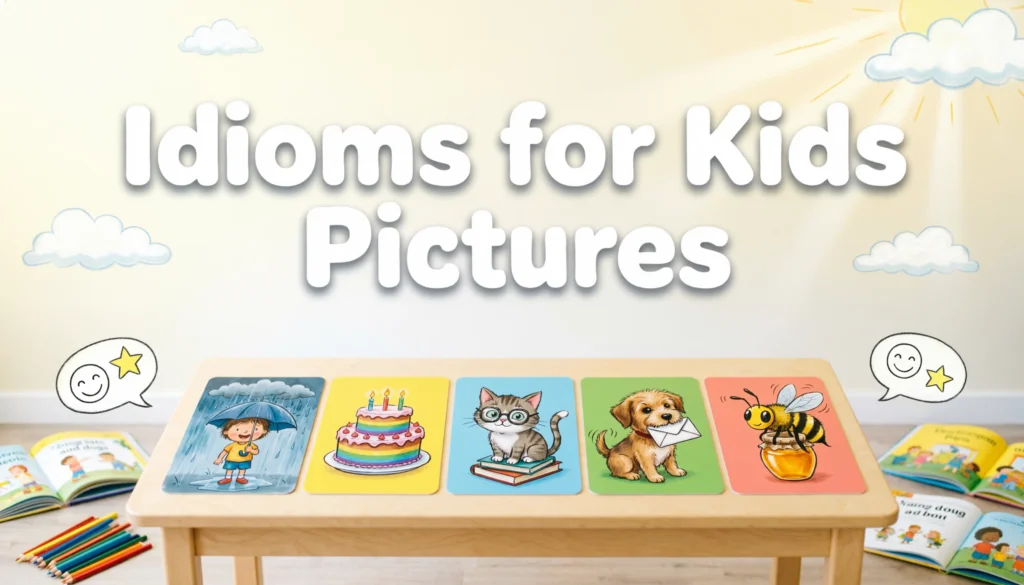
Idioms for kids pictures are simple idioms taught with images, drawings, or visual examples. They help children understand phrases that do not mean exactly what the words say. For example, a picture of a cat and dog falling from the sky can help explain it is raining cats and dogs.
These picture based idioms work well for students, writers, and ESL learners because visuals make meaning easier to remember. Children learn faster when they connect a phrase with a clear image, a short meaning, and a natural sentence.
What “Idioms for Kids Pictures” Means
Idioms for kids pictures means:
- Simple idioms explained with child friendly images
- Picture based learning for common English expressions
- Easy idioms with meanings and examples
- Visual phrases that help children remember English
- Fun expressions used in speaking, writing, and classroom work
- A helpful way for ESL learners to understand non literal language
Common, Popular, Funny, Useful, and Everyday Idioms for Kids Pictures
1. It is raining cats and dogs
Simple meaning: It is raining very heavily.
Example sentence: We stayed inside because it was raining cats and dogs.
2. A piece of cake
Simple meaning: Something very easy.
Example sentence: The spelling test was a piece of cake.
3. Break the ice
Simple meaning: To make people feel comfortable.
Example sentence: The teacher told a joke to break the ice.
4. Hold your horses
Simple meaning: Wait or be patient.
Example sentence: Hold your horses, the game will start soon.
5. Spill the beans
Simple meaning: Tell a secret.
Example sentence: Mia spilled the beans about the surprise party.
6. Under the weather
Simple meaning: Feeling sick.
Example sentence: I stayed home because I felt under the weather.
7. Let the cat out of the bag
Simple meaning: Reveal a secret by mistake.
Example sentence: Omar let the cat out of the bag about the gift.
8. Hit the books
Simple meaning: Start studying.
Example sentence: I need to hit the books before my exam.
9. The ball is in your court
Simple meaning: It is your turn to decide or act.
Example sentence: I gave you my idea, so now the ball is in your court.
10. On cloud nine
Simple meaning: Very happy.
Example sentence: Sara was on cloud nine after winning the race.
Idioms for Kids Pictures With Meanings and Examples
11. As busy as a bee
Simple meaning: Very busy.
Example sentence: Dad was as busy as a bee cleaning the house.
12. Cool as a cucumber
Simple meaning: Very calm.
Example sentence: Ali stayed cool as a cucumber during the quiz.
13. A fish out of water
Simple meaning: Someone who feels uncomfortable in a new place.
Example sentence: I felt like a fish out of water on my first day at school.
14. Butterflies in my stomach
Simple meaning: Feeling nervous.
Example sentence: I had butterflies in my stomach before the speech.
15. Cry over spilled milk
Simple meaning: Feel upset about something that cannot change.
Example sentence: Do not cry over spilled milk, just try again.
16. Cost an arm and a leg
Simple meaning: Very expensive.
Example sentence: That toy robot costs an arm and a leg.
17. In hot water
Simple meaning: In trouble.
Example sentence: He was in hot water after breaking the window.
18. Time flies
Simple meaning: Time passes quickly.
Example sentence: Time flies when we play together.
19. Keep an eye on
Simple meaning: Watch carefully.
Example sentence: Please keep an eye on your little brother.
20. Zip your lip
Simple meaning: Stay quiet.
Example sentence: The teacher said to zip your lip during the test.
How to Use Idioms for Kids Pictures in Sentences
Use idioms when the meaning fits the situation. Children should first learn the real meaning, then use the phrase in a short sentence. Pictures can help them understand the funny difference between the literal words and the actual meaning.
For example, a child may draw a cake beside the phrase a piece of cake, then write: The puzzle was a piece of cake. This makes the idiom clear, memorable, and useful.
Idioms for Kids Pictures for Writing and Speaking
Idioms make writing more colorful and speaking more natural. Kids can use them in stories, classroom conversations, short essays, and dialogue. A story sounds better when a character says, I had butterflies in my stomach, instead of only saying, I was nervous.
Writers should not use too many idioms in one paragraph. One strong idiom can make a sentence fun. Too many idioms can confuse readers, especially young learners.
Idioms for Kids Pictures for Students and ESL Learners
Students and ESL learners should learn idioms in groups. Animal idioms, food idioms, weather idioms, and school idioms are easy categories. Pictures help learners remember each group.
A good learning method is simple: look at the picture, read the phrase, understand the meaning, and write one sentence. This helps learners use idioms correctly instead of only memorizing them.
Idioms for Kids Pictures in Conversations
Idioms often appear in everyday conversations. Kids may hear adults say hold your horses, hit the books, or keep an eye on. These phrases sound natural when children know the right context.
Example conversation:
Teacher: The test is tomorrow, so you should hit the books tonight.
Student: I will study after dinner.
Teacher: Good. The test will be a piece of cake if you prepare.
Similar Phrases and Expressions
21. Easy as pie
Simple meaning: Very easy.
Example sentence: The math homework was easy as pie.
22. Fast as lightning
Simple meaning: Very fast.
Example sentence: The dog ran fast as lightning.
23. Quiet as a mouse
Simple meaning: Very quiet.
Example sentence: The baby slept quietly as a mouse.
24. Brave as a lion
Simple meaning: Very brave.
Example sentence: She was brave as a lion on stage.
25. Happy as a clam
Simple meaning: Very happy.
Example sentence: He was happy as a clam at the beach.
Common Mistakes
One common mistake is reading idioms literally. It is raining cats and dogs does not mean animals fall from the sky. It means heavy rain.
Another mistake is using idioms in the wrong situation. Under the weather means sick, not standing outside in bad weather. Kids should always learn the meaning and example together.
Learners should also avoid overusing idioms. A sentence with one idiom sounds natural. A paragraph full of idioms may feel confusing.
Conclusion
Idioms for kids pictures make English easier, brighter, and more memorable. Pictures help children understand that idioms do not always mean what the words say. When students connect each phrase with a simple image, meaning, and sentence, they learn faster and use English with more confidence. These idioms also help writers and ESL learners add natural expression to stories, conversations, and classroom work. The best way to learn them is to start with common phrases, practice short examples, and use each idiom only when it fits the meaning clearly.
FAQs
What are idioms for kids pictures?
Idioms for kids pictures are common English idioms explained with images, simple meanings, and example sentences.
Why are pictures helpful for teaching idioms?
Pictures help children understand and remember idioms because they connect the phrase with a visual idea.
Are idioms hard for ESL learners?
Idioms can feel hard at first because their meanings are not literal. Simple examples and pictures make them much easier.
What is an easy idiom for kids?
A piece of cake is an easy idiom for kids. It means something is very easy.
Can kids use idioms in stories?
Yes, kids can use idioms in stories to make characters sound natural and expressive.
Should children memorize many idioms at once?
No. Children should learn a few idioms at a time and practice them in sentences.
What is the best way to teach idioms with pictures?
Show the picture, explain the real meaning, read an example sentence, and ask the child to make a new sentence.

Eva Rose is a modern author known for emotionally rich and metaphor-driven writing.
Her work focuses on self-growth, resilience, and inner strength.
She transforms complex emotions into clear, relatable insights.
At MetaphorForge, her writing inspires reflection and personal growth.