
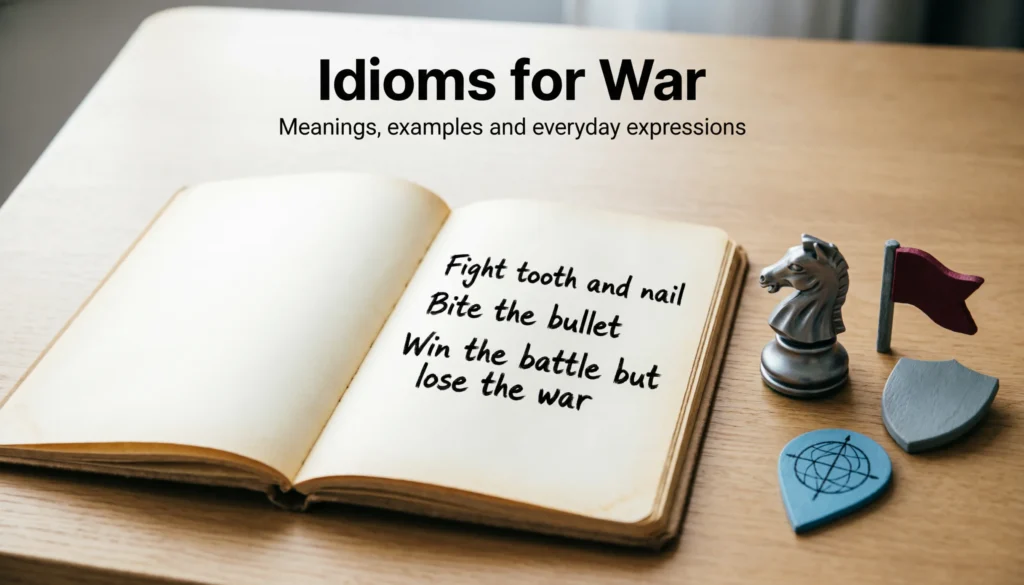
War language appears often in English, even outside real battles. People use idioms for war to describe arguments, competition, stress, teamwork, business, sports, politics, and personal struggles. These expressions can make writing stronger because they show pressure, conflict, courage, risk, and strategy in a short phrase.
Students, writers, and ESL learners should use these idioms carefully. Some sound serious, some sound dramatic, and a few can sound funny in everyday speech. The key is to understand the meaning first, then choose the right expression for the situation.
What “Idioms for War” Means
Idioms for war means expressions that use battle, army, weapon, or conflict language to describe non war situations.
They can describe:
Conflict between people or groups
A difficult challenge
A strong effort to win
A defensive attitude
A risky decision
A planned strategy
Emotional pressure
Competition in school, work, sports, or life
These idioms do not always refer to actual war. Many people use them in daily English to talk about arguments, business moves, exams, debates, and personal problems.
Common, Popular, Funny, Useful, and Everyday Idioms for War
Some war idioms sound intense, but English speakers use them casually. For example, someone may say they are fighting an uphill battle when they face a hard task. A student may say they need to choose their battles when they cannot argue about everything. A writer may use battle lines are drawn to show tension between two sides.
Funny or lighter war expressions also exist. People may say they are armed with coffee before a long study session. Someone may call a messy room a war zone. These phrases add humor without sounding too aggressive.
Idioms for War With Meanings and Examples
1. Fight an uphill battle
Simple meaning: To face a very difficult challenge
Example sentence: She is fighting an uphill battle to pass the exam after missing many classes.
2. Choose your battles
Simple meaning: To decide which problems are worth arguing about
Example sentence: A good leader knows when to choose your battles and when to stay quiet.
3. Battle lines are drawn
Simple meaning: Two sides have clearly started to oppose each other
Example sentence: After the meeting, the battle lines were drawn between the two teams.
4. Go to war over something
Simple meaning: To fight strongly about an issue
Example sentence: The neighbors went to war over the parking space.
5. A war of words
Simple meaning: A strong argument using words instead of physical action
Example sentence: The debate became a war of words between the two candidates.
6. On the warpath
Simple meaning: Very angry and ready to confront someone
Example sentence: The teacher was on the warpath after finding copied homework.
7. Fight tooth and nail
Simple meaning: To fight very hard for something
Example sentence: They fought tooth and nail to save the old library.
8. Win the battle but lose the war
Simple meaning: To win a small victory but fail in the bigger goal
Example sentence: He won the argument, but he lost his friend, so he won the battle but lost the war.
9. Declare war on something
Simple meaning: To start a strong effort against a problem
Example sentence: The school declared war on bullying.
10. A losing battle
Simple meaning: A struggle that seems impossible to win
Example sentence: Keeping the room clean with three small children felt like a losing battle.
11. Half the battle
Simple meaning: A big part of solving a problem
Example sentence: Understanding the question is half the battle in essay writing.
12. Armed with information
Simple meaning: Prepared with useful knowledge
Example sentence: She entered the interview armed with information about the company.
13. Bring out the big guns
Simple meaning: To use the strongest people, tools, or arguments
Example sentence: When sales dropped, the company brought out the big guns and hired a top strategist.
14. Bite the bullet
Simple meaning: To accept something difficult and do it
Example sentence: I had to bite the bullet and start studying before the final week.
15. Dodge a bullet
Simple meaning: To avoid a serious problem
Example sentence: He dodged a bullet when he missed the bus that later broke down.
16. Under fire
Simple meaning: Facing strong criticism
Example sentence: The manager came under fire after the project failed.
17. Fire back
Simple meaning: To reply strongly to criticism
Example sentence: She fired back with facts when people questioned her research.
18. Hold the fort
Simple meaning: To take care of things while someone else is away
Example sentence: Please hold the fort while I go to the office.
19. Fight your own battles
Simple meaning: To handle your own problems
Example sentence: Parents should teach children how to fight their own battles.
20. A call to arms
Simple meaning: A strong request for people to take action
Example sentence: The speech became a call to arms for students to protect the environment.
21. In the trenches
Simple meaning: Doing the hardest practical work
Example sentence: Nurses are in the trenches every day, helping patients directly.
22. No man’s land
Simple meaning: A confusing or uncontrolled situation between two sides
Example sentence: The project entered no man’s land after both departments refused responsibility.
23. Wave the white flag
Simple meaning: To surrender or stop resisting
Example sentence: After hours of arguing, he waved the white flag and agreed to rest.
24. Drop a bombshell
Simple meaning: To reveal shocking news
Example sentence: She dropped a bombshell when she announced her resignation.
25. A ticking time bomb
Simple meaning: A situation that may become dangerous soon
Example sentence: The unpaid bills became a ticking time bomb for the business.
26. Shoot down an idea
Simple meaning: To reject an idea quickly
Example sentence: The editor shot down my first headline because it sounded too vague.
27. Stick to your guns
Simple meaning: To keep your opinion despite pressure
Example sentence: He stuck to his guns and refused to change the report without evidence.
28. Caught in the crossfire
Simple meaning: Trapped between two arguing sides
Example sentence: The children felt caught in the crossfire during their parents’ argument.
29. Fight fire with fire
Simple meaning: To use the same strong method against someone
Example sentence: The small brand fought fire with fire by launching its own bold campaign.
30. A battlefield
Simple meaning: A place or situation full of conflict
Example sentence: The comment section turned into a battlefield after the post went viral.
More Idioms for War for Everyday Use
31. War chest
Simple meaning: Money saved for a major campaign or challenge
Example sentence: The startup built a war chest before entering a competitive market.
32. Take no prisoners
Simple meaning: To act very strongly and show no mercy
Example sentence: The lawyer took no prisoners during the final argument.
33. Marching orders
Simple meaning: Clear instructions to start doing something
Example sentence: The team received its marching orders before the event began.
34. Fight to the finish
Simple meaning: To keep trying until the end
Example sentence: Both teams fought to the finish in the final match.
35. All guns blazing
Simple meaning: With full energy and force
Example sentence: She entered the competition all guns blazing.
36. Sound the alarm
Simple meaning: To warn people about danger or a problem
Example sentence: Scientists sounded the alarm about the rising water levels.
37. Draw fire
Simple meaning: To attract criticism or attention
Example sentence: His comment drew fire from several teachers.
38. Keep your powder dry
Simple meaning: Stay ready and do not waste your resources too early
Example sentence: The coach told the players to keep their powder dry until the final round.
39. Plan of attack
Simple meaning: A clear strategy for solving a task
Example sentence: Before writing the essay, we need a plan of attack.
40. Launch an attack
Simple meaning: To strongly criticize or challenge someone
Example sentence: The journalist launched an attack on the weak policy.
Idioms for War in Writing and Speaking
War idioms help writers create tension, urgency, and emotional force. They work well in essays, stories, speeches, debates, and opinion writing. A phrase like caught in the crossfire can show emotional pressure better than a long explanation. A phrase like fight an uphill battle can show struggle in a simple way.
In speaking, these idioms can make your English sound more natural. You might say I need a plan of attack before a big assignment. You might also say I dodged a bullet when you avoid a bad situation. These expressions sound common in daily English, but you should match them to the tone.
How to Use Idioms for War in Sentences
Use war idioms when you want to show conflict, pressure, competition, or determination.
For serious writing, choose strong idioms like under fire, battle lines are drawn, or caught in the crossfire.
Or, For casual speech, use lighter idioms like bite the bullet, dodge a bullet, or hold the fort.
For school writing, explain the meaning if the idiom might confuse readers.
Do not use too many war idioms in one paragraph.
Avoid these idioms in sensitive situations where real violence or trauma may make the language feel inappropriate.
Idioms for War for Students and ESL Learners
Students can use war idioms to improve essays, speeches, stories, and classroom discussions. ESL learners should first learn the literal words, then the idiomatic meaning. For example, bite the bullet does not mean to bite a real bullet. It means to accept a hard task and do it.
The best method is to learn these idioms in groups. Learn conflict idioms together, such as war of words, under fire, and caught in the crossfire. Learn effort idioms together, such as fight tooth and nail, uphill battle, and fight to the finish. This makes memorization easier and more practical.
Idioms for War in Conversations
War idioms appear often in everyday conversations. Here are natural ways people use them.
I need to bite the bullet and finish this assignment.
The meeting turned into a war of words.
She fought tooth and nail for her scholarship.
He came under fire for his careless comment.
We need a better plan of attack for this project.
I dodged a bullet by not accepting that offer.
The kitchen looked like a war zone after dinner.
Let’s choose our battles and focus on the main issue.
Similar Phrases and Expressions
Some expressions are not pure idioms, but they fit the same topic because they use war related language.
Conflict zone
Power struggle
Verbal attack
Defensive position
Strategic move
Peace offering
Mental battle
Political fight
Emotional warfare
Survival mode
Pressure campaign
Last stand
These phrases help you write about conflict without always using the same idiom.
Common Mistakes
Using war idioms too often
Too many war idioms can make writing sound dramatic or unnatural. Use only one or two when they fit the meaning.
Using them in sensitive contexts
Avoid casual war idioms when discussing real war, injury, death, or trauma. In those cases, use respectful and direct language.
Mixing idioms incorrectly
Do not combine two idioms into one strange phrase. For example, avoid phrases like bite the battle or dodge the war.
Taking idioms literally
Many idioms do not mean what the words seem to mean. Bite the bullet means accept a difficult task. It does not describe a real bullet.
Choosing the wrong tone
Some idioms sound casual, while others sound serious. Dodge a bullet sounds conversational. Battle lines are drawn sounds more formal and dramatic.
Conclusion
Idioms for war give English more energy, emotion, and impact. They help students describe conflict, writers build tension, and ESL learners understand natural expressions in real conversations. These idioms can describe arguments, exams, business problems, sports, personal challenges, and social pressure. The best approach is to learn each phrase with its real meaning and a natural example. Use them carefully because war language can sound strong. When the tone fits, expressions like fight an uphill battle, choose your battles, under fire, and bite the bullet can make your writing clearer, sharper, and more memorable.
FAQs
What are idioms for war?
Idioms for war are expressions that use battle, weapon, army, or conflict language to describe challenges, arguments, competition, or pressure.
Are war idioms only about real war?
No. Many war idioms describe everyday situations like school stress, work problems, debates, sports, and personal struggles.
What is a common war idiom for a difficult task?
Fight an uphill battle is a common idiom for a difficult task. It means someone faces a hard challenge.
Can students use idioms for war in essays?
Yes, students can use them in essays, but they should choose idioms that match the topic and tone. They should avoid using too many.
What does choose your battles mean?
Choose your battles means you should decide which problems are worth your time, energy, or argument.
Is bite the bullet a war idiom?
Yes, it comes from a war related image, but people now use it to mean accepting a difficult task and doing it.
What is a funny idiom related to war?
War zone can sound funny in casual speech when someone describes a messy room, kitchen, or desk.

Ryan Chase is a skilled writer at MetaphorForge, recognized for his powerful and meaningful metaphors. He explores themes of personal growth, emotions, and everyday life with clarity and depth. His writing turns complex feelings into simple, relatable expressions. Through his work, readers gain fresh perspectives on their own experiences.