
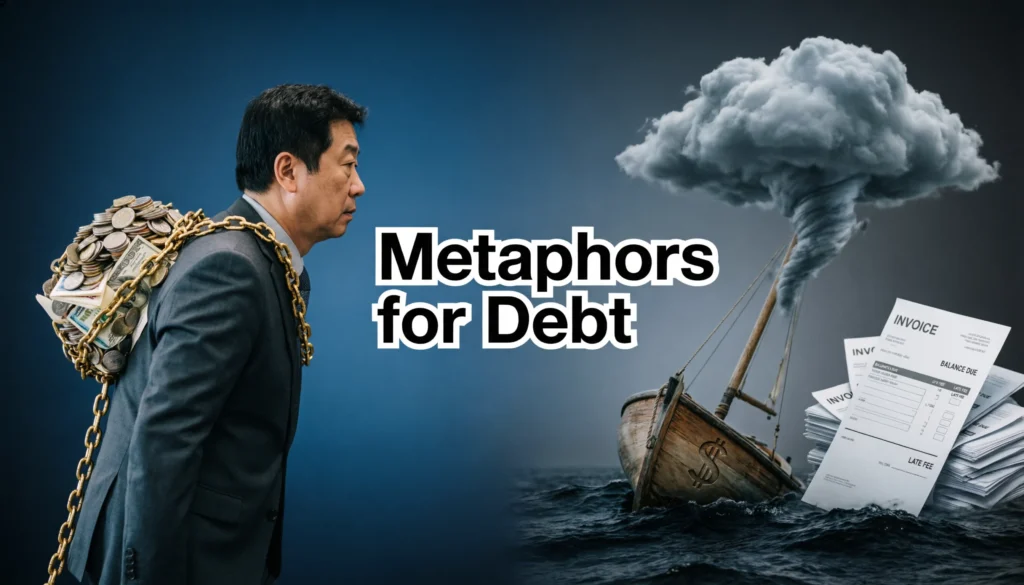
Debt is not just a financial term. People often describe it using vivid metaphors to show how it feels and how it affects life. These expressions help writers, students, and everyday speakers explain a complex idea in a simple and emotional way.
In daily language, metaphors for debt turn numbers into experiences. They show pressure, stress, and responsibility in a way people easily understand. Learning these expressions can improve your writing, speaking, and comprehension, especially if you are an ESL learner.
What “metaphors for debt” means
- Creative expressions used to describe debt in a non-literal way
- Help explain financial burden using relatable images
- Make writing and speech more engaging and emotional
- Show the impact of debt on life, stress, and freedom
Common, popular, funny, useful, and everyday metaphors for debt
A mountain of debt
Meaning: A very large amount of debt
Example: He is trying to pay off a mountain of debt after years of overspending.
Drowning in debt
Meaning: Feeling overwhelmed by debt
Example: She felt like she was drowning in debt after losing her job.
A heavy chain
Meaning: Debt that restricts freedom
Example: Student loans became a heavy chain that limited his choices.
A dark cloud
Meaning: Debt that causes constant worry
Example: Debt hung over her like a dark cloud every day.
A ticking time bomb
Meaning: Debt that will cause serious problems later
Example: Ignoring credit card bills is like living with a ticking time bomb.
A bottomless pit
Meaning: Debt that never seems to end
Example: His expenses turned into a bottomless pit of debt.
A financial trap
Meaning: A situation that is hard to escape
Example: High interest loans can feel like a financial trap.
A sinking ship
Meaning: A failing financial situation
Example: Without savings, his finances became a sinking ship.
A weight on your shoulders
Meaning: Emotional and financial burden
Example: Debt felt like a weight on her shoulders.
A slippery slope
Meaning: A situation that quickly gets worse
Example: One loan led to another, and soon he was on a slippery slope.
Metaphors for debt with meanings and examples
Debt is a cage
Meaning: It limits freedom and choices
Example: He felt like debt was a cage that kept him from traveling.
Debt is quicksand
Meaning: The more you struggle, the deeper you fall
Example: Without proper planning, debt becomes quicksand.
Debt is a shadow
Meaning: It follows you everywhere
Example: Even after moving cities, debt remained a shadow in her life.
Debt is a fire
Meaning: It spreads and grows if not controlled
Example: Interest can turn small debt into a raging fire.
Debt is a storm
Meaning: A stressful and chaotic situation
Example: Unexpected expenses brought a financial storm into his life.
How to use metaphors for debt in sentences
- Use them to explain feelings, not just numbers
- Place them in stories, essays, or conversations
- Match the metaphor with the situation
Examples:
- “I feel like I’m drowning in debt right now.”
- “This loan is turning into a financial trap.”
- “Debt has become a shadow I cannot escape.”
Metaphors for debt for writing and speaking
Metaphors make your content stronger and clearer. In essays, they help readers feel the pressure of financial problems. In speeches, they make your message more powerful and relatable. Instead of stating facts, you show the impact.
For example, saying “He has a lot of debt” sounds plain. Saying “He carries a mountain of debt” creates a strong image in the reader’s mind.
Metaphors for debt for students and ESL learners
Students can use these expressions in essays, exams, and presentations. ESL learners benefit because metaphors improve vocabulary and understanding of real-life English.
Start with simple phrases like “weight on shoulders” or “drowning in debt.” Practice using them in short sentences. Over time, you will sound more natural and fluent.
Metaphors for debt in conversations
People use these expressions often in casual talk. They help express stress, frustration, or warning.
Examples:
- “I’m drowning in bills this month.”
- “That loan is a trap, be careful.”
- “I feel like I’m carrying a financial burden.”
Similar phrases and expressions
In the red
Meaning: Losing money or in debt
Example: The company has been in the red for months.
Living beyond your means
Meaning: Spending more than you earn
Example: He got into debt by living beyond his means.
Buried in bills
Meaning: Overwhelmed with payments
Example: She was buried in bills after the emergency.
Robbing Peter to pay Paul
Meaning: Paying one debt by taking another
Example: He kept robbing Peter to pay Paul to manage expenses.
Tightening your belt
Meaning: Reducing spending
Example: They started tightening their belt to avoid more debt.
Common mistakes
- Using metaphors in formal financial reports where clarity matters
- Mixing too many metaphors in one sentence
- Using incorrect context, like using “storm” for small debt
- Overusing the same metaphor repeatedly
- Not understanding the meaning before using it
Conclusion
Metaphors for debt turn a complex financial idea into something easy to understand. They show pressure, stress, and responsibility in a human way. Writers use them to create emotional impact, while speakers use them to connect with listeners. Students and ESL learners can benefit by learning these expressions and practicing them in real sentences. With the right use, these metaphors make communication clearer and more engaging. Instead of dry numbers, they bring life to financial discussions and help people better express their experiences with debt.
FAQs
1. What are metaphors for debt?
They are creative expressions that describe debt using images or comparisons.
2. Why use metaphors for debt?
They make communication clearer, more engaging, and easier to understand.
3. Are metaphors for debt formal or informal?
They are mostly informal but useful in essays and storytelling.
4. Can ESL learners use these metaphors?
Yes, they help improve fluency and natural expression.
5. What is the most common metaphor for debt?
“Drowning in debt” is one of the most common.
6. Can metaphors replace financial terms?
No, they support explanation but do not replace technical terms.

Eva Rose is a modern author known for emotionally rich and metaphor-driven writing.
Her work focuses on self-growth, resilience, and inner strength.
She transforms complex emotions into clear, relatable insights.
At MetaphorForge, her writing inspires reflection and personal growth.