
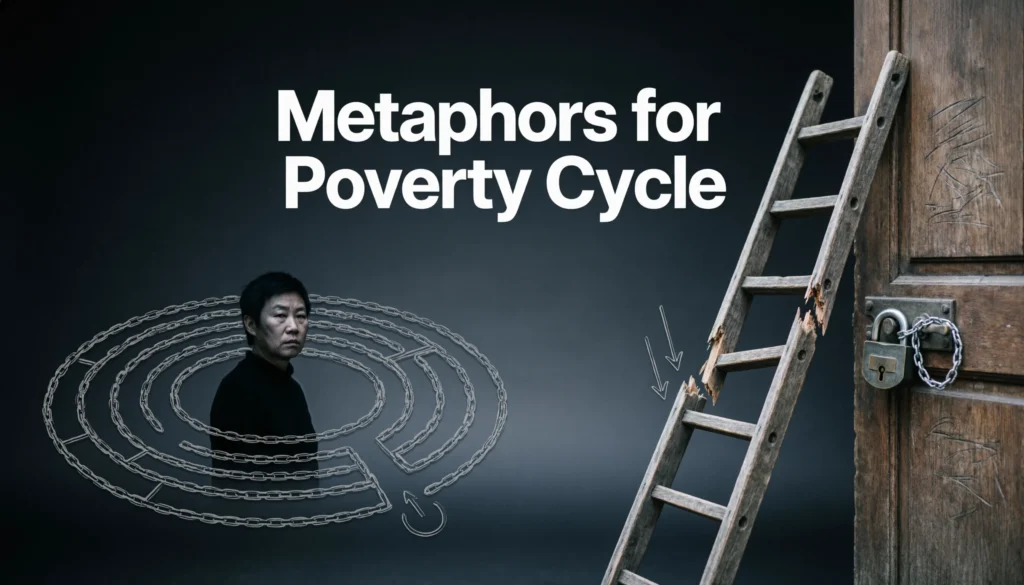
Poverty is not just a lack of money. It is often a repeating pattern that traps people over time. Writers and speakers use metaphors to explain this complex idea in simple and powerful ways. When you understand these metaphors, you can describe social issues more clearly and connect with your audience.
The poverty cycle affects education, health, and opportunities. It shows how one problem leads to another and keeps people stuck. In this article, you will learn useful metaphors for the poverty cycle, along with meanings, examples, and practical ways to use them in writing and conversation.
What “Metaphors for Poverty” Cycle Means
- Metaphors for poverty cycle describe how poverty repeats across time
- They show how people struggle to escape difficult conditions
- They explain complex social problems using simple comparisons
- They help readers and listeners understand long-term effects of poverty
- They make emotional and social issues easier to visualize
Common, Popular, Funny, Useful, and Everyday Metaphors for Poverty Cycle
Poverty cycle as a trap
- Meaning: A situation that is hard to escape
- Example: Many families feel stuck in a trap of low income and rising costs
Poverty cycle as a loop
- Meaning: A repeating pattern with no clear end
- Example: Without education, the loop of poverty continues for generations
Poverty cycle as quicksand
- Meaning: The more you struggle, the deeper you sink
- Example: Debt can feel like quicksand in a poverty cycle
Poverty cycle as a broken ladder
- Meaning: A path to success that no longer works
- Example: Job opportunities seem like a broken ladder for many people
Poverty cycle as a locked door
- Meaning: Opportunities are blocked or inaccessible
- Example: Higher education often feels like a locked door for poor communities
Poverty cycle as a maze
- Meaning: A confusing system with no easy way out
- Example: Government systems can feel like a maze for those in poverty
Poverty cycle as a heavy chain
- Meaning: Something that holds you back
- Example: Lack of resources acts like a heavy chain
Poverty cycle as running on a treadmill
- Meaning: Working hard but not moving forward
- Example: Many workers feel like they are running on a treadmill
Metaphors for Poverty Cycle with Meanings and Examples
Cycle of poverty is a cage
- Meaning: A confined space with no freedom
- Example: He described poverty as a cage that limits dreams
Poverty is a storm that never ends
- Meaning: Constant struggle without relief
- Example: For some families, poverty feels like a storm that never ends
Poverty is a sinking ship
- Meaning: A situation getting worse over time
- Example: Without support, their finances became a sinking ship
Poverty is a shadow
- Meaning: Always present and hard to escape
- Example: Poverty followed him like a shadow
Poverty is a chain reaction
- Meaning: One problem leads to another
- Example: One missed payment can start a chain reaction
How to Use Metaphors for Poverty Cycle in Sentences
- Use simple comparisons to explain complex issues
- Choose metaphors that match your tone and audience
- Avoid mixing too many metaphors in one sentence
- Keep the meaning clear and direct
Example sentences:
- The poverty cycle is like a treadmill that never stops
- Her life felt like a maze with no exit
- Debt became a chain that held him back
Metaphors for Poverty Cycle for Writing and Speaking
Use these metaphors in essays, speeches, and stories to create strong impact. They help explain social problems in a relatable way. Writers often use metaphors to add depth and emotion to their content.
When speaking, these expressions make your message easier to understand. They also help your audience remember your ideas. Keep your language simple and your examples realistic.
Metaphors for Poverty Cycle for Students and ESL Learners
Students can use these metaphors to improve essays and assignments. They make writing more engaging and clear. ESL learners benefit because metaphors connect new words to familiar ideas.
Practice using one metaphor at a time. Focus on understanding the meaning before using it in sentences. This approach builds confidence and accuracy.
Metaphors for Poverty Cycle in Conversations
In everyday conversation, these metaphors help explain serious topics in simple words. They make discussions more meaningful without sounding too technical.
Examples:
- It feels like a loop we cannot break
- Life becomes a maze when opportunities are limited
Similar Phrases and Expressions
- Vicious cycle
- Stuck in a loop
- Trapped situation
- Endless struggle
- No way out
Common Mistakes
- Using too many metaphors in one sentence
- Choosing metaphors that do not match the context
- Making meanings unclear or confusing
- Overusing dramatic expressions without explanation
Conclusion
Metaphors for poverty cycle help explain a complex and sensitive issue in simple terms. They show how poverty repeats and why it is difficult to escape. When used correctly, these metaphors improve writing, speaking, and understanding. Students and ESL learners can use them to express ideas more clearly and confidently. Always choose metaphors that match your message and audience. Keep them simple, meaningful, and relevant. With practice, you will use these expressions naturally and effectively in both academic and everyday communication.
FAQs
- What is a poverty cycle
A poverty cycle is a situation where poverty continues across time due to limited resources and opportunities - Why use metaphors for poverty cycle
Metaphors make complex ideas easier to understand and more relatable - Can students use these metaphors in essays
Yes, they help improve clarity and make writing more engaging - Are these metaphors formal or informal
They can be used in both, depending on context and tone - How can ESL learners practice these metaphors
By using them in simple sentences and real-life examples - What is the best metaphor for poverty cycle
It depends on context, but loop, trap, and treadmill are very common

Eva Rose is a modern author known for emotionally rich and metaphor-driven writing.
Her work focuses on self-growth, resilience, and inner strength.
She transforms complex emotions into clear, relatable insights.
At MetaphorForge, her writing inspires reflection and personal growth.