
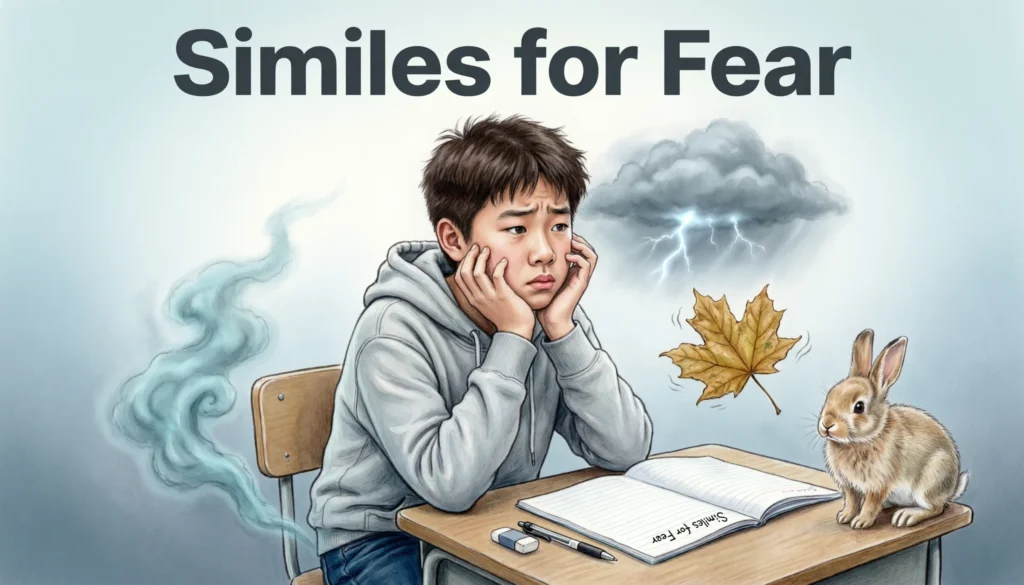
Fear can feel heavy, sharp, cold, or sudden, and similes help writers describe that feeling in a clear and vivid way. Similes for fear compare fear to familiar things, such as ice, shadows, storms, or trapped animals, so readers can understand the emotion quickly.
Students, writers, and ESL learners can use these comparisons to make sentences more expressive. Instead of only saying “I was scared,” you can say “I shook like a leaf” or “fear spread through me like ice water.” These phrases add emotion, image, and movement to your writing.
What “Similes for Fear” Means
- Similes for fear are comparisons that describe fear using “like” or “as.”
- They help readers imagine how fear feels in the body and mind.
- They can show panic, nervousness, shock, dread, anxiety, or horror.
- They make writing stronger than plain sentences like “He was afraid.”
- They work well in stories, essays, poems, speeches, and conversations.
- Many fear similes use images of cold, darkness, animals, danger, or weakness.
Common, Popular, Funny, Useful, and Everyday Similes for Fear
As scared as a rabbit
Simple meaning: Extremely frightened and ready to run away.
Example sentence: The little boy looked as scared as a rabbit when the thunder shook the window.
Shaking like a leaf
Simple meaning: Trembling because of fear or nervousness.
Example sentence: She was shaking like a leaf before her first stage performance.
As pale as a ghost
Simple meaning: Very pale because of fear, shock, or sickness.
Example sentence: He turned as pale as a ghost when he heard footsteps behind him.
Like a deer caught in headlights
Simple meaning: Frozen with fear and unable to react.
Example sentence: When the teacher asked him a question, he stood like a deer caught in headlights.
As frightened as a child in the dark
Simple meaning: Deeply scared, often in a helpless way.
Example sentence: I felt as frightened as a child in the dark during the power cut.
Like ice running through my veins
Simple meaning: A sudden cold feeling of fear.
Example sentence: When I saw the shadow move, it felt like ice running through my veins.
As jumpy as a cat near water
Simple meaning: Nervous and easily startled.
Example sentence: After watching the horror movie, Ali was as jumpy as a cat near water.
Like a trapped bird
Simple meaning: Scared and desperate to escape.
Example sentence: Her heart beat like a trapped bird when the door locked behind her.
As nervous as a mouse
Simple meaning: Quiet, frightened, and unsure.
Example sentence: The new student looked as nervous as a mouse on his first day.
Like thunder in my chest
Simple meaning: A loud, fast heartbeat caused by fear.
Example sentence: My heart pounded like thunder in my chest before the exam result came out.
Similes for Fear With Meanings and Examples
Fear spread through me like cold water
Simple meaning: Fear slowly moved through the whole body.
Example sentence: Fear spread through me like cold water when I realized I was lost.
He froze like a statue
Simple meaning: He became completely still because of fear.
Example sentence: He froze like a statue when the dog started barking at him.
Her voice shook like a candle flame
Simple meaning: Her voice sounded weak and unsteady because of fear.
Example sentence: Her voice shook like a candle flame as she told us what happened.
My stomach dropped like a stone
Simple meaning: I suddenly felt scared, shocked, or worried.
Example sentence: My stomach dropped like a stone when I saw the missed calls from home.
The room felt as dark as a nightmare
Simple meaning: The room felt frightening and unreal.
Example sentence: After midnight, the empty room felt as dark as a nightmare.
He ran like the wind
Simple meaning: He ran very fast because he was afraid.
Example sentence: When the guard shouted, the thief ran like the wind.
She hid like a frightened kitten
Simple meaning: She hid quietly because she felt afraid.
Example sentence: The child hid like a frightened kitten during the loud fireworks.
My fear grew like a storm
Simple meaning: Fear became stronger and stronger.
Example sentence: As the footsteps came closer, my fear grew like a storm.
His hands trembled like dry leaves
Simple meaning: His hands shook badly from fear.
Example sentence: His hands trembled like dry leaves when he opened the strange letter.
The silence pressed on me like a heavy blanket
Simple meaning: The silence felt uncomfortable and frightening.
Example sentence: In the abandoned house, the silence pressed on me like a heavy blanket.
How to Use Similes for Fear in Sentences
When you use similes for fear, choose a comparison that matches the type of fear. A small worry needs a soft simile, while horror needs a stronger one. For example, “as nervous as a mouse” works for classroom anxiety, but “fear spread through me like ice water” works better for danger or suspense.
Good fear similes also show body reactions. Fear can make people shake, freeze, sweat, run, whisper, or breathe quickly. When your simile connects with a real physical feeling, it sounds more natural.
Examples in sentences
- I stood as still as a statue when I heard the strange noise.
- Her heart beat like a drum during the interview.
- He looked as scared as a rabbit in the principal’s office.
- Fear crawled over me like a shadow.
- The bad news hit me like a cold wind.
- I shook like a leaf before speaking in front of the class.
- She froze like a deer caught in headlights.
Similes for Fear for Writing and Speaking
Writers use fear similes to create suspense, tension, and emotional depth. A strong simile can help readers feel what the character feels. Instead of saying, “The girl was afraid,” you can write, “The girl stood frozen like a statue, her breath stuck in her throat.”
In speaking, simple fear similes make your language more expressive. You can say, “I was shaking like a leaf,” “I turned as pale as a ghost,” or “My heart was beating like a drum.” These phrases sound natural in everyday English.
Useful fear similes for creative writing
Fear crawled over him like a spider
Simple meaning: Fear moved slowly and unpleasantly through him.
Example sentence: Fear crawled over him like a spider as he entered the dark hallway.
Her scream cut through the air like a knife
Simple meaning: Her scream sounded sharp and frightening.
Example sentence: Her scream cut through the air like a knife when the lights went out.
The shadows moved like silent ghosts
Simple meaning: The shadows looked scary and mysterious.
Example sentence: The shadows moved like silent ghosts across the wall.
His courage melted like snow in the sun
Simple meaning: He quickly lost his bravery.
Example sentence: His courage melted like snow in the sun when he saw the angry crowd.
Panic rose like a wave
Simple meaning: Panic became stronger very quickly.
Example sentence: Panic rose like a wave when the elevator stopped.
Similes for Fear for Students and ESL Learners
For students and ESL learners, similes for fear are useful because they teach both emotion and comparison. Most similes follow a simple pattern: “as + adjective + as + noun” or “verb + like + noun.” These patterns make them easy to remember.
Start with common phrases first. “Shaking like a leaf,” “as pale as a ghost,” and “like a deer caught in headlights” appear often in stories and conversations. Once you understand these, you can create your own similes.
Easy fear similes for learners
As scared as a mouse
Simple meaning: Very quiet and afraid.
Example sentence: The child was as scared as a mouse during the storm.
As cold as ice
Simple meaning: Feeling cold because of fear or shock.
Example sentence: My hands became as cold as ice when I heard the noise.
Like a bird in a cage
Simple meaning: Feeling trapped and afraid.
Example sentence: She felt like a bird in a cage during the interview.
As silent as a grave
Simple meaning: Completely silent in a frightening way.
Example sentence: The classroom became as silent as a grave after the announcement.
Like a candle in the wind
Simple meaning: Weak, nervous, or uncertain.
Example sentence: His confidence shook like a candle in the wind.
Similes for Fear in Conversations
In daily conversations, people often use fear similes to describe moments of shock, nervousness, or embarrassment. These phrases do not always mean real danger. Someone may say, “I was shaking like a leaf” before an exam, interview, or public speech.
Conversational similes should sound simple and natural. Avoid very dramatic phrases in casual situations unless you want a funny or exaggerated effect.
Conversation examples
Person A: How did you feel before your driving test?
Person B: I was shaking like a leaf.
Person A: Did the horror movie scare you?
Person B: Yes, I was as jumpy as a cat all night.
Person A: What happened when the boss called your name?
Person B: I froze like a deer caught in headlights.
Person A: Were you scared during the blackout?
Person B: Honestly, I felt as frightened as a child in the dark.
Similar Phrases and Expressions
Some fear phrases are not strict similes, but they still describe fear clearly. Writers can use these expressions with similes to add variety. They help show different levels of fear, from mild nervousness to deep terror.
Scared stiff
Simple meaning: So scared that you cannot move.
Example sentence: I was scared stiff when the door opened by itself.
Heart in my mouth
Simple meaning: Extremely nervous or afraid.
Example sentence: My heart was in my mouth when the car suddenly stopped.
Blood ran cold
Simple meaning: A sudden strong feeling of fear.
Example sentence: My blood ran cold when I heard the scream.
Goosebumps rose on my skin
Simple meaning: Fear or cold made small bumps appear on the skin.
Example sentence: Goosebumps rose on my skin when someone whispered my name.
A chill ran down my spine
Simple meaning: A cold feeling of fear moved through the body.
Example sentence: A chill ran down my spine when I saw the empty swing moving.
Weak at the knees
Simple meaning: Feeling physically weak because of fear or shock.
Example sentence: I felt weak at the knees after the near accident.
Frozen with fear
Simple meaning: Unable to move because of fear.
Example sentence: The child stood frozen with fear when the dog growled.
Common Mistakes
One common mistake is using a simile that does not match the situation. “As pale as a ghost” fits shock or fear, but it may not fit a small worry like forgetting homework. Choose the comparison based on the strength of the emotion.
Another mistake is mixing too many similes in one sentence. For example, “He shook like a leaf, froze like a statue, and ran like the wind” feels overloaded. Use one strong image at a time.
Students also confuse similes and metaphors. A simile uses “like” or “as,” such as “fear spread like ice.” A metaphor says something directly, such as “fear was ice in my veins.” Both work, but they have different structures.
Avoid clichés when you need fresh writing. Common phrases like “shaking like a leaf” are useful, but original similes can make creative writing stronger. For example, “His fear flickered like a dying lamp” feels more personal and vivid.
Conclusion
Similes for fear help writers, students, and ESL learners describe fear with more detail and emotion. They turn simple sentences into vivid images by comparing fear to things people already understand, such as ice, storms, shadows, animals, and darkness. Common similes like “shaking like a leaf” and “as pale as a ghost” work well in everyday English, while creative similes can improve stories, poems, and essays. The best fear simile matches the situation, shows a real feeling, and avoids overloading the sentence. With practice, these comparisons can make your writing clearer, stronger, and more memorable.
FAQs
What are similes for fear?
Similes for fear are comparisons that describe fear using “like” or “as.” For example, “shaking like a leaf” means someone is trembling because they feel scared or nervous.
What is a good simile for being very scared?
A good simile for being very scared is “as scared as a rabbit.” It shows fear, weakness, and the desire to escape quickly.
Is “shaking like a leaf” a simile for fear?
Yes, “shaking like a leaf” is a common simile for fear or nervousness. It describes someone trembling in a visible way.
What is a scary simile for creative writing?
“Fear spread through me like ice water” is a strong scary simile. It shows how fear can feel cold, sudden, and physical.
Can ESL learners use fear similes in speaking?
Yes, ESL learners can use simple fear similes in daily speaking. Phrases like “I was shaking like a leaf” and “I froze like a statue” sound natural and clear.
What is the difference between a simile and a metaphor for fear?
A simile uses “like” or “as,” such as “fear moved like a shadow.” A metaphor says the comparison directly, such as “fear was a shadow.”
Are fear similes useful in essays?
Yes, fear similes can improve descriptive essays, narratives, and creative writing. They help readers imagine the emotion instead of only reading a plain statement.

Eva Rose is a modern author known for emotionally rich and metaphor-driven writing.
Her work focuses on self-growth, resilience, and inner strength.
She transforms complex emotions into clear, relatable insights.
At MetaphorForge, her writing inspires reflection and personal growth.