
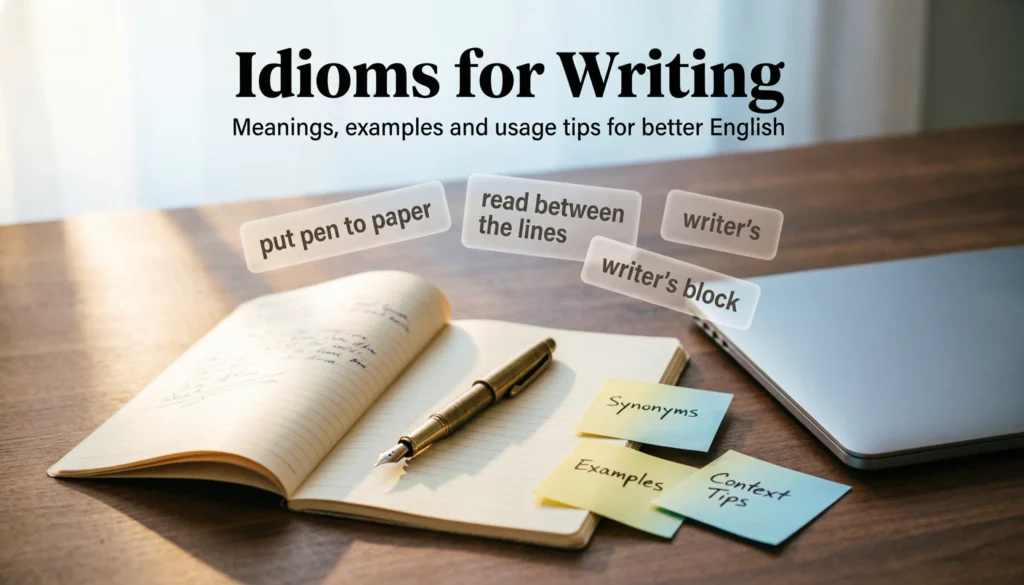
Writing becomes stronger when words feel clear, vivid, and natural. Idioms for writing help students, writers, and ESL learners describe the writing process in a more expressive way. These phrases can talk about ideas, creativity, editing, storytelling, effort, and communication.
Many of these idioms do not only belong to writing. People also use them in speaking, schoolwork, business emails, essays, stories, and daily conversations. Learning them helps you understand native English better and makes your own sentences sound more confident, polished, and natural.
What “Idioms for Writing” Means
Idioms for writing means expressions that help describe writing, creativity, ideas, communication, and the writing process.
They can describe:
- How someone starts writing
- How ideas come to mind
- How a writer explains something clearly
- How a person edits or improves text
- How writing sounds to the reader
- How someone tells a story
- How someone expresses strong feelings
- How a writer avoids unnecessary words
These idioms are useful for essays, stories, articles, speeches, emails, and classroom writing.
Common Idioms for Writing
Put pen to paper
Simple meaning: To start writing.
Example sentence: I had many ideas, but I finally put pen to paper after dinner.
Writer’s block
Simple meaning: A time when a writer cannot think of what to write.
Example sentence: She had writer’s block, so she took a short walk to clear her mind.
Get the words flowing
Simple meaning: To begin writing smoothly and easily.
Example sentence: A simple outline helped me get the words flowing.
Write from the heart
Simple meaning: To write honestly and emotionally.
Example sentence: His letter felt powerful because he wrote from the heart.
A way with words
Simple meaning: A natural skill for using language well.
Example sentence: My teacher says I have a way with words.
Paint a picture with words
Simple meaning: To describe something so clearly that readers can imagine it.
Example sentence: The novelist painted a picture with words when she described the old village.
Say it in black and white
Simple meaning: To write something clearly and officially.
Example sentence: The rules were written in black and white on the form.
Read between the lines
Simple meaning: To understand the hidden meaning behind words.
Example sentence: You need to read between the lines to understand the poet’s sadness.
The writing is on the wall
Simple meaning: A sign that something bad or important will happen soon.
Example sentence: After several poor reviews, the writing was on the wall for the magazine.
Choose your words carefully
Simple meaning: To speak or write with care.
Example sentence: You should choose your words carefully when writing an apology.
Popular Idioms for Writing With Meanings and Examples
In so many words
Simple meaning: Said directly or almost directly.
Example sentence: She did not say I failed, but she said it in so many words.
Word for word
Simple meaning: Exactly as written or spoken.
Example sentence: He copied the sentence word for word from the textbook.
In your own words
Simple meaning: To explain something using your own language.
Example sentence: The teacher asked us to explain the paragraph in our own words.
To make a long story short
Simple meaning: To give only the main point.
Example sentence: To make a long story short, I finished the article before midnight.
Cut to the chase
Simple meaning: To get to the main point quickly.
Example sentence: In your introduction, cut to the chase and explain the topic clearly.
Get to the point
Simple meaning: To say the main idea without wasting time.
Example sentence: Good academic writing gets to the point early.
Beat around the bush
Simple meaning: To avoid saying something directly.
Example sentence: Do not beat around the bush when giving feedback.
A rough draft
Simple meaning: The first version of a piece of writing.
Example sentence: My rough draft needs better examples and a stronger conclusion.
Fine tune
Simple meaning: To make small improvements.
Example sentence: I need to fine tune my essay before submitting it.
Polish your writing
Simple meaning: To improve writing by editing style, grammar, and clarity.
Example sentence: Reading aloud helps you polish your writing.
Funny Idioms for Writing
Throw words on the page
Simple meaning: To write quickly without worrying too much at first.
Example sentence: I threw words on the page and fixed the messy parts later.
Kill your darlings
Simple meaning: To remove a sentence or idea you like because it does not help the writing.
Example sentence: I loved that paragraph, but I had to kill my darlings during editing.
Word salad
Simple meaning: Confusing writing with too many mixed ideas.
Example sentence: The paragraph sounded like word salad before I reorganized it.
Purple prose
Simple meaning: Writing that sounds too fancy or overly decorated.
Example sentence: The description became purple prose because every sentence had too many adjectives.
Fluff and filler
Simple meaning: Extra words that add little value.
Example sentence: Remove fluff and filler if you want your article to feel stronger.
Go off on a tangent
Simple meaning: To move away from the main topic.
Example sentence: My essay went off on a tangent when I started discussing movies.
Lost the plot
Simple meaning: To lose focus or stop making sense.
Example sentence: The story lost the plot in the middle chapters.
Too many cooks spoil the broth
Simple meaning: Too many people giving input can make the writing worse.
Example sentence: Five people edited the same paragraph, and too many cooks spoiled the broth.
Useful Everyday Idioms for Writing
Dot the i’s and cross the t’s
Simple meaning: To check every small detail carefully.
Example sentence: Before sending the report, dot the i’s and cross the t’s.
Back to the drawing board
Simple meaning: To start again because the first attempt did not work.
Example sentence: My outline was weak, so I went back to the drawing board.
Turn a phrase
Simple meaning: To express an idea in a clever or graceful way.
Example sentence: The poet knows how to turn a phrase beautifully.
Get your point across
Simple meaning: To make others understand your idea.
Example sentence: Examples help writers get their point across.
Put it plainly
Simple meaning: To say something in simple words.
Example sentence: Put it plainly so younger readers can understand it.
Keep it short and sweet
Simple meaning: To make writing brief but effective.
Example sentence: The email should stay short and sweet.
Spell it out
Simple meaning: To explain something clearly and fully.
Example sentence: The guide spells it out for beginners.
On the same page
Simple meaning: To share the same understanding.
Example sentence: The editor and writer need to be on the same page before revisions begin.
Make your mark
Simple meaning: To become known for your work or style.
Example sentence: Young writers can make their mark by writing with honesty.
Speak volumes
Simple meaning: To show a lot without saying much.
Example sentence: A single detail can speak volumes in a short story.
Idioms for Writing With Meanings and Examples
The pen is mightier than the sword
Simple meaning: Writing and ideas can have more power than violence.
Example sentence: History shows that the pen is mightier than the sword.
Put something into words
Simple meaning: To express a feeling, idea, or experience through language.
Example sentence: She found it hard to put her grief into words.
Have the final word
Simple meaning: To make the last or most important statement.
Example sentence: The conclusion should have the final word on your argument.
By the book
Simple meaning: To follow rules exactly.
Example sentence: Formal reports should follow the instructions by the book.
Off the record
Simple meaning: Not meant for official writing or public sharing.
Example sentence: The journalist knew that the comment was off the record.
For the record
Simple meaning: Said or written so people know the facts clearly.
Example sentence: For the record, I submitted the essay before the deadline.
A blank page
Simple meaning: A fresh start or an empty writing space.
Example sentence: A blank page can feel exciting and scary at the same time.
Between the lines
Simple meaning: The hidden meaning inside a text.
Example sentence: The story reveals its real message between the lines.
A page turner
Simple meaning: A book or story that is very interesting.
Example sentence: Her mystery novel is a real page turner.
Close the book on something
Simple meaning: To finish or end something.
Example sentence: After the final draft, I closed the book on that project.
How to Use Idioms for Writing in Sentences
Use idioms for writing when they add meaning, style, or personality. Do not force them into every paragraph. One good idiom can make a sentence more natural, but too many idioms can confuse readers.
For example, instead of writing:
I started my essay yesterday.
You can write:
I finally put pen to paper yesterday.
Instead of writing:
The story was very interesting.
You can write:
The story was a page turner.
Instead of writing:
My paragraph had unnecessary words.
You can write:
My paragraph had too much fluff and filler.
Idioms work best when the meaning fits the situation. In academic writing, use them carefully. In creative writing, blogs, dialogue, and informal essays, you can use them more freely.
Idioms for Writing and Speaking
Many writing idioms also work in speech. People use them in classrooms, meetings, interviews, workshops, and casual conversations.
Let me put it this way
Simple meaning: A phrase used before explaining something more clearly.
Example sentence: Let me put it this way, your introduction needs a stronger hook.
That speaks for itself
Simple meaning: Something is clear without extra explanation.
Example sentence: Her improvement speaks for itself.
In other words
Simple meaning: Used before explaining the same idea more simply.
Example sentence: In other words, your essay needs a clearer main point.
Long story short
Simple meaning: Used before giving a short summary.
Example sentence: Long story short, I rewrote the whole article.
Mark my words
Simple meaning: Remember what I am saying because it may prove true.
Example sentence: Mark my words, clear writing will always beat fancy writing.
Put words in someone’s mouth
Simple meaning: To say someone meant something they did not actually say.
Example sentence: Do not put words in the author’s mouth during analysis.
Idioms for Writing for Students and ESL Learners
Students and ESL learners should learn idioms in context. Memorizing long lists does not help much unless you also understand how people use each phrase.
Start with simple idioms
Use easy expressions first, such as:
- Put pen to paper
- In your own words
- Get to the point
- Word for word
- Read between the lines
These phrases appear often in school instructions, textbooks, essays, and teacher feedback.
Learn meaning before style
Do not use an idiom only because it sounds advanced. First, ask yourself what it means. Then check whether it fits your sentence.
Use idioms in natural places
Good places to use writing idioms include:
- Essay introductions
- Creative writing
- Book reviews
- Classroom discussions
- Writing reflections
- Email communication
- Story analysis
Avoid idioms in very formal lines
Some idioms sound too casual for formal academic writing. For example, cut to the chase may sound natural in a blog post, but it may feel too informal in a research paper.
Idioms for Writing in Conversations
Here are natural conversation examples that show how people use writing idioms in real life.
Put pen to paper
Simple meaning: Start writing.
Example sentence: I have the idea ready, but I still need to put pen to paper.
Back to the drawing board
Simple meaning: Start again.
Example sentence: My teacher rejected my topic, so I am back to the drawing board.
Get your point across
Simple meaning: Make your idea clear.
Example sentence: Your speech is good, but you need stronger examples to get your point across.
Dot the i’s and cross the t’s
Simple meaning: Check details.
Example sentence: The essay is almost ready. I just need to dot the i’s and cross the t’s.
Read between the lines
Simple meaning: Understand hidden meaning.
Example sentence: The character never says he is lonely, but you can read between the lines.
Keep it short and sweet
Simple meaning: Make it brief and clear.
Example sentence: The presentation intro should stay short and sweet.
Similar Phrases and Expressions
Not every useful phrase about writing is a strict idiom. Some are common expressions, writing terms, or metaphorical phrases. They still help students and writers talk about writing naturally.
Strong opening
Simple meaning: A powerful beginning.
Example sentence: A strong opening makes readers want to continue.
Clear voice
Simple meaning: A writing style that feels personal and recognizable.
Example sentence: Her blog has a clear voice that readers enjoy.
Main idea
Simple meaning: The central point of a text.
Example sentence: Every paragraph should connect to the main idea.
Supporting detail
Simple meaning: A fact, example, or reason that supports a point.
Example sentence: Add a supporting detail to make your argument stronger.
Smooth transition
Simple meaning: A natural link between ideas.
Example sentence: A smooth transition helps the essay flow better.
Strong conclusion
Simple meaning: An ending that leaves a clear final message.
Example sentence: A strong conclusion reminds readers why your topic matters.
Clear structure
Simple meaning: Organized writing with a logical order.
Example sentence: Clear structure makes long articles easier to read.
Natural flow
Simple meaning: Writing that moves smoothly from one idea to the next.
Example sentence: Short paragraphs can improve the natural flow of your article.
Common Mistakes When Using Idioms for Writing
Using too many idioms
Too many idioms can make writing confusing. Use them only when they make the sentence clearer or more expressive.
Mixing idioms incorrectly
Do not combine two idioms into one strange phrase. For example, do not mix read between the lines with get to the point unless the sentence truly needs both ideas.
Using informal idioms in formal essays
Some idioms work better in conversation than academic writing. Choose formal language for research papers and exams.
Translating idioms word for word
Idioms often do not translate directly from one language to another. ESL learners should learn the full phrase and its meaning together.
Ignoring context
An idiom may sound correct but still feel wrong in a sentence. Always check the situation, tone, and audience.
Copying phrases without understanding them
Do not use an idiom just because it sounds impressive. Clear meaning matters more than fancy wording.
Repeating the same idiom
Using the same idiom again and again weakens your writing. Try similar expressions or rewrite the sentence in simple language.
Conclusion
Idioms for writing help students, writers, and ESL learners express ideas with more color, confidence, and clarity. Phrases like put pen to paper, read between the lines, polish your writing, and get your point across make writing conversations sound more natural. They also help readers understand tone, effort, creativity, and meaning. Still, strong writing does not need too many idioms. Use them where they fit, explain ideas clearly, and keep your audience in mind. When you understand both the phrase and the context, idioms can make your writing more effective and enjoyable.
FAQs
What are idioms for writing?
Idioms for writing are common expressions that describe writing, editing, storytelling, communication, and creativity. Examples include put pen to paper, read between the lines, and polish your writing.
Are idioms for writing useful for students?
Yes, they help students understand teacher feedback, write better essays, discuss books, and express ideas more naturally in English.
Can ESL learners use idioms in essays?
ESL learners can use idioms in essays, but they should use them carefully. Some idioms sound informal, so they fit better in creative writing, conversations, and blog style writing.
What is the best idiom for starting to write?
Put pen to paper is one of the best idioms for starting to write. It means to begin writing your thoughts, ideas, essay, story, or article.
What does read between the lines mean?
Read between the lines means to understand a hidden meaning that the writer does not state directly.
What does writer’s block mean?
Writer’s block means a writer cannot think of ideas or cannot continue writing for a period of time.
Should I use many idioms in one paragraph?
No. One clear idiom is usually enough. Too many idioms can make writing sound crowded, confusing, or unnatural.

Eva Rose is a modern author known for emotionally rich and metaphor-driven writing.
Her work focuses on self-growth, resilience, and inner strength.
She transforms complex emotions into clear, relatable insights.
At MetaphorForge, her writing inspires reflection and personal growth.